
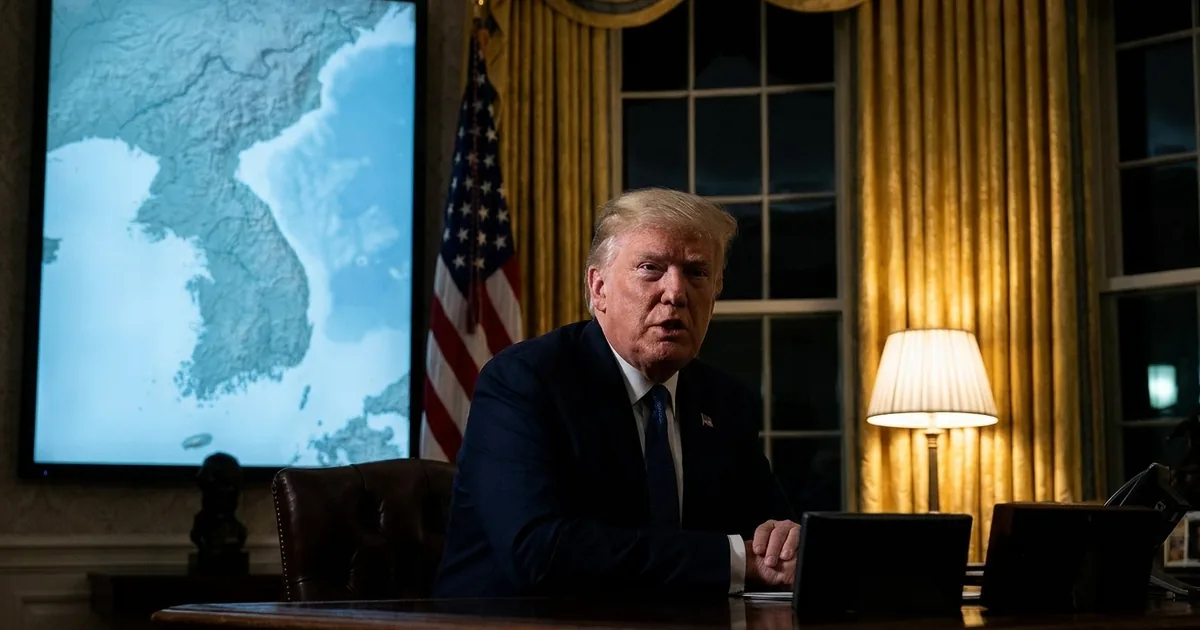
President Donald Trump ordered the Pentagon on Sunday to substantially reduce Ulchi Freedom Shield, the 11-day exercise with South Korea that was scheduled to begin Monday with roughly 18,000 South Korean troops. The reason he gave was not a military one. Seoul, he said, had declined to help him denuclearize Iran.
In a social media post, Trump instructed Pete Hegseth, whom the post addressed by the administration’s renamed title of Secretary of War, to “substantially reduce the Joint Military Exercises.” He called the drills costly and said they “send a signal that is totally inappropriate and hostile” to North Korea, a country he described as having been “unthreatening and respectful” while he has been in the White House. Axios reported that the instruction landed roughly a day before the exercise was due to begin.
That last description is the part worth stopping on, because the record from the preceding ten days says something else entirely.
The Timeline the Statement Leaves Out
North Korea fired a short-range ballistic missile from the Wonsan area on August 6, its first ballistic test since late June. On August 10, Seoul and Washington announced that Ulchi Freedom Shield would run from August 17 to 27. Two days after that announcement, Pyongyang fired again. Al Jazeera reported that the missile traveled more than 700 kilometers, making it the North’s second ballistic launch inside a week and, by most counts, its eleventh suspected ballistic test of the year. South Korea’s presidential national security council called the launch a provocation in violation of UN Security Council resolutions, which bar the North from launching ballistic missiles at all.
Then came Friday. A North Korean foreign ministry spokesperson, in a statement carried by state media, called the coming exercise a rehearsal for “aggressive war” and warned that Pyongyang would answer any threat with overwhelming force. The Korea Times reported that the statement cast this year’s drill as more provocative than earlier versions and framed it as an effort to “complete preparations for the substantial military confrontation with the DPRK.” The same statement attacked the deepening American, South Korean and Japanese security relationship as a “nuclear alliance.”
Two ballistic missile launches, a formal threat of overwhelming force, and a denunciation of the alliance as a nuclear bloc. That is the ten-day record sitting behind the words “unthreatening and respectful.”
None of this is obscure. It was reported in Seoul, in Washington and in Tokyo as it happened. A president is entitled to argue that scaling back an exercise will lower the temperature on the peninsula. He is not entitled to a factual premise that the previous week did not happen.
What “No Thanks” Actually Meant
Trump said he had asked South Korea’s president to join American efforts to denuclearize Iran “and they said, ‘No thanks!'” Framed that way, it reads as a snub from an ungrateful ally. Framed accurately, it is a position President Lee Jae Myung has been stating in public for months.
Lee, who took office in June 2025 on a platform of unconditional engagement with the North, has argued that the Iran war made his task harder rather than easier. The Korea Times summarized his assessment after his interview with The Economist in June: having watched what happened to Iran, North Korea will be even less willing to surrender its nuclear weapons, and Kim Jong Un is unlikely to meet Trump at all unless denuclearization comes off the agenda first. Seoul’s read is that a US-led disarmament campaign in the Middle East raised the value of Pyongyang’s arsenal instead of lowering it. Our earlier reporting on the Iran ceasefire pause and the North Korean troop question traced how tightly those two theaters had already become wired together.
Whether Lee has that right is a legitimate argument. That it is an argument about proliferation strategy, rather than an ally refusing a favor, is not.
The Part That Already Happened Once
Trump has run this play before. After his 2018 Singapore meeting with Kim, he announced the cancellation of joint exercises with South Korea, called them provocative, and cited the money saved. The announcement caught both the Pentagon and Seoul off guard. What followed was not denuclearization. North Korea kept building, kept testing, and arrived in 2026 with a larger arsenal, a combat-experienced military after its deployment alongside Russian forces, and, as Stars and Stripes reported, enough lessons from Ukraine that this year’s exercise was redesigned around them.
The 2018 version at least had a summit attached to it. This one is being traded for a decision Seoul made about a different war on a different continent.
What Actually Comes Off the Calendar
Ulchi Freedom Shield is not a parade. This year’s iteration was built to rehearse the threats that have changed most: drone attack, GPS jamming and cyber intrusion, alongside a live-fire test of joint precision targeting, a wet gap crossing, and the distribution of prepositioned equipment. Those are the unglamorous mechanics of whether two militaries that would have to fight together can actually do it. Readiness is perishable in a way that rhetoric is not, and it degrades quietly.
It is also a signal to Seoul that the terms of the alliance are now set case by case. Newsweek noted that Trump anchored the decision to his personal relationship with Kim, which places the exercise schedule inside a bilateral channel that excludes the country hosting the exercise. South Korea was not presented with a security assessment. It was presented with a bill for a position it took on Iran.
That is the structural change worth naming. The drills have stopped being a readiness requirement measured against a threat and started being a favor, granted or withdrawn according to what an ally does for the president somewhere else. Every alliance commitment priced that way becomes negotiable in every direction, which is a lesson Pyongyang and Beijing can read as easily as Seoul can. Our coverage of Trump calling off a second round of Iran strikes showed the same pattern of decisions announced by post and explained afterward.
The open question is what the Pentagon does now, and the clock is less forgiving than it looks from Washington. It is already Monday morning in South Korea, the day Ulchi Freedom Shield was due to begin. As of Sunday evening in Washington, neither Seoul’s defense ministry nor US Forces Korea had said whether it will start on schedule, start smaller, or not start at all. Eighteen thousand South Korean soldiers are waiting to find out, and they will learn the answer before most of Washington wakes up.