
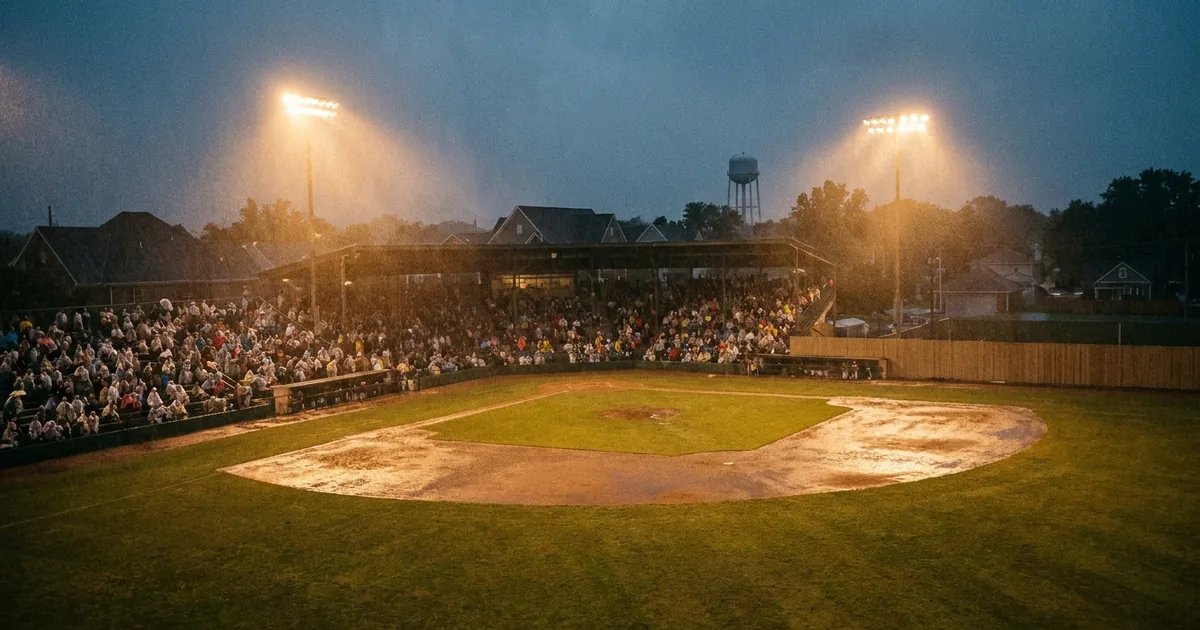
The Los Angeles Queens beat the New York Heights 10-8 on August 1 in front of a sold-out crowd in Springfield, Illinois, which is not where either club is from.
Neither are the Boston Hunters or the San Francisco Firebells, and that piece of deliberate misdirection is the smartest decision the Women’s Pro Baseball League has made so far.
Every game of the inaugural season is being played at Robin Roberts Stadium, a 5,200-seat park in central Illinois named for the Hall of Fame pitcher who grew up there. Four teams, four coastal identities, one stadium in a city none of them claims. It sounds like a compromise. It is closer to the whole business plan.
The Geography Is a Placeholder
Women’s professional baseball has been tried before, and the way it usually dies is boring. A league announces franchises in six cities, signs six stadium leases, buys six sets of travel, and then discovers that attendance in one or two markets cannot carry the rest. The AAGPBL, the league that inspired A League of Their Own, lasted from 1943 to 1954 and folded partly because its small-city clubs ran out of runway. Nothing since has made it out of the pitch deck.
Putting all four clubs in Springfield removes almost every one of those line items at once. There are no road trips, because there is no road. There is one grounds crew, one ticketing operation, one broadcast setup, one insurance policy. Attendance risk is pooled instead of distributed, so a rainy Tuesday hurts the league once rather than four times.
The city names are doing something else entirely. They are reserving shelf space. “Boston Hunters” is a bet that a Boston market will exist to move into, and the branding gets three seasons of runway before anyone has to sign a lease there. Each name is also a small history lesson, which is a nice touch that costs nothing: the Queens are named for Lizzie Murphy, the “Queen of the Diamond” and the first woman to play against major leaguers, and the Firebells for Lillie Hitchcock Coit, the San Francisco patron of the city’s volunteer fire department.
The Christian Science Monitor laid out the mechanics of how the format actually works, and the short version is that the league bought itself time. Time is the resource every previous attempt ran out of.
Free on YouTube Is Not the Consolation Prize
The other decision worth noticing is where you can watch. Every regular-season game streams live and free on the league’s own YouTube channel. ESPN carries 37 games across its platforms, including the postseason, which it holds exclusively.
A more conventional league would have chased a rights fee and locked the season behind it. A rights check looks like validation, and for a first-year property it is usually a trap, because you cannot build an audience the audience cannot reach. Giving away the regular season and selling the playoffs is the approach that treats attention as the scarce asset rather than inventory.
That is also why the sold-out opener mattered more as a picture than as a gate receipt. More than 4,000 fans sat through the rain in ponchos to watch a first-year league in a minor-league park in central Illinois. That image travels. A quiet stadium on opening night would have traveled too, in the wrong direction.
The Talent Showed Up First
None of the structure would matter if the baseball were bad, and the league’s real luck is that the supply of players had been building for years with nowhere to go.
More than 600 athletes went to tryouts. The league drafted 120 of them in November 2025, 30 to a roster, at salaries the league has described as comparable to minor league baseball. San Francisco took Kelsie Whitmore first overall, a two-way pitcher and outfielder who had already played in men’s professional leagues because there was no women’s league to play in. Los Angeles took Mo’ne Davis tenth, twelve years after she became the first girl to win a game at the Little League World Series and briefly the most famous pitcher in America at age 13.
Commissioner Justine Siegal, who co-founded the league and in 2015 became the first woman to coach for a Major League club with the Oakland Athletics, has spent a career being the first one through a door that then closed behind her. The point of a league, as opposed to a milestone, is that it does not close.
The ceremonial first pitch on opening night went to Maybelle Blair, who is 99 and played in the AAGPBL, and who threw it from her wheelchair. NPR photographed the whole night, and Blair is the part of the story everyone will remember, which is fair. She waited 72 years.
The regular season runs through September 6, with semifinals and a best-of-five championship series stretching to September 22. The interesting test is not this year, though. It is whatever happens when the league has to decide whether Boston becomes an actual place rather than a name on a jersey, and whether the economics that worked with one stadium survive contact with four. Springfield bought them the time to answer that. Very few sports leagues get a second summer to figure it out, and this one built its first summer specifically so it would.