
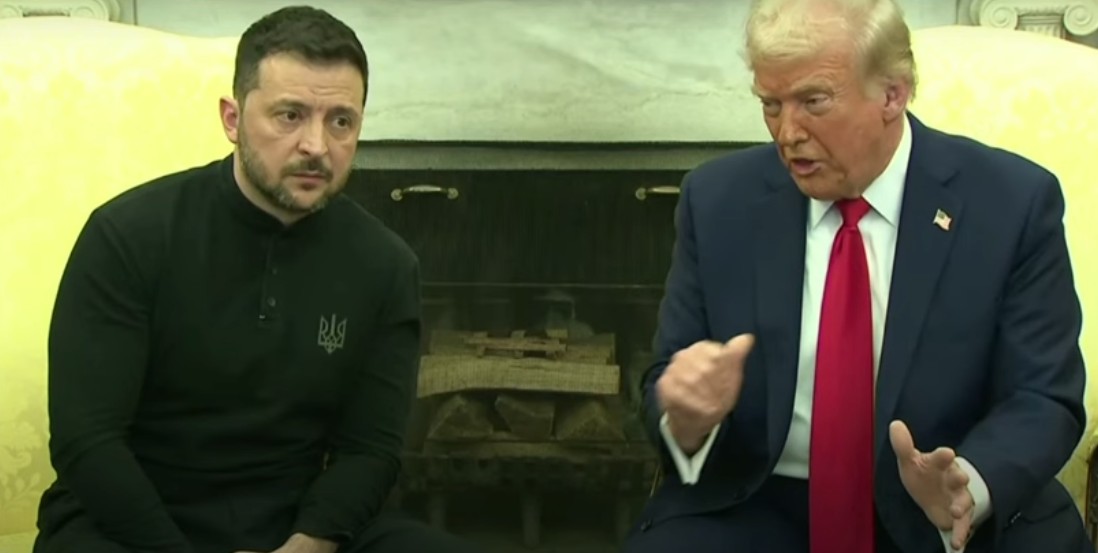
In a meeting that will likely be remembered as one of the most contentious diplomatic exchanges in recent history, President Donald Trump and Vice President J.D. Vance berated Ukrainian President Volodymyr Zelensky during a heated Oval Office encounter on Friday.
The meeting, ostensibly convened to discuss a potential peace deal to end Russia’s war on Ukraine and a rare-earth minerals agreement, devolved into a public spectacle of raised voices, accusations, and threats.
The tension was palpable from the start. Trump, who has repeatedly praised Russian President Vladimir Putin as a “very smart guy” and “a cunning person,” opened the meeting by chastising Zelensky for what he described as a lack of gratitude for U.S. military aid. “You’re gambling with World War III,” Trump told the Ukrainian leader, adding, “You don’t have the cards. You’re not in a good position right now.”
Vice President Vance echoed Trump’s sentiments, accusing Zelensky of being “disrespectful” for advocating Ukraine’s position in front of the American media. “Have you ever said thank you once?” Vance demanded, as Zelensky attempted to explain Ukraine’s need for security guarantees and its refusal to cede territory to Russia. The Ukrainian president, visibly frustrated, pushed back, questioning whether Vance had ever visited Ukraine or understood the stakes of the conflict.
A Fractured Alliance
The meeting underscored the growing rift between the United States and Ukraine under Trump’s administration. Since taking office, Trump has sought to distance the U.S. from its traditional role as a staunch supporter of Ukraine, instead adopting a more conciliatory stance toward Russia. This shift has alarmed European allies and Ukrainian officials, who view Trump’s approach as dangerously naive and dismissive of Russia’s ongoing aggression.
Trump’s rhetoric during the meeting further highlighted this divide. He falsely claimed that Ukraine had started the war with Russia and referred to Zelensky as a “dictator without elections,” a reference to Ukraine’s suspension of elections under martial law during the ongoing conflict. These comments starkly contrasted with Trump’s glowing praise of Putin, whom he described as a leader who “really wants peace” and “will keep his word” in any negotiated agreement—despite Russia’s repeated violations of past accords.
Zelensky, for his part, remained firm in his demands. He insisted that any peace deal must include security guarantees for Ukraine and that the proposed rare-earth minerals agreement should not come at the expense of his country’s sovereignty or long-term stability. “The war is in Ukraine, so for me, the Ukrainian position is the priority,” Zelensky said earlier this week in Kyiv, setting the stage for Friday’s contentious meeting.
The Minerals Deal: A “Protection Racket”?
At the heart of the dispute was a proposed agreement that would grant the United States partial access to Ukraine’s rare-earth minerals in exchange for continued military aid. Trump has framed the deal as a mutually beneficial economic partnership, but critics have likened it to a “protection racket,” with the U.S. demanding payment in resources for its support. Under the draft agreement, Ukraine would reportedly allocate half of its revenues from the monetization of critical minerals, oil, and gas to the U.S.
Zelensky has resisted the deal, arguing that it prioritizes American interests over Ukraine’s security needs. His refusal to acquiesce has drawn ire from Trump, who has repeatedly threatened to withdraw U.S. support if Ukraine does not comply. “You’re either going to make a deal, or we’re out,” Trump warned during the meeting. “And if we’re out, you’ll fight it out, and I don’t think it’s going to be pretty.”
A Dangerous Illusion
The meeting’s fallout has raised serious questions about the future of U.S.-Ukraine relations and the broader implications for global security. Ukrainian officials and international observers have expressed alarm at Trump’s apparent willingness to abandon Ukraine in pursuit of a quick resolution to the conflict—one that many fear would disproportionately benefit Russia.
Kira Rudik, a member of Ukraine’s parliament, described Trump’s belief that Putin genuinely seeks peace as a “dangerous illusion.” “We have not seen any fact that would support that,” Rudik said, pointing to ongoing Russian attacks on Ukrainian cities and front-line positions. She emphasized that NATO membership remains Ukraine’s best hope for long-term security, a goal that Trump has shown little interest in supporting.
A Public Spectacle
The meeting’s dramatic conclusion played out in front of television cameras, a rare and unsettling display of diplomatic discord. Trump’s decision to air grievances publicly, rather than behind closed doors, marked a stark departure from traditional norms of statecraft. The spectacle left many observers questioning the administration’s commitment to resolving the conflict in Ukraine and its broader approach to international diplomacy.
For Zelensky, the meeting was a stark reminder of the challenges his country faces in securing support from an increasingly unpredictable ally. For Trump, it was an opportunity to double down on his transactional approach to foreign policy, one that prioritizes short-term gains over long-term alliances. And for the world, it was a sobering glimpse into the fragility of the international order at a time of escalating tensions and uncertainty.
As the dust settles, one thing is clear: Friday’s meeting was not just a clash of personalities but a collision of fundamentally different visions for the future of Ukraine, the U.S., and the global balance of power. Whether this moment will serve as a turning point or a further unraveling of the U.S.-Ukraine partnership remains to be seen.