
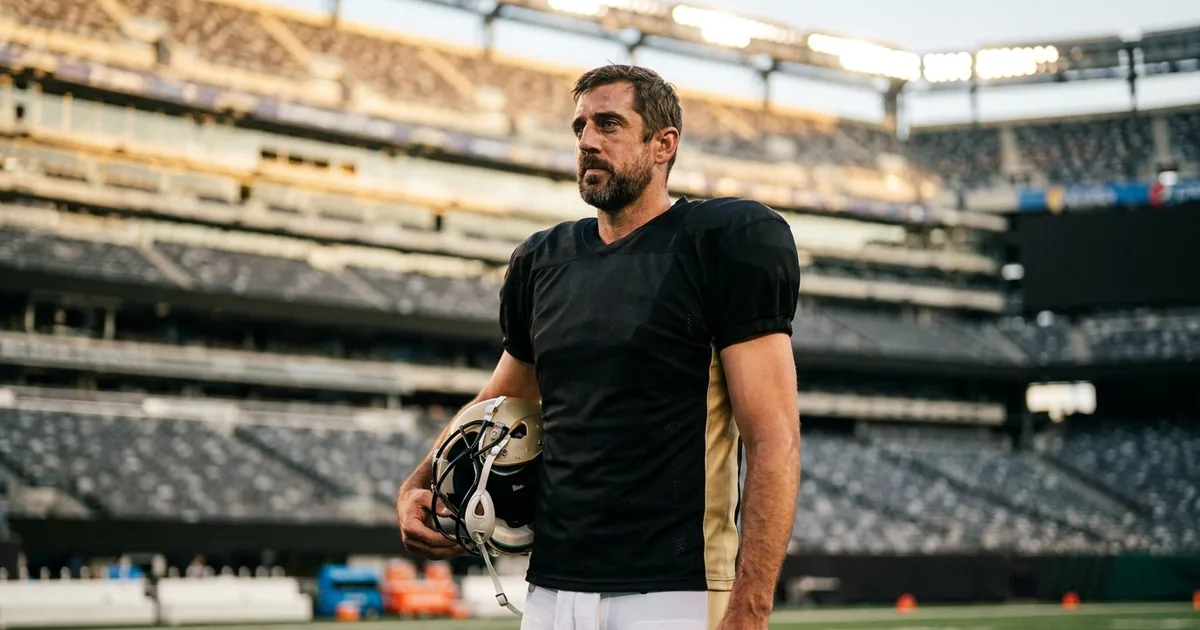
Mike McCarthy would like his 42-year-old quarterback, the one playing out an announced farewell season, to take live snaps in Pittsburgh’s first two preseason games.
Those two games happen to be against the Green Bay Packers and the New York Jets, which is either the best piece of scheduling luck an NFL marketing department has had in years or a genuinely bad idea dressed up as a nostalgia play.
Rodgers, for his part, is not pretending to be enthusiastic. “Mike, if you want me to play, I’ll play,” he said, per Bleacher Report’s account of his remarks. “I’m not saying I want to do it. But if he wants me to, I will.” He put the workload McCarthy has floated at 30 or 40 plays.
Nobody Does This With a 42-Year-Old
Start with why this is unusual, because it is genuinely unusual.
Veteran starting quarterbacks have not played meaningful preseason snaps in roughly a decade. The calculus is not complicated. The downside is a season-ending injury in a game that does not count. The upside is timing work you can approximate in joint practices against another team’s defense, where nobody is allowed to hit the quarterback. Most coaches decided years ago that trade was obviously bad, and the league’s best quarterbacks now show up for the opener having taken zero live hits since January.
Rodgers is on the extreme end of every variable that usually argues for sitting. He is 42. He turns 43 on December 2, at which point he becomes the sixth quarterback in NFL history to start a game at 43 or older. He has already said there is zero debate that 2026 is his last season, his 22nd. There is no development curve to protect and no future to invest in. He is a depreciating asset with a hard expiration date, which normally means you wrap him in bubble wrap until Week 1.
McCarthy wants him out there anyway. That is the interesting part.
The Reps Are Diagnostic, Not Ceremonial
The temptation is to read this as sentiment. McCarthy coached Rodgers in Green Bay, the two of them are back together in Pittsburgh, and now the schedule hands them the Packers and the Jets in consecutive weeks. Write the storyline yourself.
That read is too cute. McCarthy is a first-year head coach in Pittsburgh installing his offense with a quarterback he has not coached since 2018, and eight years is a long time in a 42-year-old’s career. Everything he knows about how Rodgers processes a live pass rush is a decade stale.
That is the thing camp cannot tell him. You can run every install period you want, and joint practices will give you route timing and protection calls, but nobody is permitted to put Rodgers on the ground. The specific question McCarthy needs answered is what this particular arm and these particular legs do when a defensive end is actually arriving, and there is exactly one place to get that answer before it matters.
McCarthy is also hedging in public, which is what you would expect from a coach who knows how this reads. “Those decisions are really gonna be made once we get up to it,” he said, adding that the team has plans but wants to see how things go, and that a lot can happen between now and then. Translation: this is the plan until the first time somebody’s knee bends the wrong way in practice.
The rest of the depth chart supports the diagnostic reading. Rodgers is taking first-team reps throughout camp, Mason Rudolph is running the second team, and Will Howard and Drew Allar are splitting third-team snaps. That is not a room with a viable emergency plan. It is a room where the season is Rodgers or it is nothing, which paradoxically makes it more important, not less, to find out early exactly what Rodgers still has.
The Sentence Rodgers Never Used to Say
“If you want me to play, I’ll play. I’m not saying I want to do it.”
Sit with that for a second. This is Aaron Rodgers, a quarterback who spent the better part of a decade in Green Bay conducting contract negotiations through media availability, who made his displeasure with front-office decisions a recurring national story, and who arrived in New York with enough leverage to shape a roster. That man did not defer to coaching staffs on snap counts.
The version speaking in Pittsburgh this month is doing something different. He is deferring, on the record, to a decision he says he does not want, and framing it explicitly as the coach’s call. When we covered the McCarthy reunion back in May, the open question was whose team it would actually be, given the history between them. This is a fairly clear answer, and it is not the one Rodgers would have given at any prior stop.
A retiring quarterback on a one-year deal has no leverage, and Rodgers appears to know it. There is no next contract to protect, no trade to threaten, no franchise-quarterback premium to spend. What is left is a coach who wants information and a player with no standing to refuse.
What Actually Happens
The likeliest outcome is still that he plays a series or two in the first game, throws six passes, and watches the second one from the sideline in a visor. Coaches float ambitious preseason plans in early August and quietly shelve them by the third week of camp roughly every year, and McCarthy’s own hedging language suggests he has already left himself that exit.
But if Rodgers does take 30 or 40 plays across two games against Green Bay and New York, pay attention to something other than the completion percentage. Watch what he does on the second and third reps after he gets hit. That is the only question the preseason can actually answer about a 42-year-old quarterback, and it is presumably the reason McCarthy is asking it now rather than finding out in Week 1.