
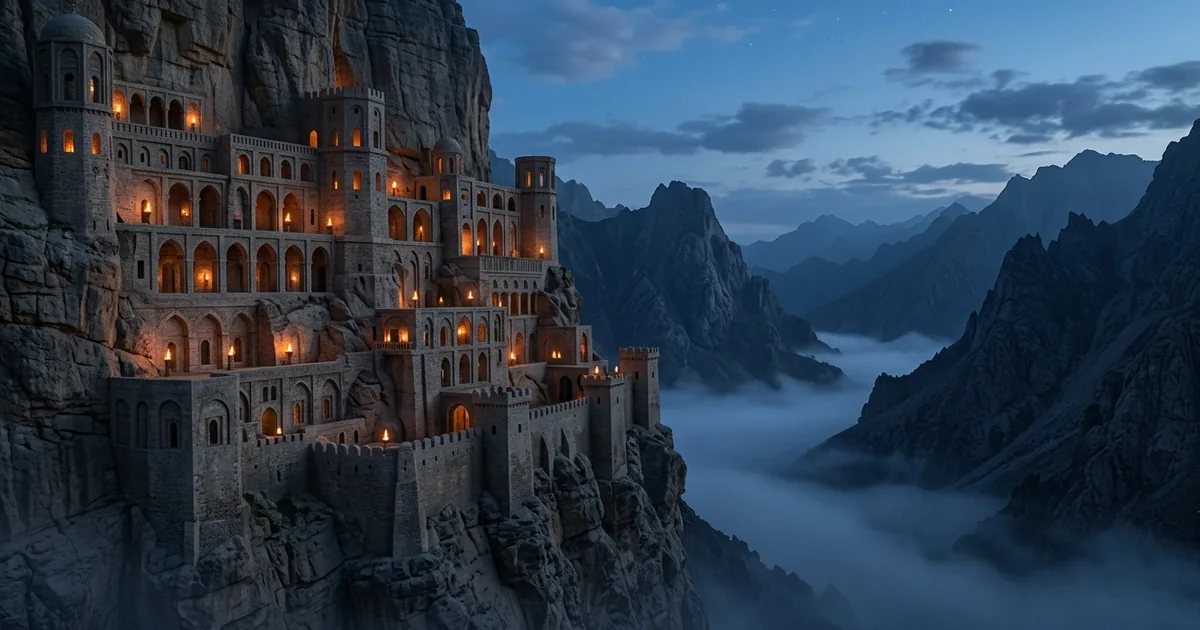
Amazon’s Prime Video began streaming “Castle Walls” worldwide on Wednesday, a two-episode historical drama that its producers say was generated end to end by artificial intelligence. It is the first long-form AI production to get a simultaneous global release on a major streaming platform, and the most interesting thing about it is not the pixels.
It is where the model got its training data.
What Actually Shipped
“Castle Walls” runs two episodes of roughly 15 minutes each, built around the legend of Alamut, the mountain fortress in what is now northern Iran that most Western viewers know from the Assassin’s Creed games. GamesBeat noticed the lineage immediately, which tells you something about which audience the setting was chosen for. It comes from AI Yapım, a unit of Ay Yapım, one of the biggest drama producers in Turkey, and the trade press covering the industry treated it as the studio’s first fully AI-generated production rather than a one-off stunt.
Variety, which covered the launch, laid out the production stack, and the details matter more than the headline does:
- The scripts were written by two human television veterans, Kerem Deren and Çisil Hazal Tenim, whose credits include the internationally distributed period drama “El Turco.”
- AI was used for prompt enhancement and creative development on top of those scripts.
- The storyboards ran through a proprietary system the company built in-house.
- The visuals came from AYDNA, a video diffusion model developed by the AI Yapım team.
- Every language dub was performed by human voice artists.
Read that list again and the phrase “fully AI-generated” starts doing a lot of load-bearing marketing work. Humans wrote it. Humans voiced it. What the machine generated was the image sequence, which is enormous, but it is not the whole of a television show and nobody involved is really pretending otherwise once you get past the press release.
The Training Data Is the Whole Ballgame
Here is the sentence in the announcement that should have been the headline: AYDNA was trained exclusively on Ay Yapım’s own licensed content catalogue.
That is the reason this shipped from Istanbul and not from Burbank.
Every major American studio has been sitting on the same capability for well over a year and has been unable to use it at scale, because the legal exposure is unresolved. If you train a video model on scraped material, you inherit litigation risk from every rights holder whose work went into the weights, plus a guild fight, plus an insurance problem, plus a distribution partner who wants indemnity you cannot honestly offer. The technology stopped being the constraint a while ago. Provenance became the constraint.
Ay Yapım solved it by owning the input. A studio with a deep library of its own productions can train on itself, and when it does, the ugly question of whose work is in the model has a clean answer. That is not a technical breakthrough. It is a corporate structure that happens to be shaped correctly for this moment, and it is a structure that a Turkish drama house, which produces enormous volume and retains its rights, has and an American streamer that licenses from a hundred suppliers largely does not.
Turkish drama is already one of the world’s most widely exported television categories, sold into Latin America, the Middle East, the Balkans and South Asia at volume. The industry that built that export machine is now the industry with the cleanest possible training corpus. The advantage compounds.
Thirty Minutes Is a Tell
Two episodes at 15 minutes is not a series. It is a demonstration.
Nobody launches a flagship at that length if the pipeline can sustain more. Video diffusion models remain expensive per second, temporally unstable over long takes, and heavily dependent on human cleanup between generations. The shape of this release, short, historical, set in a fantastical fortress where “slightly dreamlike” reads as style rather than error, is the shape of a project engineered around its tooling’s weak points rather than against them.
Choosing Alamut is smart for the same reason. Nobody in the audience knows what eleventh-century Persian fortress interiors looked like, so the model cannot be caught being wrong. Try that with a show set in a contemporary Istanbul apartment and every viewer becomes a continuity supervisor.
What Amazon Gets Out of It
Prime Video’s role here is worth naming plainly. Amazon did not produce this. It distributed it, globally, with a “first ever” tag attached.
That is a nearly free option. If audiences hate it, it was a 30-minute Turkish experiment on a service with tens of thousands of titles. If they do not, Amazon has established itself as the platform where AI-native content premieres, at a moment when every streamer is hunting for content that does not cost what content currently costs. The company also happens to sell the cloud compute that any studio building an AYDNA of its own would need to rent.
The strategic logic is not subtle, and it does not require Amazon to say a word about whether AI-generated drama is good.
The Question Nobody in the Release Answers
The interesting fight is not whether audiences will accept this. Audiences accept a great deal when it is cheap and available.
The fight is over what “trained on our own catalogue” means for the people who made that catalogue. Every actor, cinematographer, gaffer and director who worked on an Ay Yapım production over the past two decades contributed to the corpus that AYDNA learned from. They were paid for the show they made. They were almost certainly not paid, or asked, for the model.
That is exactly the issue the 2023 Hollywood strikes fought to a partial standstill in the United States, and it is arriving in markets with far weaker collective bargaining infrastructure. The clean-provenance model that makes this legally shippable is only clean from the studio’s side of the contract. From the crew’s side, “the company owns it” and “the company can regenerate you from it” are not the same sentence, and most existing contracts were written before anyone needed to distinguish them.
“Castle Walls” is 30 minutes long and will be forgotten by October. The precedent it sets, that a studio’s back catalogue is also a machine that can replace the people who filled it, will not be.