
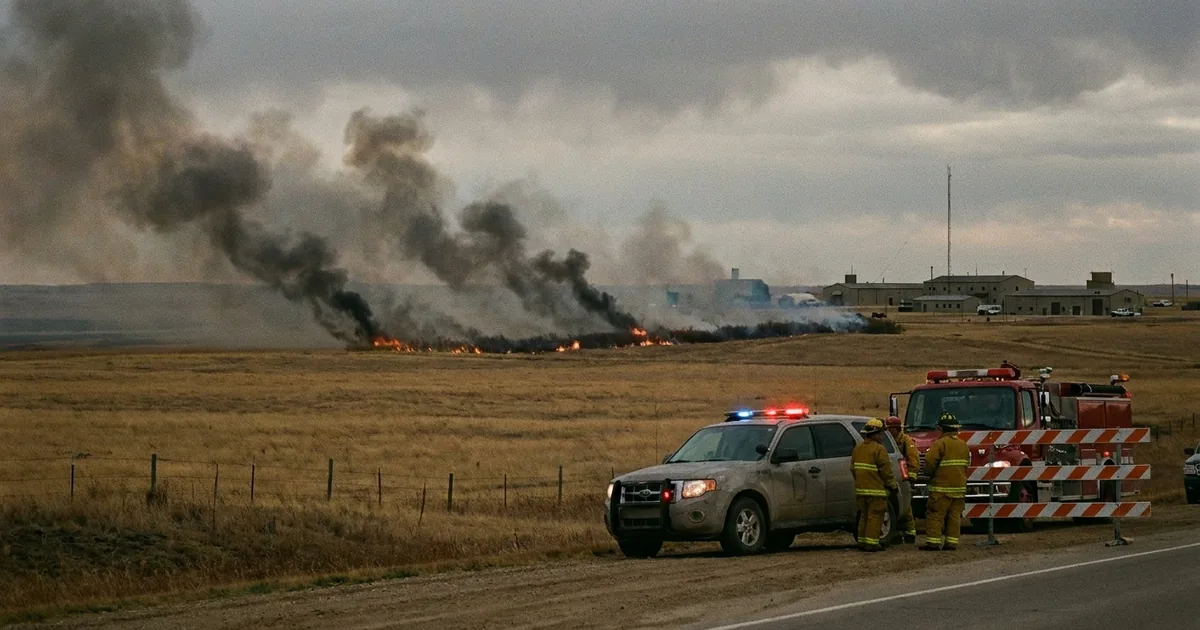
Canada’s defence minister confirmed Saturday night that people died and others were hurt when a fire tore through Canadian Forces Base Wainwright in Alberta, and as of Sunday morning the government has still not said how many, or what started it.
“I’m saddened to share that there have been both fatalities and injuries as a result of an incident on the base,” Defence Minister David McGuinty said, and he told reporters the situation was “very, very active and delicate.” Prime Minister Mark Carney called it a “serious incident.” Those two words have carried most of the official weight so far, and they are doing a lot of work for a fire that sent so many patients to Edmonton that one emergency physician called it “a disaster”.
What is confirmed, what is reported, what nobody has said
The gap between those three columns is the story right now, so here it is laid out.
- Confirmed by the government: fatalities and injuries, on the base, from an “incident” followed by a large fire. The call for help came shortly after 4 p.m. Saturday, and by 11 p.m. authorities said the fire was being held and critical infrastructure protected. No evacuation order was issued for residents.
- Reported, not confirmed: Global News, citing unnamed military sources, reported at least seven dead and dozens injured, and that a gas line or gas well was struck during live-fire training, setting off an explosion. The Canadian Armed Forces say numbers will not be released until next of kin are told. We are treating the seven and the gas line as one outlet’s sourcing until someone on the record says otherwise.
- Not stated by anyone: the exact death toll, the exact injury count, the cause, what training was under way, and how large an area burned. The cause is under investigation by the RCMP.
The wind, the distance and the hospitals
Gusts of up to 100 kilometres an hour, about 62 miles an hour, were hitting the province, which is how a fire that began on a base reached the rural land around it. Wainwright is one of the country’s busiest training bases, home to the Canadian Manoeuvre Training Centre, and the nearby town has about 7,000 residents. Local hospitals were overwhelmed, so patients were driven roughly 180 kilometres to Edmonton, where Dr. Warren Thirsk said the number of casualties “would overwhelm the city of Edmonton” and called it a one-in-every-15-to-25-years disaster.
Put the arithmetic next to the official language. A fire reported at about 4 p.m. was still being held, not out, seven hours later. In that window a physician was describing a mass-casualty event while the federal line was “serious incident.” McGuinty himself said he could not recall an incident like it in recent memory.
What we think
Governments are right to hold a casualty count until families know. That is decency, and nobody should push for names. But the cause is a different matter. A military that trains with live ammunition next to energy infrastructure owes the public a plain answer about whether this started on a range, and whether the same exercise is running anywhere else today. If Global’s gas-line account is wrong, say so. If it is right, say that too. Silence on the cause for another day invites exactly the speculation the “serious incident” phrasing was meant to avoid.
McGuinty promised more “in the coming hours and days.” We will update this page when the toll and the cause are on the record.