
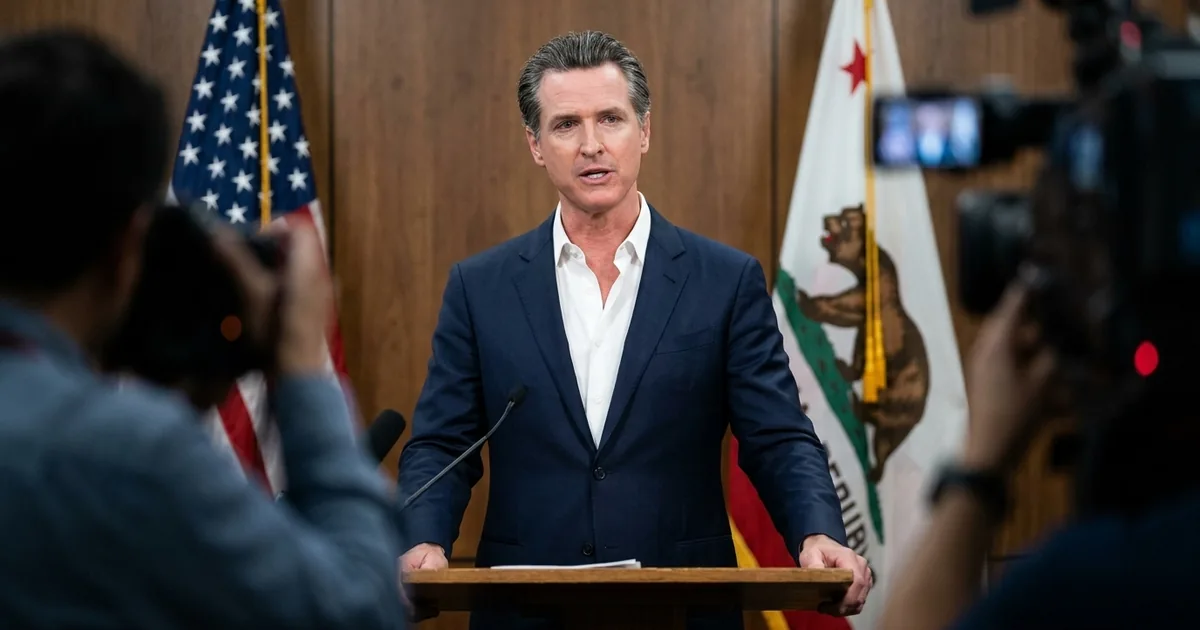
Gavin Newsom put four years of federal tax returns in front of reporters on Friday, more than 700 pages of them, and the coverage since has mostly been arithmetic.
The more useful question is not what is in the returns but why they arrived when they did, on the last Friday in July, handed to a hand-picked list of newsrooms.
The Numbers, Briefly
The headline figures depend on which one you pick, which is normal for tax returns and worth explaining rather than glossing over. Bloomberg Tax reported taxable income of about $1.4 million for 2024, the most recent year in the release. The Associated Press, looking across the full span, put the couple’s earnings at $1.7 million to $2 million a year between 2022 and 2024. Taxable income and total earnings are different measurements, so both can be right at once.
The composition matters more than the total. Newsom’s wages as governor came to roughly $192,000. His wife Jennifer Siebel Newsom’s wages were about $148,000. The remaining million-plus came from investments.
That is the actual portrait: a governor whose public salary is a minority of his household income, whose wealth sits in the wine and hospitality businesses he built before politics, and whose financial life is therefore governed by markets rather than by the job voters elected him to. None of that is unusual for a California governor. It is also not nothing, and it is exactly the thing a full return shows that a summary disclosure form does not.
Why Friday
Here is the part that explains the rest of it.
Newsom’s own aides told the New York Times the release was prompted in part by a federal investigation into his wife’s finances. CNN has laid out what is known about the Justice Department inquiry into Jennifer Siebel Newsom, which concerns tax-related conduct connected to the nonprofit she founded to work on gender equity in media. She has not been charged with anything, and an investigation is not an accusation of wrongdoing.
But it does change what a tax return is for. Documents you release voluntarily are a transparency gesture. Documents you release because a federal investigation is going to surface some version of them anyway are a different instrument entirely. You are not opening the books. You are choosing the day, the framing, and the first paragraph.
The San Francisco Standard framed the release squarely against the backdrop of the Trump Justice Department’s interest in the governor’s orbit, and that context deserves to be held honestly from both directions. A Justice Department under a president who has openly named his political enemies investigating the wife of the most likely 2028 Democratic nominee is a genuine institutional problem, whatever the underlying facts turn out to be. It is also true that the existence of a politically motivated investigator does not make the underlying questions disappear. Both things can be true, and the discipline of saying so is what separates analysis from cheerleading.
The Distribution Was the Tell
Newsom did not post the returns. He made them available to a selected list of outlets for review, which critics immediately called an insult to the word transparency.
That criticism is fair on the mechanics even if you think the underlying disclosure was worth doing. There is a meaningful difference between publishing a document and staging a reading room. One lets anyone with a browser and a grudge go looking. The other means the first wave of coverage comes from reporters working on your clock, under your access terms, from a stack you assembled.
Politicians have understood this for a long time, and it is why so many disclosure fights are really distribution fights. The standard Newsom is inviting comparison to is not a good one: American politics has spent the last several years watching financial disclosure norms erode from the top, and “better than the worst example available” is a low bar for someone building a national argument about democratic norms.
The $200,000 Line
Then there is the household staff.
Mediaite pulled out the detail that the couple paid roughly $200,000 for household staff in 2024, a number that is entirely legal, fully disclosed, and going to appear in an attack ad within about eighteen months.
It is worth being clear-eyed about why. That figure will not matter because $200,000 is a lot of money to spend on staff for people who earn what the Newsoms earn. It will matter because it is concrete, it is visual, and it lands in a Democratic primary electorate that has spent a decade arguing with itself about whether its leaders live anything like the people they represent. A number you can picture beats an argument you have to follow, every time.
The Newsom team knows this. Releasing it now, in July of an off year, with nothing else competing for attention and no campaign to attach it to, is the cheapest moment it will ever cost.
What This Actually Was
Read all of it together and the shape is clear. This was not a governor deciding the public deserved to see his books. It was a probable presidential candidate clearing a liability off the board on a Friday in the summer before the race starts, while a federal investigation into his household gave him a reason he could point at.
That is competent politics. It is also not transparency, and the two keep getting filed under the same heading. The test of the first framing arrives whenever the Justice Department’s inquiry produces something, or produces nothing, because the returns Newsom chose to release are now the baseline everyone will measure that outcome against. He picked the ruler. That was the point.