
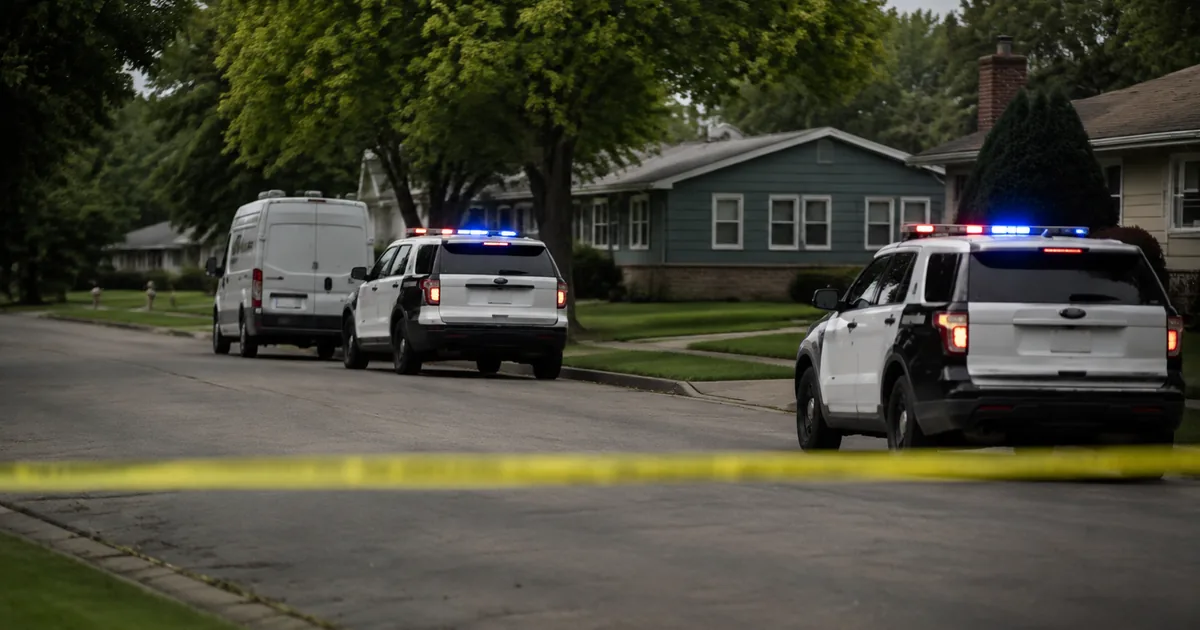
Police in Hopkins, Minnesota, were called to an in-home daycare on Wednesday morning and found three people dead inside, one of them a child.
Six other children were in the house at the time and all six walked out unharmed, which is the only mercy in a story that otherwise rests on an uncomfortable fact: in Minnesota, a licensed daycare can be someone’s living room.
The call did not come in as a childcare emergency. It came in shortly after 9 a.m. as a domestic situation, and officers responded to the 200 block of Tyler Avenue North, to a house that operated as Brown Bear Daycare. Inside they found a man, a woman, and a child, all dead. Police believe the three were members of the same family.
Fox 9 reported that officers were alerted after another parent arrived to drop off a child and saw the attack. Sit with that for a second. The person who made the call was a parent standing at a door they had probably walked up to a hundred mornings in a row, at the moment a routine drop-off stopped being routine.
Officers got the six surviving children out of the house and back to their families, a detail NBC News confirmed as the first national reports landed. Police closed Tyler Street between 2nd Street and Lake Street while crime scene investigators, multiple agencies, and an ambulance worked the address.
What Police Have Confirmed, and What They Have Not
Hopkins Police Chief Brent Johnson held a news conference just after 11 a.m., and he was careful in a way worth noticing. Investigators preliminarily believe the man killed the woman and the child before taking his own life, according to CBS News. Johnson also said officials are still working to determine the exact cause of the three deaths, and he would not say whether the victims were shot or stabbed. MPR News characterized the case, on the department’s account, as an isolated attack.
Those two positions can look contradictory in a headline and still both be correct. A department can be confident about the sequence of events, particularly with a witness who saw part of it, and still decline to describe the mechanism until a medical examiner has done the work. The distinction matters, because the preliminary read is the version that will travel all day, and it is not yet the confirmed one.
Here is the honest split as of Wednesday afternoon:
- Confirmed: three people dead, one a child, at an in-home daycare on Tyler Avenue North; six other children present and unharmed; no ongoing threat to the public.
- Preliminary: that this was a murder-suicide committed by the man.
- Not established: the cause of death, the identities of the three, and their exact relationships to one another and to the business.
“There’s no worse scenario than this, where you drop off your child to” a safe place.
That is Johnson, quoted mid-sentence by the outlets in the room, and the broken-off shape of it is closer to the truth of the morning than a polished statement would have been. Jacob Frey, the mayor of nearby Minneapolis rather than of Hopkins itself, offered the civic version: “I know that our hearts and our prayers are with the people of Hopkins and any families that have been impacted.”
The Model Puts Children Inside a Private Household
Here is the part that deserves more than a day of attention, and it is a question rather than an accusation.
Minnesota, like most states, runs two different kinds of childcare. One is the center: a commercial building, staff who go home at night, a workplace that is nobody’s house. The other is family child care, which is licensed to operate inside the provider’s own home, can serve up to 14 children at a time, and is licensed through a county-delegated system. Oversight of it moved from the Department of Human Services to the new Department of Children, Youth and Families in June 2025.
Family child care is not a loophole. It is a deliberate, load-bearing piece of how the state delivers care, and for a lot of Minnesota families it is the only affordable option within driving distance. Providers who run it are licensed, inspected, and background-checked, and the model exists because parents want small settings with a consistent adult.
But the model does place children inside a private household, and a household is not a workplace. Licensing can screen the adults in a home, verify the smoke detectors, check the ratios, and count the exits. What no inspection schedule is built to detect is the state of a marriage, or the week a private crisis turns lethal. That is not a criticism of an inspector. It is a description of what periodic inspection can and cannot see.
So the question worth asking, once the immediate facts are settled, is not whether someone missed a box on a form. Nothing is known yet about this daycare’s licensing history, and nobody should pretend otherwise. The question is whether a regulatory model that deliberately puts children inside private homes has anything at all to say about domestic risk, or whether that is simply the residual danger the state has decided to accept in exchange for the capacity family child care provides. Those are both defensible answers. Neither one gets debated unless somebody asks.
The Names Are Not Out Yet
Police said the event was isolated and that there is no continuing danger to the neighborhood, and they expected to brief reporters again around 4 p.m. Wednesday. The three victims had not been publicly identified. Their names, once released, will do what names always do to a story like this, which is make it much harder to discuss in the abstract.
Six sets of parents in Hopkins got a phone call Wednesday morning telling them their child was safe. Every one of those parents had made the same ordinary decision that thousands of Minnesota families make every week, which is to leave a small child in a stranger’s house because the state says the house is licensed and the person in it has been checked. That arrangement mostly works, and it worked for six children on Tyler Avenue North. What it could not do was protect the one child who was not dropped off that morning, because he or she already lived there.