
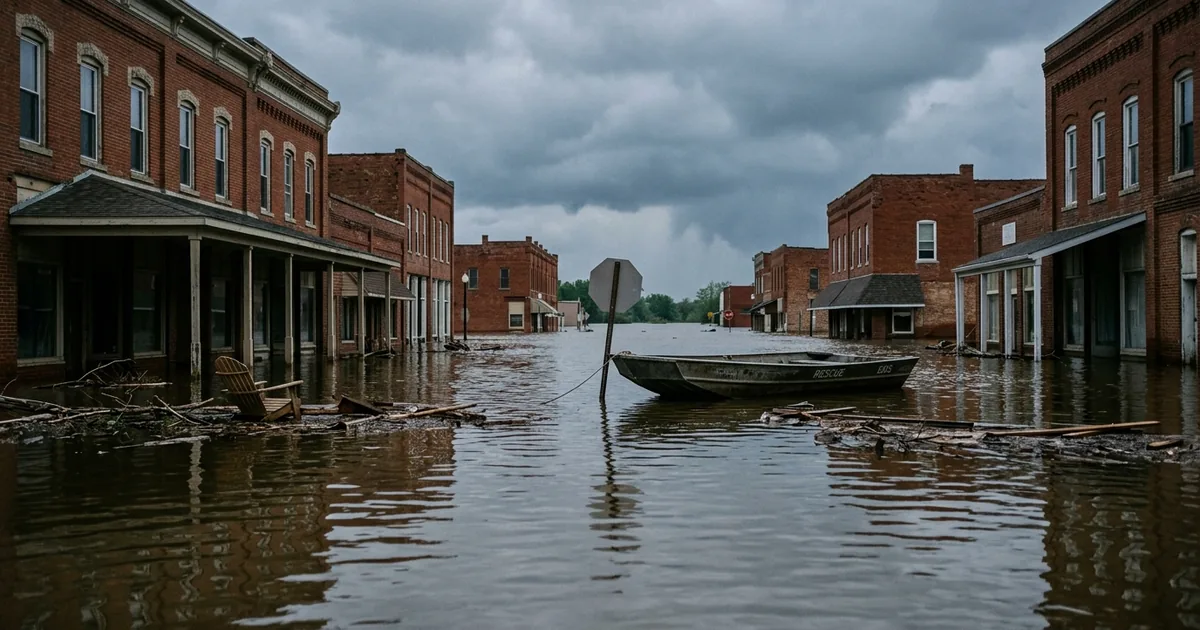
Governor Mike Braun declared a statewide disaster emergency Thursday and put the Indiana National Guard on the ground, roughly 36 hours after eastern Indiana took a rainfall event the National Weather Service put in the 1-in-1000-year range. By Friday morning the storms were on their sixth consecutive day and more than 300,000 customers were still without power.
The sequencing here is the story. Indiana did not get hit by one disaster. It got hit by two, in an order that made the second one much worse.
Tuesday Took the Grid, Wednesday Took the Ground
A derecho tore across the Midwest on Tuesday, a straight-line windstorm that knocked out power to more than 700,000 customers and killed three people. We wrote about that storm when it happened, and about the uncomfortable fact that every alert the warning system was built to trigger fired correctly and people died anyway.
Then Wednesday arrived. Parts of eastern Indiana absorbed rain the National Weather Service office in Indianapolis catalogued as a genuinely extreme event, with parts of seven counties placed under a flash flood emergency, the highest tier the agency issues and one it uses only when lives are already at risk. Fox Weather counted multiple simultaneous flash flood emergencies across the state at once, which is not a common sight in a landlocked state in August.
Cambridge City, a town of about 1,800 in Wayne County, effectively shut down Wednesday morning. Rescue boats worked the streets. In neighboring Henry County, crews pulled more than 50 people out of a flooded apartment complex in a single operation.
Why the Second Storm Hit So Much Harder
A derecho and a flood are different physical events, but they interact, and the interaction is what turned a bad week into a disaster declaration.
Start with the ground. Tuesday’s system brought heavy rain alongside the wind that did the visible damage. By the time Wednesday’s slow-moving storms parked over the same counties, the soil had little absorption capacity left. Water that would normally soak in ran off instead, straight into creeks and then into the Whitewater River. CNN reported that parts of the region have taken 6 to nearly 12 inches this week, most of it on ground that was already full.
Then the response capacity. County emergency management in eastern Indiana spent Tuesday and Wednesday morning on downed lines, blocked roads and shelter for people without power. Utility crews were staged for wind damage, which is a restoration problem, not a rescue problem. When the water came up Wednesday, the people and equipment you would want free were already committed to a different emergency 24 hours old.
And the communication layer. Hundreds of thousands of households had no power, which in 2026 also means no wifi, degraded cell service where towers were running on backup, and no television. Flash flood emergencies are pushed to phones, and phones were the only channel left. That works if the phone has charge and a signal. Plenty did not.
The Declaration Came After the Water
Braun signed the statewide disaster emergency Thursday and traveled to Cambridge City to walk the damage with first responders. ABC News reported that the declaration mobilized the National Guard and unlocked state resources for response and recovery.
That is the right action. It is also, by definition, a Thursday action for a Wednesday flood.
This is not a knock on Braun specifically, because the structure is the same in nearly every state. A governor’s disaster declaration is primarily a fiscal and legal instrument. It opens the state’s emergency fund, waives procurement rules, activates the Guard under state control, and starts the paperwork clock for a federal request. None of those things pull a family off a roof. The declaration is the mechanism for paying for the recovery, and it is written to be issued once the scope of damage is known, which means it structurally arrives after the worst hour.
The rescue layer is entirely local: county emergency management, volunteer fire, mutual aid from adjacent counties. In a rural Indiana county, that is a small number of trained people with a small number of boats. When 50 people are stuck in one apartment complex and the water is still rising in four other towns, the constraint is not authority. It is boats.
Thursday Night Made It Two States
The Whitewater River kept rising after the declaration. Emergency managers in Dearborn County, Indiana and Hamilton County, Ohio ordered residents along the river to evacuate Thursday night, using the words “unprecedented” and “dangerous,” and CBS News documented neighborhoods where the water reached second stories.
Cross-border river flooding is its own coordination problem. The Whitewater does not care about the state line, but the emergency management structures on either side of it are separate agencies with separate authorities, separate radio systems and separate governors. They coordinate well when they have practiced. They have less time to improvise when the crest is moving faster than the phone tree.
Meanwhile the atmosphere was not finished. Forecasters warned Friday of storms capable of training over the same corridor from Des Moines to Lexington, producing rainfall rates of 1 to 2 inches per hour. Training is the technical term for storms moving repeatedly over the same ground like cars on a track, and it is how a normal August thunderstorm complex becomes a 1-in-1000-year total.
What Indiana Will Actually Have to Decide
The Midwest has now absorbed a heat dome, a derecho and a historic flood inside one summer. Three separate hazard types, three separate response postures, one exhausted set of county responders.
The rebuild question in Wayne, Henry and Dearborn counties is going to be uncomfortable, because the honest version of it is not about rainfall. It is about floodplain maps drawn on twentieth-century return periods, small-town storm sewers sized for a rain event that no longer describes the risk, and a rural mutual-aid model that assumes your neighboring county is available to help. When the same storm system covers six states at once, the neighboring county is busy.
That is a spending conversation, and it will happen in a legislature that has to weigh it against everything else. The floodwater will be gone in a week. The question of whether Indiana’s small towns are engineered for the weather they are actually getting will still be sitting there in October, when nobody is filming.