
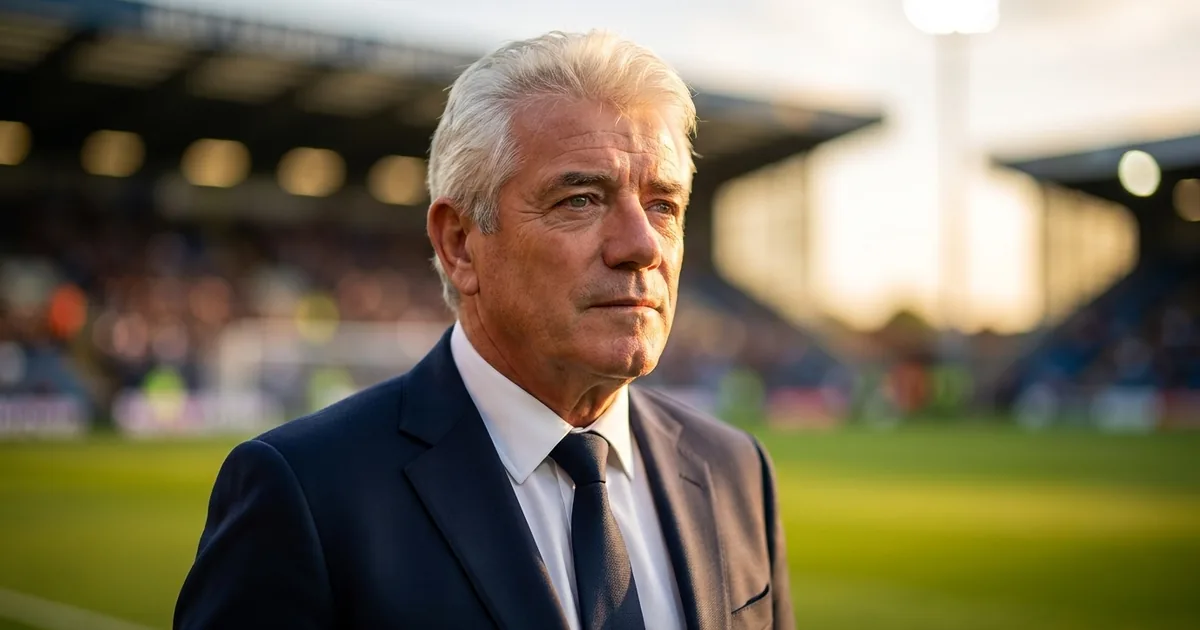
Kevin Keegan, the Doncaster miner’s son who became the most electric footballer of his generation and the only Englishman to win the Ballon d’Or twice, has died at 75 after a battle with stage four cancer.
His family confirmed the news on Sunday, saying he was surrounded by his wife Jean and their daughters.
A Career Built on Relentless Energy
Keegan’s story was never supposed to happen. Born in Armthorpe, South Yorkshire, he was rejected by his local club Doncaster Rovers before Scunthorpe United gave him a chance in 1968. Bill Shankly brought him to Anfield in 1971 for just 35,000 pounds, and what followed was a decade that rewrote what an English footballer could achieve on the global stage.
At Liverpool, Keegan won three First Division titles, two UEFA Cups, an FA Cup, and a European Cup, accumulating the kind of medal haul that most players across an entire national generation never match. He earned 63 caps and scored 21 goals for England between 1972 and 1982, captaining the side with the same combustible intensity he brought to every club dressing room.
His move to Hamburg in 1977 was a gamble that paid off spectacularly. In an era when English players almost never left for the continent, Keegan won the Bundesliga and collected back-to-back Ballon d’Or awards in 1978 and 1979, a feat no English player has matched since. He did not win them by being the most technically gifted player in Europe. He won them by being the most relentless.
The Manager Who Nearly Changed Everything
Keegan’s managerial career was defined by one impossible season. When he took over Newcastle United in February 1992, the club was heading for the third tier of English football. Within four years he had them playing the most thrilling football in the Premier League, 12 points clear at the top of the table in January 1996 with a side the press called “The Entertainers.”
What happened next became the defining moment of 1990s English football. Newcastle’s lead evaporated under Manchester United’s relentless pressure, and Keegan’s famous televised outburst after a provocative comment from Alex Ferguson, the “I would love it if we beat them” rant, captured something genuine about a man who could never disguise what he felt. The title went to Old Trafford. The moment became immortal.
He went on to manage Fulham, winning the Second Division title, before taking charge of the England national team in February 1999. His tenure ended abruptly in October 2000 when he resigned in the Wembley tunnel after a 1-0 defeat to Germany in a World Cup qualifier, the last competitive match played at the old stadium. He managed Manchester City from 2001 to 2005, winning the Division One title, and returned briefly to Newcastle in 2008 for eight turbulent months.
Why English Football Loved Him
The structural reason Keegan mattered, beyond the goals and the trophies, was that he proved an English player could dominate European football through sheer force of personality. The Ballon d’Or in the 1970s was decided by journalists who watched every league in Europe. They chose Keegan twice not because England was producing technically superior players, which it was not, but because no one in the sport played with more visible commitment to winning every single contest on the pitch.
That quality made him a cultural figure beyond sport. “Mighty Mouse,” as Hamburg fans called him, became the first English footballer whose celebrity crossed into mainstream entertainment: Brut aftershave commercials, pop singles, a public persona that felt human in a way that modern athlete branding never does. He was famous for being genuine, which is the rarest commodity in professional sport.
Alan Shearer, who played under Keegan at Newcastle and went on to become the Premier League’s all-time top scorer, said Sunday: “My Hero. My manager. My friend. Sleep easy Boss.”
A Legacy That Outlasts the Statistics
Keegan announced his stage four cancer diagnosis in January 2026, and the outpouring of support that followed reflected what he meant to multiple generations of English football fans. He was not the most decorated English footballer; Bobby Charlton won a World Cup and a European Cup. He was not the most naturally talented; Paul Gascoigne had more raw ability. But no English player in the modern era was more universally loved, because Keegan played and managed with his heart entirely visible.
In an era when England’s current squad is competing on the world stage at the 2026 World Cup, Keegan’s death is a reminder that the foundation those players stand on was built by someone who refused to accept limitations. Nearly 750 club appearances, two Ballon d’Or trophies, a European Cup, and a managerial career that produced the most beloved team the Premier League has ever seen.
The last English footballer who made you feel like anything was possible. That was Kevin Keegan.