
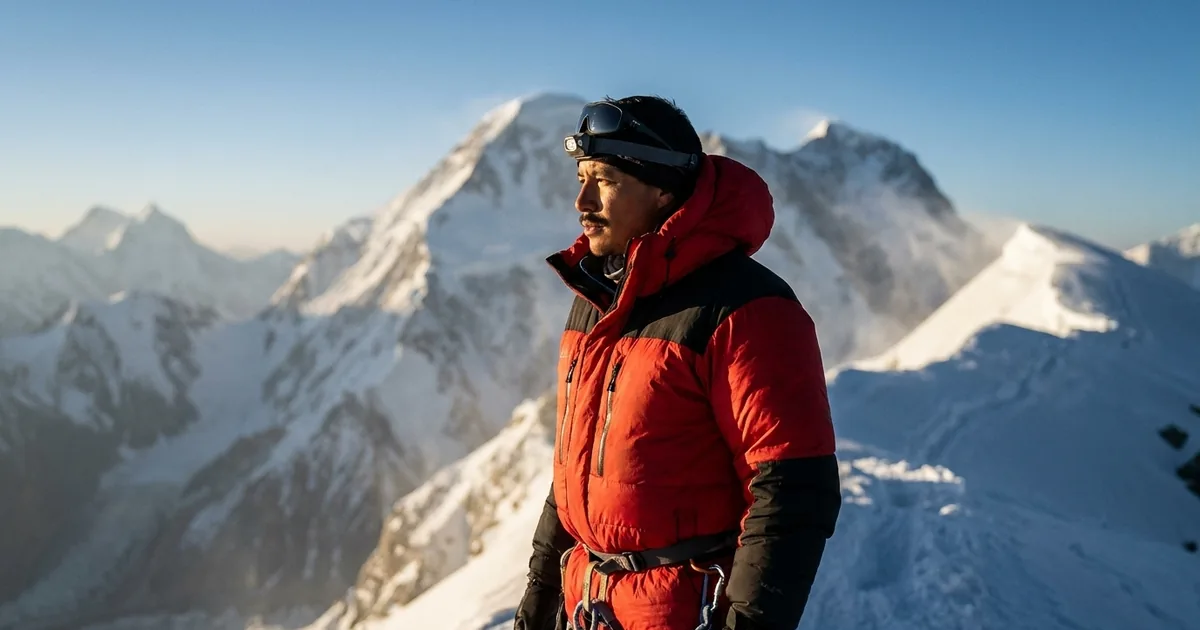
Elite Exped confirmed on Saturday that Nirmal Purja, the Nepali-born British mountaineer who turned high-altitude climbing into mass entertainment, was killed by the avalanche that hit Pakistan’s Broad Peak on Thursday.
Nine other people on his expedition died with him, and the detail that separates this from an ordinary mountaineering accident is that the slope took the entire team in one stroke.
Purja was 43. He was leading a ten-person international group up the standard West Ridge route on the world’s twelfth-highest mountain, an 8,051-meter peak in the Karakoram range of Pakistan’s Gilgit-Baltistan region. The avalanche released on Thursday morning, local time, while the climbers were moving between Camp II and Camp III at roughly 6,579 meters. Al Jazeera reported that Pakistani recovery teams have brought three bodies down so far. Six climbers are still on the mountain.
The confirmation came through an Instagram post from Elite Exped, the guiding company Purja founded. “It is with profound sadness and immense heartbreak that we confirm that Nirmal Purja tragically lost his life following the avalanche on Broad Peak,” the company wrote. Karrar Haidri, vice president of the Alpine Club of Pakistan, confirmed the wider toll and extended condolences to the families of the climbers.
What the Satellite Trackers Recorded
This is a disaster with an unusually precise record, because nearly everyone on the slope was carrying a satellite tracker.
The devices kept transmitting after the snow stopped moving. Explorersweb reported that the group was carried roughly 1,000 meters down the mountain, and that individual traces varied enormously depending on where each climber stood when the slope let go. Mallory Geis, the American on the team, dropped 543 meters. Nadhira Al Harthy, the Omani climber, fell 1,651 meters. Those two numbers describe the same avalanche, three times apart in scale, which is a fair summary of how little control anyone retains once a slab releases at altitude.
Search teams therefore knew within hours roughly where to look. That knowledge did nothing to speed up the recovery. Severe weather grounded the helicopters for stretches of Friday and Saturday, and Broad Peak’s upper mountain sits well above the altitude at which a helicopter operates comfortably. The information was close to perfect. The access was not. That gap, between knowing exactly what happened and being able to reach anyone it happened to, is the part of high-altitude climbing that no amount of equipment has closed.
The Man Who Turned the 8,000ers Into a Product
Purja was not an ordinary casualty, and treating him as one misses what this event actually says.
In 2019 he climbed all fourteen of the world’s 8,000-meter peaks in six months and seven days, taking apart a record that had stood for years and doing it with a public-facing swagger that Himalayan climbing had never had. Netflix bought the story and released it as “14 Peaks: Nothing Is Impossible.” The film worked. It made a former British Army soldier from Nepal into the most recognizable mountaineer alive, and it made the fourteen 8,000ers legible to an audience that had never heard of Annapurna.
His own record did not last. In July 2023, the Kathmandu Post reported that Norwegian climber Kristin Harila and Nepali guide Tenjen Lama Sherpa finished the same fourteen peaks in 92 days. By then the record was almost beside the point. Purja had built Elite Exped into a guiding operation that sold the experience he had made famous, and he had helped move Himalayan climbing decisively from an expedition sport into a client industry.
That industry is why ten people were standing in the same place.
Who Was on the Mountain
The composition of the team is the part most of the coverage has skipped.
Climbing reported that the group included five Nepali climbers led by Purja, the Pakistani guide Sohail Sakhi of Moving Mountains, Al Harthy, Geis, a Chinese climber identified only as Mr. Wang, and one further foreign climber. Among the confirmed dead are Purja, Nima Sherpa, Pur Bahadur Gurung, Al Harthy and Geis.
Geis was on her first 8,000-meter mountain. She had climbed 6,000-meter peaks in Nepal, one of them with Sakhi, who was guiding her on Broad Peak using bottled oxygen. None of that is unusual. It is the ordinary shape of a commercial 8,000-meter expedition in 2026, where a client with real but modest altitude experience is attached to the reputation and the logistics of a professional outfit.
The risk this model creates is not mainly about individual skill. It is about simultaneity. Guided expeditions move clients and guides through the dangerous sections of a route together, on a schedule set by weather windows and permits, because that is the only way the economics work. A small independent team crossing an avalanche-prone slope between Camp II and Camp III exposes two or three people to the hazard. A commercial expedition moving as a unit exposes ten. When the slab released on Thursday, there was nobody left lower on the route to mount a rescue, because everyone with the skill to do it was inside the avalanche.
Three Bodies, Three Days
Pakistan Army helicopters lifted three bodies to Skardu, one American, one Nepali and one Omani, in flights broken up by weather. CBS News reported that military aircraft and experienced Pakistani climbers are working the recovery. The search for the remaining six resumed on Saturday and stays at the mercy of conditions on a mountain that has been actively shedding snow.
Broad Peak carries a reputation among alpinists that never quite reached the public the way K2’s did. It is a serious, technical climb, and its standard route is not the walk that a checklist of 8,000-meter summits can make these mountains sound like from a distance.
The uncomfortable part of Purja’s legacy is that he is a large reason the distance closed. He was one of the most capable high-altitude climbers who has ever lived, and avalanches kill people at that level with complete indifference to how good they are. Both of those things are true at once. What his career changed is how many people are standing on the slope when it happens.
Nepal’s climbing community is now absorbing the loss of at least five of its own from a single release of snow, on a mountain in another country, on an expedition sold to international clients. That is the industry Purja helped build, running exactly as designed, on the day it failed.