
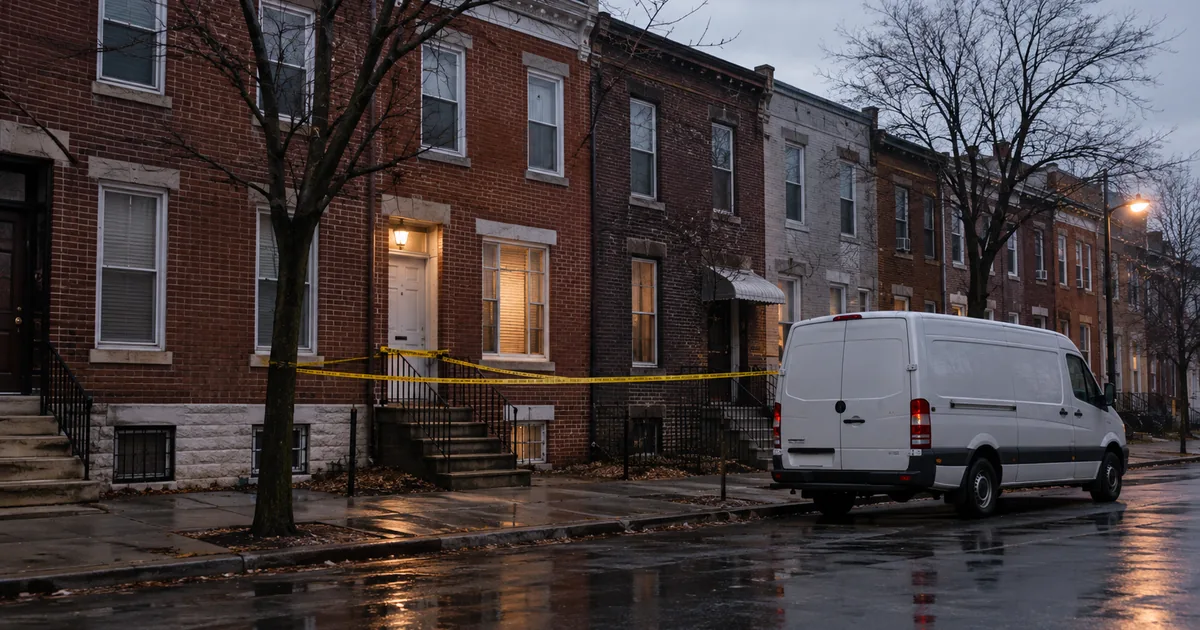
Philadelphia police have now connected five missing women to a single house on West Chew Avenue, and the FBI has added agents to help authenticate more than a million images pulled off devices inside it. What has gone almost unexamined in the national coverage is that city narcotics detectives had already served a warrant in that house, walked through it, and left, and the disappearances stayed unsolved for years afterward.
That is not a hindsight complaint. It comes from the department itself. Deputy Commissioner Frank Vanore told NBC10 Philadelphia that officers had been in the property before this investigation began, and that it looked nothing like it did when they returned:
“Narcotics had served the warrant and been inside that house previous to this incident. That wasn’t the first time we were there. It didn’t look like it looked when we went in. It was different.”
The same reporting describes court documents from May 2025 showing that Eugene Horsch, 44, had marijuana and amphetamines at the property and a firearm with an obliterated serial number. He pleaded out and received three years of probation. A little over a year later, his address became the center of one of the largest missing-persons investigations the city has run in decades.
How the Case Actually Opened
Not through the missing-persons files. On June 19 of this year, a federal park ranger noticed a black BMW parked where it should not have been near Independence Mall. The woman in the passenger seat handed over an identification card carrying the name Blair Tonzelli, who had been missing since 2023. The driver was Horsch.
Everything since has followed from a parking violation. Investigators searched the West Chew Avenue home and, according to CBS News Philadelphia, recovered chemicals, drugs, firearms, ballistic evidence and a 55-gallon drum plumbed into the house’s water lines, along with hundreds of thousands of images, tens of thousands of videos and thousands of pages of writing. Police said in August that material recovered from the devices appeared to show two of the missing women dead.
The five women now linked to the house, per 6abc Philadelphia, disappeared across fourteen years: Gabrielle Amarando in 2012, at 22. Maribel Fresses and Nicole Fusaro in 2018, both 27. Amy McHale, last heard from at the house in 2016, at 44. Tonzelli in 2023, at 35.
Horsch remains in federal custody on charges of being a convicted felon in possession of firearms and possessing counterfeit DEA and FBI credentials. He has not been charged in connection with any of the women. His father, Raymond Horsch, an erotic photographer and drug manufacturer who died in 2025, is described by investigators as a central figure; The Philadelphia Inquirer has reported that video recovered from the home appears to show him killing a woman. He was never charged with anything related to the disappearances and never will be.
Fourteen Years, Five Women, One Address
Here is the question that ought to be at the front of every story about this case and is not. What did the Philadelphia Police Department know about that house, and when?
The department has not said whether any officer ever visited the property or interviewed Horsch about Tonzelli after she vanished in 2023. It has not said whether anyone noticed that, as the Inquirer reported in August, a photograph of Tonzelli appeared on Raymond Horsch’s public website. It has not explained how the narcotics case that put officers inside the house in 2025 ended in a probation deal without anyone cross-referencing the address against open missing-persons reports.
None of that requires clairvoyance in reverse. It requires a records check.
The reason cases like this stall for a decade is not usually a criminal mastermind. It is triage. Women who use drugs, who have arrest records, who work in the sex trade, who have moved around, get classified as voluntarily missing. No homicide file opens, so no detective owns the case, so nothing gets connected to anything else. Four of these five women vanished before 2020, and each of those years was a chance for a different decision at a desk in Philadelphia to produce a case file instead of a form. The comparison local outlets keep reaching for is Gary Heidnik, and the resemblance that matters is not the house of horrors framing. It is that Heidnik’s victims were also women the city had already decided not to look for.
The Cost of Waiting Is Already Visible
Delay is not neutral in a case like this, and the evidence file shows it. The Inquirer reported in July that no blood or DNA from any of the missing women had been recovered from the house, and in August that prosecutors and families were confronting the absence of bodies as a legal problem, not just a human one. Homicide charges without a body are winnable but hard. They get harder with every year between the disappearance and the search, which in this case runs to fourteen for the earliest woman on the list, and came down in the end to one parking check near Independence Mall.
Commissioner Kevin Bethel has signaled an update could come this week. When it does, the number that will lead the coverage is how many women, and the number worth asking about is how many times the city was already inside that house. A full public accounting of every prior police contact with the address, and of what the 2025 narcotics plea negotiation knew, belongs in that briefing rather than in a records request a year from now. Five families have waited long enough for the version where someone explains the gap instead of announcing the total.