
Vladimir Putin ordered a 72-hour halt to Russian strikes on Kyiv on Saturday, hours after Russian missiles and drones killed at least eight people and wounded more than twenty elsewhere in Ukraine. That pause is real, and it is also the cheapest thing Moscow could have offered the American delegation that had just landed to talk about ending the war.
Almost every account of Saturday framed the order as a step toward peace. What almost none of them did was hold the order up against the map. The Kremlin did not pause the war. It paused one city, for exactly as long as Steve Witkoff and Jared Kushner are expected to be standing in it, and Russian forces spent that same day hitting the Kharkiv, Dnipropetrovsk, Zaporizhzhia, Khmelnytskyi and Mykolaiv regions. A ceasefire that stops at the city limits of the place the negotiators are visiting is not a concession. It is air-traffic control.
The Map Is the Message
Kremlin spokesman Dmitry Peskov put the order on the record through the state news agency Tass in a single sentence, saying that Putin has ordered that no strikes be carried out against Kyiv for three days, starting at midnight. Kyiv, and nothing else. As RFE/RL noted in its account of the day, Peskov’s announcement made no mention of any other Ukrainian region, and Russian forces kept striking through the announcement.
The record of that same day, compiled from Ukrainian regional officials:
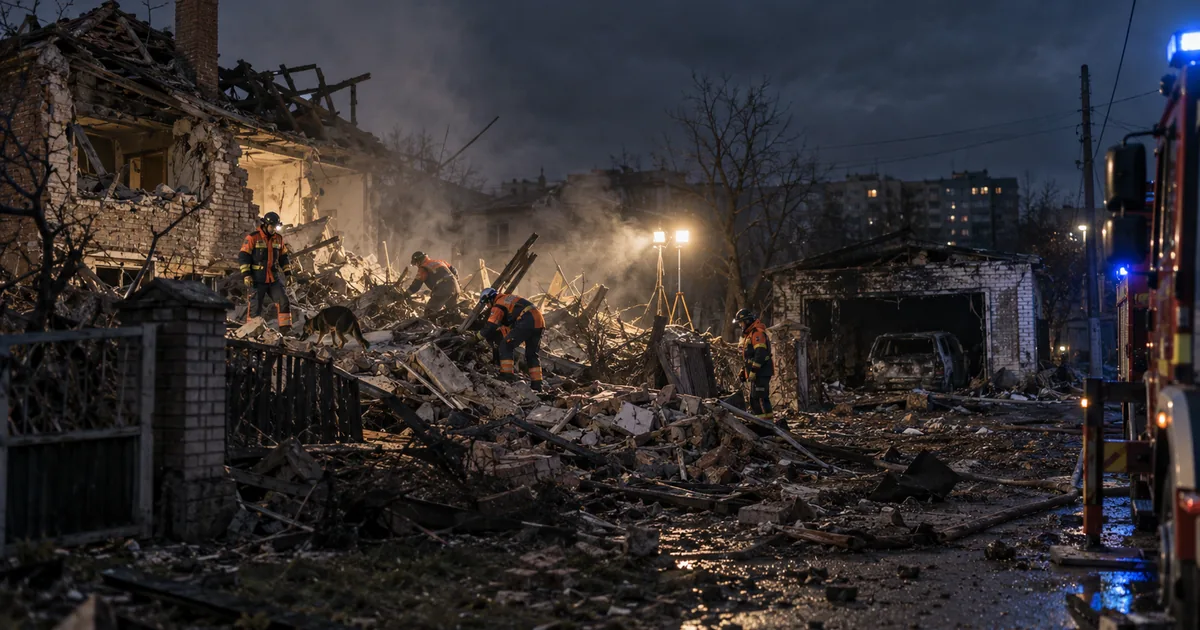
- In Kamianske, in the Dnipropetrovsk region, a ballistic missile hit an industrial enterprise. RFE/RL counted five people killed and five wounded there.
- In Chuhuiv, in the Kharkiv region, a jet-powered Geran-4 drone destroyed a house in the city center. The Kyiv Independent reported that the strike killed nearly an entire family: a 45-year-old man and two children, a 19-year-old woman and an 11-year-old boy. Rescue crews pulled all three from the rubble.
- In Zaporizhzhia, drones hit several buildings including a high-rise, wounding more than a dozen people.
- In Khmelnytskyi, drone debris fell on a three-story building and wounded seven, one of them a minor.
- In Mykolaiv, jet-powered Shahed drones struck an Epicenter store and wounded a 72-year-old man and a 17-year-old girl.
Overnight, Russia sent roughly 167 drones, about half of them jet-powered, alongside Iskander-M ballistic missiles. Ukrainian air defenses shot down or suppressed 128 of them. Those are not the numbers of a country winding anything down.
Then there is the detail that should have led more of Saturday’s coverage than it did. Before the pause began, Russia struck Kyiv’s Zhulyany and Boryspil airports, the two runways an American delegation would plausibly use. Volodymyr Zelenskyy said out loud what that looked like, telling reporters that these Russian strikes on the airports are a reaction to the discussions and the preparations for the American side to fly in. Moscow bombed the airports, then promised not to bomb the city around them. Both of those are messages, and they are the same message.
Three Hours, and No New Ideas
Witkoff and Kushner met Putin at the Kremlin for more than three hours on Saturday, finishing close to 11 p.m. Moscow time. Nothing was announced. Peskov, the same spokesman who delivered the pause, said afterward that there had been no talk of new ideas for ending the conflict. Putin himself described the situation as “not simple.”
The most revealing line came from Kremlin aide Yuri Ushakov, who called the talks constructive and said they had covered economic issues and, in his phrasing, potentially large, mutually beneficial joint projects.
A meeting convened to end the largest land war in Europe since 1945 produced a Kremlin readout foregrounding joint business projects.
That is worth sitting with. Ushakov chose what to put in front of the cameras, and he chose economic cooperation and commercial upside rather than territory, security guarantees or a single word about the eight people killed that day. The Kremlin is negotiating for the thing it actually wants, and it is not a line on a map in the Donbas.
Zelenskyy, for his part, matched the gesture and named its limits in the same breath, saying that Ukraine is ready to refrain from strikes on Moscow, and we expect the Russians to do the same regarding Kyiv. Note the asymmetry buried in that sentence. Ukraine paused strikes on a capital it rarely reaches. Russia paused strikes on a capital it hits most weeks.
Kyiv Has Been Here Before
Short pauses in this war have a track record, and it is not a good one. In May, a three-day ceasefire brokered with Washington’s involvement buckled on its second day as both sides traded strikes. Three days is not a peace framework. It is the length of a visit.
There is also a reason Kyiv specifically is the currency Moscow chose to spend. Ukraine’s ability to defend the capital has been degrading for months, because the Patriot interceptors that stop ballistic missiles are the one thing its partners have not replaced fast enough. In August, Russia killed 17 people around Kyiv using the single weapon Ukraine can no longer reliably intercept. Putin is not giving up leverage by pausing strikes on Kyiv for three days. He is demonstrating that he owns the switch, and that he can turn it off and on around a diplomatic calendar.
What This Should Have Been Called
Our read: reporting this as a ceasefire, without the map, does the Kremlin’s framing work for it. Moscow gave up nothing it wanted, conceded no territory, offered no timetable and did not stop the war for a single hour anywhere outside one city. In exchange it bought three days of headlines containing the word ceasefire, on the weekend it most needed them.
The honest description is narrower and more useful to a reader: Russia has guaranteed the airspace over the city where American negotiators will be working, and has continued the war everywhere else. If Putin wants to signal that he is serious about ending this, the instrument for that already exists and it is not geographically clever. It is a nationwide halt, and he has not ordered one.
Witkoff and Kushner are due in Kyiv on Sunday, their first visit to the Ukrainian capital. The test of whether Saturday meant anything is not what gets said there. It is what happens on Tuesday, when the 72 hours expire and the only thing standing between Kyiv and the next Iskander is whether Moscow still finds a pause useful.