
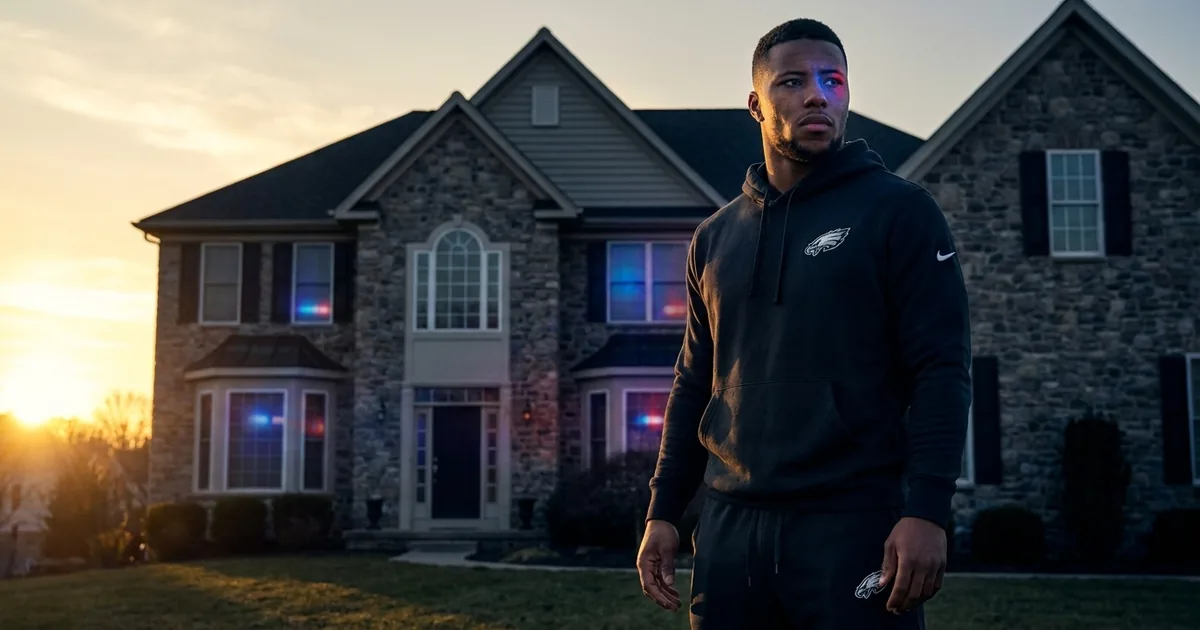
Philadelphia Eagles All-Pro running back Saquon Barkley and his family were inside their Chester County, Pennsylvania home when multiple suspects broke in at 5 a.m.
Saturday, the Chester County District Attorney’s office confirmed. No one was injured, but the invasion fits a pattern that federal prosecutors have tied to an organized transnational theft ring, and it raises a question the NFL and its security apparatus have failed to answer: why are the homes of the league’s biggest stars still this easy to hit?
What Happened in Malvern
Tredyffrin Township police responded to Barkley’s residence in the Malvern area of Chester County early Saturday morning after the family reported a break-in, NBC News reported. Multiple suspects were involved, though only one entered the home. The suspects fled before officers arrived, and investigators told reporters they believe nothing was taken from the residence.
Police are searching for a large white SUV, described as a GMC Yukon, that may have been involved. Local law enforcement is working alongside federal agencies to determine whether the break-in is connected to a broader pattern of athlete-targeted burglaries that has rattled the league for more than two years.
Barkley’s family, including young children, was home at the time. The Chester County DA’s office confirmed to NBC Philadelphia that all occupants were physically unharmed but “obviously a little unsettled.”
A Pattern That Federal Prosecutors Already Named
This is not an isolated break-in. It lands in a documented pattern of home invasions targeting professional athletes that federal prosecutors formally charged in 2025, linking a South American theft ring to burglaries at the homes of Kansas City Chiefs quarterback Patrick Mahomes, Chiefs tight end Travis Kelce, and Cincinnati Bengals quarterback Joe Burrow.
The playbook is remarkably consistent: the ring exploits the public visibility of professional athletes, whose game schedules, travel patterns, and home locations are either publicly available or trivially discoverable. They case the residences, wait for game days or road trips, and move in fast. The fact that Barkley’s family was home when the suspects arrived Saturday suggests either a miscalculation in timing or a brazenness that marks an escalation from the earlier pattern, where targets were typically away.
Police have not confirmed a direct connection between Saturday’s invasion and the previously charged ring. But the operational similarities (multiple suspects, a pre-dawn entry window, a large SUV staged for rapid exit) are difficult to ignore, and federal involvement in the investigation signals that authorities are treating the link seriously.
The NFL’s Security Gap
The league and its players’ association have spent billions on stadium security, broadcast rights protection, and brand management. What they have not done, at least not visibly, is build a systematic security infrastructure for player residences that matches the threat environment.
Individual players are left to arrange their own home security, a patchwork approach that creates exactly the kind of inconsistency an organized ring exploits. Some players invest in full residential security systems with monitored cameras and hardened entry points. Others, particularly younger players or those new to a city after a trade or free-agency signing, do not. Barkley signed a three-year, $37.75 million contract with the Eagles in March 2024 and relocated from the New York area, the kind of transition period that can leave a home’s security posture incomplete.
The broader pattern of organized criminal operations targeting high-profile individuals underscores how sophisticated networks exploit gaps between institutional resources and individual vulnerability. In this case, the gap is between the NFL’s enormous institutional wealth and the fact that its most valuable assets go home every night to houses protected by whatever they personally arranged.
What Comes Next
The investigation is active, with Tredyffrin Township police leading locally and federal agencies involved. The white GMC Yukon is the primary lead. No arrests have been made.
For Barkley, the immediate concern is his family’s safety. For the league, the question is whether this latest incident, targeting one of the NFL’s most visible players while his family slept, finally forces a systemic response rather than another round of individual advisories telling players to “be vigilant.”
The athlete burglary ring charged in 2025 demonstrated that this is not random crime. It is targeted, organized, and transnational. Saturday’s break-in in Chester County is a data point that suggests the problem is getting worse, not better, and that the current approach of leaving residential security to individual players is not working.
The Barkley family is safe. The question is who is next.