
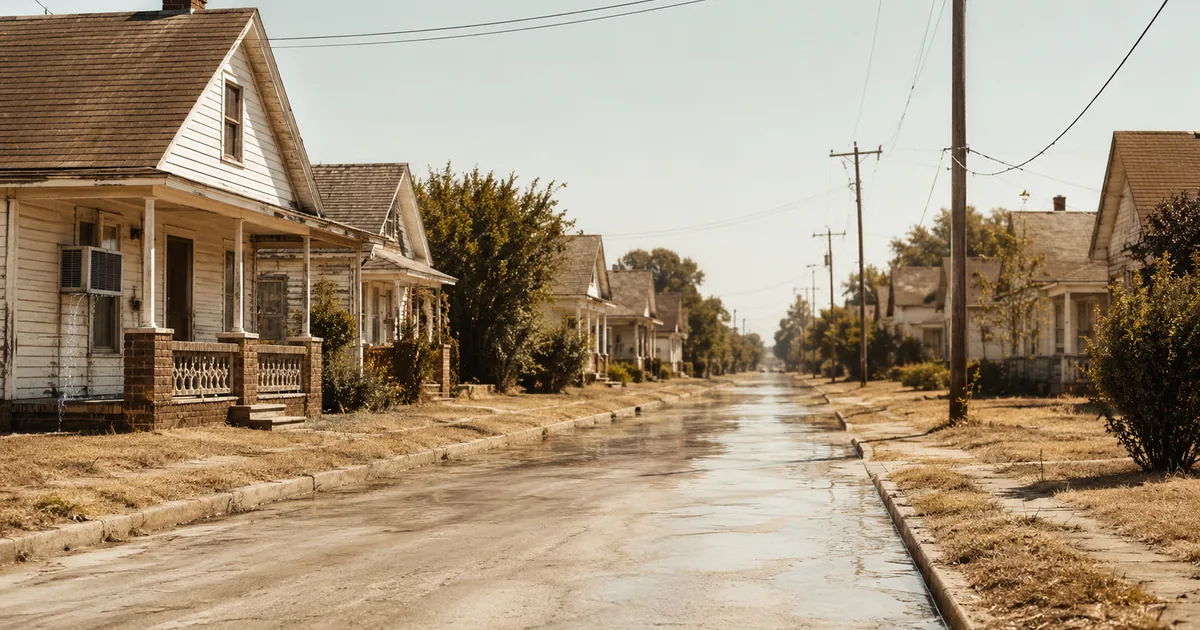
Roughly 60 million people across the South woke up Tuesday under heat advisories and extreme heat warnings, with Oklahoma City forecast to break a temperature record that has stood since 1918 and North Texas facing air temperatures near 108 degrees. This is the third heat dome to park over the country this summer, and the federal government still has no legal authority to treat any of it as a disaster.
That second sentence is the story. The first one is just August now.
What the Forecast Actually Says
The numbers this week are not abstractions. Weather.com’s regional outlook has dozens of records falling across the South, with the dome locked in place from Texas through the Carolinas and no meaningful overnight relief, which is the variable that actually kills people. Heat indices have climbed past 110 in southern Georgia, coastal South Carolina, the Florida Panhandle and the Memphis area.
In Oklahoma City, forecasters expect around 106 degrees against a record of 104 set in 1918. Dallas and Fort Worth hit 106 on Monday, matching the hottest reading of the year in the metroplex, and an extreme heat warning runs from noon to 8 p.m. Tuesday with some locations expected to reach 108. Charleston is forecast to touch 100 with a feels-like temperature of 112.
None of this is a surprise to anyone who watched July. The contiguous United States just recorded its hottest month on record, averaging 76.89 degrees across the Lower 48 and edging past the Dust Bowl benchmark of July 1936. When the summer’s second dome sat on 80 million people in the central states, the pattern was already legible: not one freak event, but a season that keeps reloading.
The Deadliest Weather in the Country, and the Least Legible to Washington
Extreme heat kills roughly 2,000 Americans a year, according to figures the Centers for Disease Control and Prevention compiles. That is more than double the toll from flooding, the next deadliest weather hazard, and it exceeds tornadoes, hurricanes and lightning combined. The recorded totals have been climbing: 2,415 deaths in 2023, 2,394 in 2024. Another 70,000 people land in emergency rooms annually and about 10,000 are hospitalized.
Researchers consider all of those numbers undercounts, because heat rarely appears on a death certificate. It shows up as a cardiac event in a 72-year-old with an air conditioner they could not afford to run, or as a fall, or as kidney failure in a roofer. The cause of death is written down as the thing heat did to a body, not as heat.
Here is the part that should be a bigger scandal than it is. Extreme heat is not listed in the Stafford Act, the statute that gives the Federal Emergency Management Agency its authority to respond to major disasters. A governor can request a declaration after a hurricane, a flood, an earthquake or a wildfire. There is no equivalent path for a heat emergency, which means no federal cost-share for cooling centers, no reimbursement for the utility bills of people who cannot pay them, and no disaster designation for the deadliest weather the country experiences.
So the response falls to cities and counties, funded out of general revenue, improvised each summer. Some open libraries as cooling centers. Some run bus routes to them. Some do neither, because a county with a $40,000 emergency budget cannot staff a building for eleven days. The result is a hazard that kills more Americans than any other kind of weather and is managed almost entirely at the level of government with the least money.
Why Overnight Temperatures Are the Number to Watch
The forecast detail that gets buried in every heat story is the overnight low, and it is the one that determines who dies. A body can tolerate a brutal afternoon if it gets to shed heat after dark. When the low stalls in the upper 70s or low 80s for consecutive nights, the recovery window closes, core temperature ratchets up night over night, and cardiovascular strain compounds in exactly the populations with the least margin.
That is what a dome does that a hot day does not. It is a high-pressure lid that suppresses convection, blocks cloud cover, and traps outgoing radiation, so the ground never gets to dump its heat. Duration is the weapon.
It is also why the standard advice about hydration and shade is necessary but insufficient. The people who die in heat waves are disproportionately older, poorer, living alone, and often in housing with no functioning cooling. What they need is not a public service announcement. It is a working air conditioner and someone knocking on the door on day four. Knowing what to do in the first minutes of a suspected heat stroke matters enormously, and it is still triage on the back end of a policy failure.
The Season Is the Signal
One dome is weather. Three consecutive domes, a record-hot July, and 32 states with records in play is a climate pattern being processed by disaster machinery designed for discrete events with a beginning and an end.
The Stafford Act was written for the flood that crests and recedes. Heat does not crest. It sits, for a week or two, over a region the size of Western Europe, and it kills quietly enough that no one shows up with a camera crew. Fixing that requires Congress to add extreme heat to the statute, which has been proposed repeatedly and has gone nowhere.
Until then the forecast will keep saying 108, and the federal response will keep being a website with tips on it.