
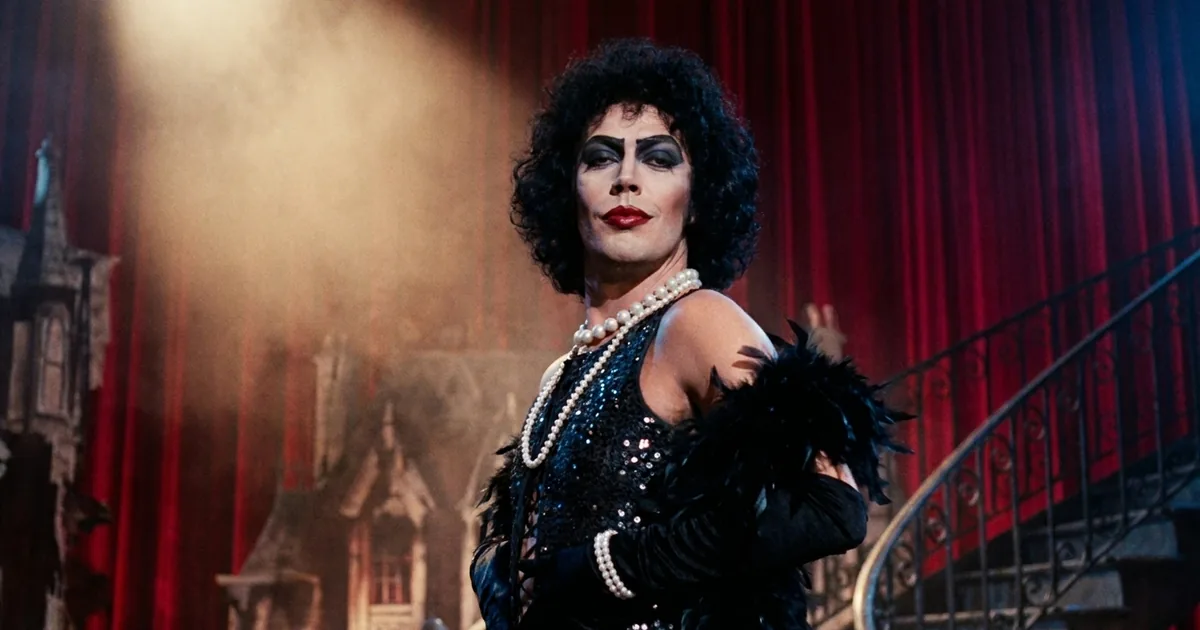
Tim Curry, who died at his North Hollywood home late Tuesday night at the age of 80, built the most famous performance of his career out of a corset, a strut, and a chin tilted up at the balcony.
A stroke in July 2012 took all of that away from him, and he went on working for another fourteen years regardless.
Los Angeles police responded to the house shortly after 11 p.m. Tuesday and no foul play is suspected. His manager confirmed the death, CBS News reported on Wednesday. A cause has not been released.
The Instrument Was Always the Body
Curry originated Dr. Frank-N-Furter in the London stage production of The Rocky Horror Show in 1973, three years before the film adaptation turned a modest cult musical into a ritual that has never actually stopped running. What made the performance land was not the singing, though he could sing. It was the physical argument he made: the entrance in the elevator, the cape thrown back, the deliberate slowness of a man who knows the room is already his.
That was the through line. Rooster Hannigan in Annie in 1982 was a body part first, all shoulders and slouch. Darkness in Legend in 1985 buried him under hours of prosthetics and still read as him, because the walk survived the makeup. Wadsworth in Clue the same year is essentially a sustained feat of choreography, a butler sprinting through a mansion re-enacting three murders without dropping a syllable. Even Pennywise in the 1990 miniseries adaptation of Stephen King’s It, the role that quietly ruined a generation’s relationship with storm drains, worked because of what he did with his face between lines rather than the lines themselves.
He was the oily concierge in Home Alone 2: Lost in New York in 1992, sharing a film with the pigeon lady played by Brenda Fricker, who died in July. He was Cardinal Richelieu in The Three Musketeers in 1993 and Long John Silver in Muppet Treasure Island in 1996, a performance calibrated so precisely against felt co-stars that it remains the reference for how to play opposite a puppet without condescending to it.
What July 2012 Took
The stroke happened on a massage table. Curry told the story himself more than once, and the version he gave TODAY is characteristically undramatic about the most consequential event of his life.
I was having a massage at the time and I didn’t even actually notice anything, but the guy who was doing the massage said, “I’m worried about you, I want to call an ambulance.”
It required brain surgery. He used a wheelchair for the rest of his life and never regained the ability to walk. For a performer whose entire vocabulary was gesture and movement and physical timing, this was not a health setback that happened alongside a career. It was the removal of the instrument.
What is remarkable is how little he pretended otherwise. At the Academy Museum of Motion Pictures on 26 September 2025, reunited with Patricia Quinn, Barry Bostwick, Nell Campbell and producer Lou Adler for the film’s 50th anniversary, he addressed it directly and then made a joke of it. CNN found his wry humor on full display that night, which was standard operating procedure.
I still can’t walk, which is why I’m in this silly chair, and that’s very limiting. So I won’t be singing and I won’t be dancing very soon.
The Half of the Career That Could Not Be Taken
Here is the part the obituaries are underplaying. Curry did not retire in 2012. He moved into the one register the stroke had left alone and worked there for over a decade.
He voiced Chancellor Palpatine in Star Wars: The Clone Wars from 2012 to 2014, taking over a role that is nothing but vocal menace, the exact skill the stroke had spared. He narrated audiobooks. He returned to Rocky Horror in 2016 as the Criminologist in Fox’s The Rocky Horror Picture Show: Let’s Do the Time Warp Again, seated, narrating the story he had once performed on his feet, which is either bleak or triumphant depending on how you want to read it. In 2024 he appeared in the horror film Stream, his first feature since the stroke. His memoir, Vagabond, was published in October 2025.
There is a version of this obituary that treats the last fourteen years as an epilogue. That version is wrong. Voice work was not a consolation prize he accepted after the real career ended. It was where his only competitive award had come from in the first place.
The Record Is Narrower Than the Wire Copy Says
The syndicated obituary that moved across American local stations on Wednesday morning credits Curry with multiple Emmy, Grammy, and Tony Awards over his decades-long career. That is not accurate, and the actual record is more interesting.
Curry won exactly one competitive major award: a Daytime Emmy in 1991, for Outstanding Performer in a Children’s Series, for voicing Captain Hook in Peter Pan and the Pirates. As BroadwayWorld noted in its own obituary, he was nominated for three Tony Awards and won none of them, for Amadeus in 1981, My Favorite Year in 1993, and Spamalot in 2005. He was nominated for a Grammy in 2002, for a children’s spoken-word recording of A Series of Unfortunate Events: The Bad Beginning, and did not win. Two Olivier nominations, no wins.
So the establishment’s single formal endorsement of Tim Curry, across fifty-odd years, was for playing a cartoon pirate on Saturday morning television. It is hard to construct a cleaner illustration of the gap between what awards bodies measure and what actually lodges in the culture. Three generations can do the Time Warp. The Tony went to somebody else all three times.
What Actually Survives
Curry never married and had no children. What he leaves is stranger and more durable than an estate: a character that midnight audiences have been performing in costume, in person, continuously, for fifty years, in rooms where the film is less a movie than an excuse to assemble.
He told The Hollywood Reporter at that anniversary that the film’s message, don’t dream it, be it, was the important part, and that he was proud the movie gave anyone permission to behave as badly as they really wanted. Coming from a man who had spent thirteen years at that point unable to stand up, delivering the line to a room that had come specifically to watch him be it, that is not a greeting-card sentiment. It is a working instruction from someone who had to find out whether it held up after the dreaming got considerably harder.
It held up. He kept going to work.