
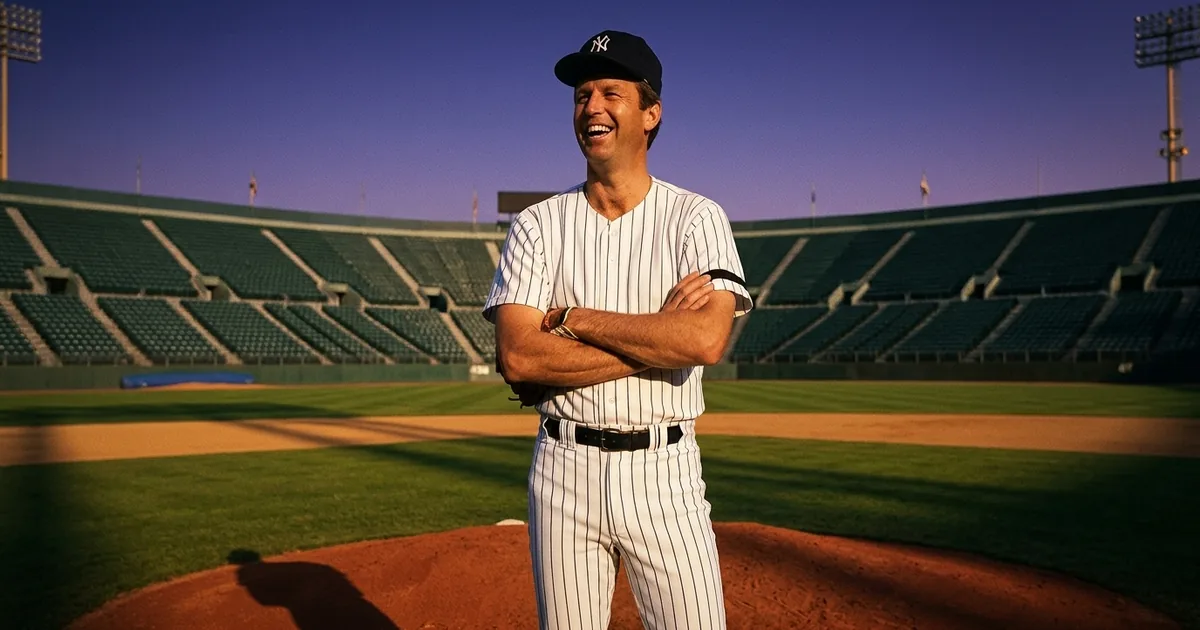
Tommy John died Saturday at his home in Bradenton, Florida, at 83, and the first line of almost every obituary was not about the 288 games he won. It was about the surgery, which is exactly the outcome a 31-year-old left-hander with a shredded elbow would have found absurd in 1974, when the procedure had no name because nobody had ever done it.
He was pitching for the Dodgers that July when the ulnar collateral ligament in his throwing elbow gave out. At the time that was the end of a career, not a setback. MLB’s own obituary recounts what happened next: Dr. Frank Jobe proposed harvesting a tendon from elsewhere in John’s body and weaving it through drilled holes in the elbow to replace the ligament. Jobe put the odds of success at 1 in 100 and told him so. John took it, because the alternative was retirement at 31.
He missed all of 1975. He came back in 1976 and pitched until 1989, retiring at 46.
The Numbers Still Read as Implausible
The career splits are the part that never stops being strange. John won more games after the operation than before it, and it is not close.
- 124 wins before the surgery, 164 after
- 288 career wins against 231 losses across 26 seasons
- 2,245 strikeouts
- Four All-Star selections
- Second-most wins of any pitcher since 1900 who is not in the Hall of Fame
That last one is a genuine grievance, and ESPN’s obituary lays out how thoroughly the voters passed on him. Fifteen years on the writers’ ballot, never elected. Veterans committee reconsiderations in 2011, 2014, 2018 and 2020, and no plaque from any of them. The standard argument against him is that he was a compiler, a sinkerball pitcher who was very good for a very long time rather than dominant in any given stretch. The standard argument for him is that he pitched twenty-six seasons on a rebuilt elbow and beat a 1 percent projection by a decade and a half, and that if the Hall is a museum of the sport’s history rather than a leaderboard, the man who proved the operation works has a reasonable claim to a room in it.
John himself was generous about the naming, and slightly bemused by it. Jobe did the thinking and John supplied the elbow, but the procedure is called Tommy John surgery, and after fifty years there is no dislodging that. NPR noted that the surgery saved his career before it saved anyone else’s, which is the detail that gets lost when the phrase becomes shorthand. He was the experiment. The odds he accepted were the odds of a man with nothing left to protect.
The Part of the Legacy Nobody Wanted
Here is what has happened to his name since, and it is not a tribute.
Ulnar collateral ligament reconstruction was invented as a rescue for a professional athlete at the end of his rope. It has become something closer to an expected stage of development in American youth baseball. A 2025 clinical review found that athletes under 18 account for nearly a third of all Tommy John surgeries at some major orthopedic centers, a distribution that would have been unthinkable when Jobe was drilling holes in a 31-year-old’s elbow. Columbia University’s medical center has tracked the same shift among adolescent throwers, and the ligament injury rate in youth sports now runs roughly ten times what it was in 2000.
The mechanism is not mysterious and it is not medical. It is economic. Year-round travel ball replaced seasonal play. Showcase circuits made radar-gun velocity the single legible metric a fourteen-year-old can present to a college recruiter, and velocity is precisely the input that loads the elbow. Sports Illustrated was writing about this feedback loop a decade ago, and the trend has continued through every awareness campaign and pitch-count guideline aimed at it, because guidelines are advisory and scholarships are not.
Then there is the folk belief, which is the genuinely dark part. Some players and some parents have come to treat the surgery as an upgrade, on the theory that pitchers throw harder afterward. They mostly do not. What happens is that a pitcher who was hurt and losing velocity gets repaired and returns to his own prior form, and the before-and-after comparison flatters the scalpel. John’s own case is the origin of the myth and the worst possible evidence for it, because his post-surgery career was built on a sinker, control and durability rather than raw arm speed.
An operation designed to rescue a career now gets performed on children who have not yet had one. That is not a failure of the surgery. It is a failure of every incentive layered on top of it, and it accelerated for fifty years while the man whose name is on the thing watched from the other end of it.
What the Name Actually Marks
There is a version of this obituary that treats the surgery as an unambiguous gift to the sport, and that version is mostly right. Hundreds of pitchers who would have been finished at 25 have had full careers. The 1-in-100 estimate turned out to be spectacularly conservative, and it turned out that way because one man agreed to find out.
But a name that attaches to a medical procedure stops belonging to the person. It belongs to whatever the procedure becomes. Tommy John the pitcher was a four-time All-Star with 288 wins and a Hall of Fame case that never quite landed. Tommy John the phrase is now something a high school sophomore says to explain why he is in a sling in March.
He earned the first one. He had no say in the second.