
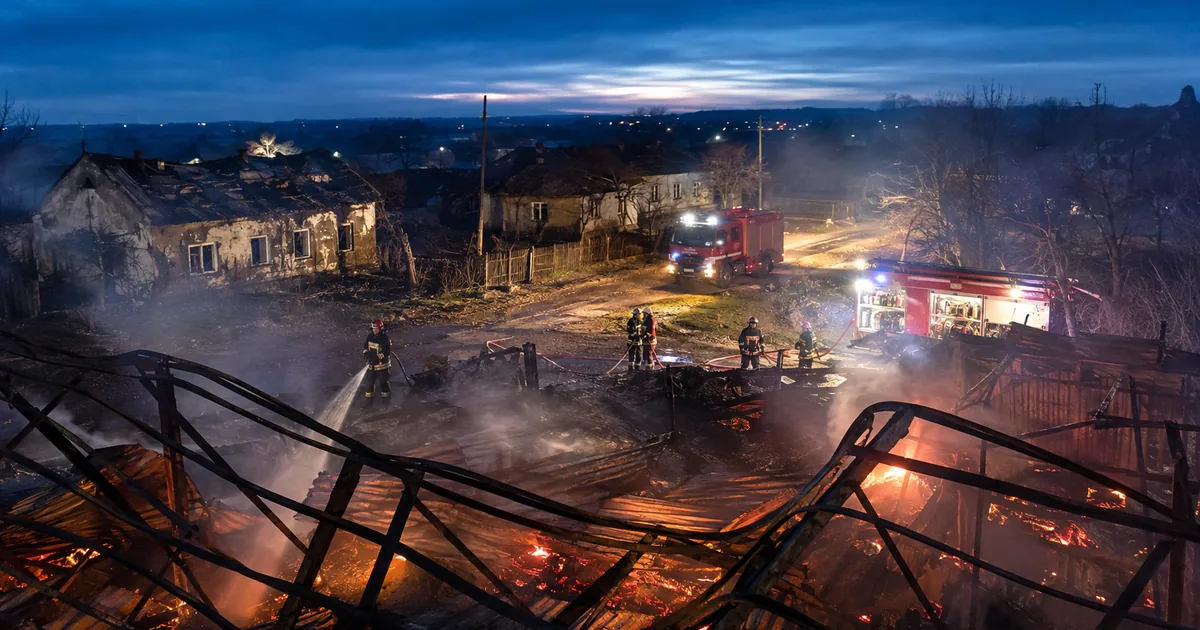
A Russian drone struck a warehouse in the village of Myla, about 22 miles west of Kyiv, shortly after 8pm on Friday.
By Saturday morning at least 27 people were dead, and Ukraine’s Prosecutor General’s Office had opened a criminal case that is not aimed at Russia.
Almost every account of this attack leads with the drone, the death toll and the evacuation. All of that is true, and none of it answers the question sitting in the middle of the story: why this single strike killed 27 people on a night when Russia put 267 drones and missiles into the air across the entire country. The drone was the trigger. What did most of the killing was whatever was stored inside that building, and Ukraine’s own prosecutors spent Saturday morning asking whether it was legally there.
What the Prosecutors Are Actually Asking
The Prosecutor General’s Office said its pre-trial investigation will cover the legality of storing explosive materials at the site, the availability of the necessary permits and approvals, and the actions of officials.
Take that apart, because each clause is a separate accusation waiting to land. Explosive material was on the site. Whether it was permitted to be there is open. Whether the company held the approvals is open. And “the actions of officials” is prosecutorial language for the possibility that somebody signed off on it.
The enterprise has not been named, and we are not going to guess. The obvious guess, given what happened outside Kyiv in July, is a state defense firm, and an obvious guess printed as a fact is how a real accountability story turns into a correction three days later.
The Numbers Are Still Moving
Tymur Tkachenko, who heads the Kyiv Oblast Military Administration, gave the toll as 27 and said the figure may not be final. Euronews reported 42 injured, four of them children, and 381 people evacuated overnight. Fire spread from the warehouse into five private houses and a catering business. Roughly 50 residential buildings were damaged. A stretch of the M-06 Kyiv-Chop highway was closed between the 15th and 32nd kilometer markers while crews worked the site, because the explosions kept going after the drone was long gone.
President Volodymyr Zelensky described the sequence in seven words that contain the whole story.
A warehouse was struck, followed by a detonation.
He went on to say the surrounding infrastructure had suffered significant damage, and named what was hit: residential buildings, and a care home for elderly people and people with disabilities. A care home, next to a building that Ukraine’s own prosecutors now suspect was holding explosives without the right paperwork.
This is the second mass-casualty attack on the Kyiv region this month. Three weeks ago Russia killed 17 people around the capital with ballistic missiles Ukraine’s thinning interceptor stock could not reach. That one was a straightforward story about air defense. This one is not.
Seven Weeks Ago the Same Sequence Killed Seven
Here is what turns a tragedy into a pattern. On 6 July, a Russian strike hit an ammunition depot operated by Ukroboronprom in Vyshneve, on Kyiv’s western outskirts. Secondary detonations followed. Seven people died and 29 were injured.
The investigation that followed did not stop at the drone either. Ukraine’s Security Service identified the heads of two state-owned enterprises inside the Ukroboronprom group as primarily responsible for violating ammunition storage rules, and Zelensky said the weapons had been kept somewhere storing them was expressly prohibited, close to civilian housing. A criminal case was opened and dismissals followed; Ukroboronprom removed the two officials who ran those enterprises.
So Ukraine had already run this exact investigation, reached a finding, and fired people over it, seven weeks before Myla.
Prime Minister Serhii Koretskyi, who took the job in July’s government reshuffle, did not soften the comparison. “On the fifth year of the full-scale invasion, making the same mistakes is criminal negligence,” he said, calling for a fast investigation and severe punishment for whoever is responsible.
Where We Stand
Russia fired the drone. Russia chose to aim a weapon at a warehouse in a village where people sleep, and nothing that follows moves an ounce of that off Moscow.
But 27 people did not die because a drone hit a warehouse. They died because a drone hit a warehouse that appears to have been holding explosive material next to houses and a care home, seven weeks after the Ukrainian state established in writing, and with firings, that doing precisely this gets civilians killed. If the permits turn out to be missing, this was not bad luck. It was the predictable end of a decision somebody made and somebody else approved.
The creditable thing here is that Ukraine is the one saying so. The prosecutors opened the file overnight. The Prime Minister used the words “criminal negligence” about his own government’s institutions before the fires were fully out. That is not a state covering for itself, and coverage that stops at the drone is not protecting Ukraine. It is just incomplete, and it lets the part Ukraine can actually control disappear from the story.
What should happen next is not complicated, and Vyshneve already sketched it. Name the enterprise. Publish the permit status. If officials approved explosive storage inside a residential village, say who they are and prosecute them, rather than dismissing two managers and closing the file. Dismissals were the July answer. The July answer did not survive to the end of August.
The Question Nobody Has Answered
There is one thing neither the prosecutors nor the President has addressed, and it decides how big this story becomes: how many other sites look like Myla.
Vyshneve produced a finding about two enterprises. It did not produce a public audit of every place in Ukraine where munitions sit within a few hundred yards of somebody’s kitchen, and if such an audit exists, nobody has released it. Until that number is public, every Russian drone that gets through to a warehouse near Kyiv is a coin flip on whether the building simply burns or takes the street with it, and the people living on the other side of the fence have no way of knowing which side of the fence they are on.