
The headline
“Simple exercise done just once a week could help lower blood pressure.” Fox News, October 27
The paper
“…higher frequencies are required to preserve these benefits.” The researchers, BMJ Open Sport & Exercise Medicine, September 29
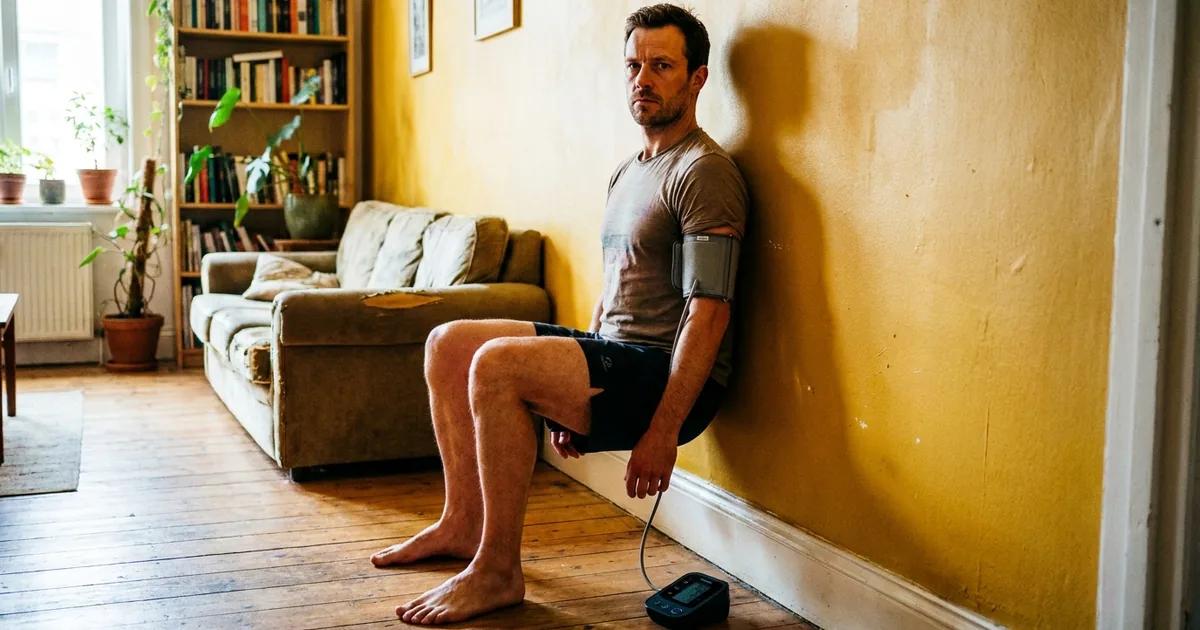
The trial behind the once-a-week headline found something narrower: cutting back from three wall-squat sessions a week to one kept about half of the blood pressure drop for a month. The group that kept training three times a week held its full systolic drop of 13.73 mmHg, while the once-a-week group held 6.56, which is 48 percent of it (6.56 divided by 13.73). Those once-a-week volunteers had already done four weeks at three sessions a week before they were allowed to cut back. The researchers’ own conclusion, quoted in the journal’s press release, is that lower frequencies may be enough to maintain reductions over the short term but that higher frequencies are needed to preserve the full benefit. Readers who see “once a week” and imagine a starting dose have the study backwards.
| Group during weeks 5 to 8 | Systolic change at week 8 vs. start | Share of the three-a-week drop |
|---|---|---|
| Three sessions a week | -13.73 mmHg | 100% |
| Two sessions a week | -6.95 mmHg | 51% |
| One session a week | -6.56 mmHg | 48% |
| Stopped after week 4 | Reverted to levels not significantly different from control | n/a |
The shares in the last column are our arithmetic, each group’s average divided by 13.73. They compare group averages, not individuals, and the press release and the coverage we read report no formal test of one frequency against another.
What the Terms of the Trial Were
The volunteers were 100 adults with an average age of 37.4 and systolic readings between 120 and 140 mmHg, and none had been diagnosed with hypertension. They were not taking blood pressure medication, did not exercise regularly and were randomly split into five groups, one of them a control. The four exercise groups did four wall-squat holds per session, with two minutes of seated recovery between holds, three times a week for four weeks. Then the groups diverged for four more weeks: three sessions, two, one, or none. The follow-up ended at week 8, and the researchers say longer trials are needed to know whether less frequent training holds up over months or years.
We think the honest headline is “Cutting Back to Once a Week Kept About Half the Gain for a Month.” That is useful to someone who found three sessions hard to sustain, and it is not evidence that one session a week lowers high blood pressure, because nobody in the trial had it. Fox News’ own story carries the researchers’ warning that the results cannot automatically be generalized to people with diagnosed hypertension, older adults with mobility limits or patients on heart medication, and a headline that skips that warning is selling a different study. Nobody on blood pressure medication should change it on the strength of a four-week trial of 100 healthy volunteers. If you want what the trial’s best-performing group got, that group trained three times a week.