
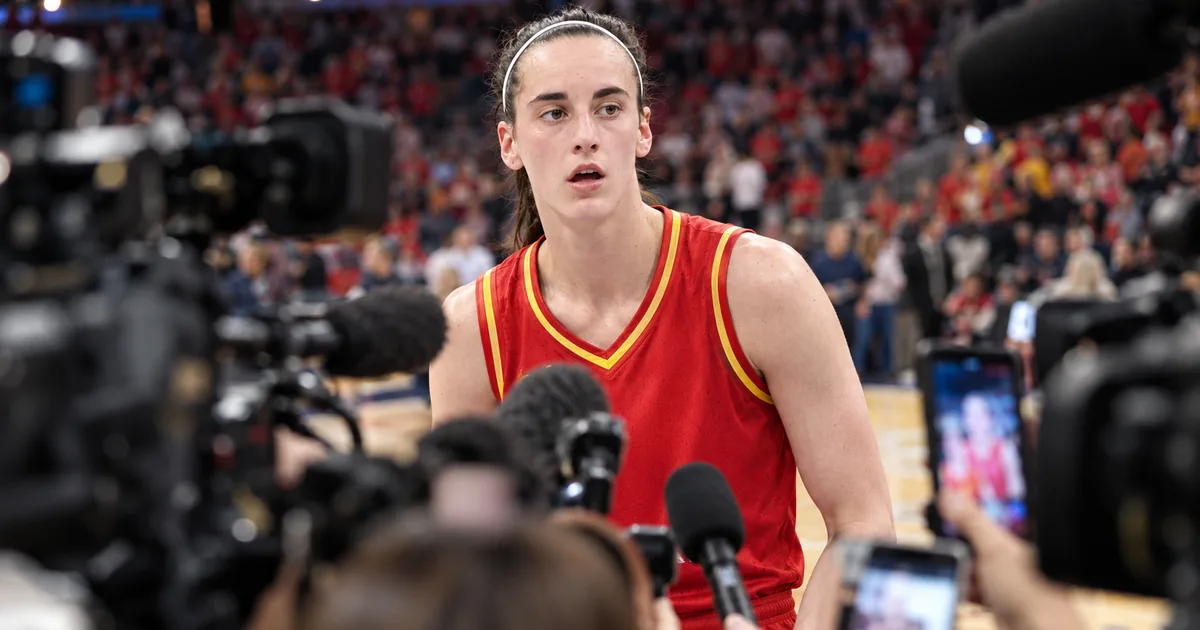
Former ESPN host Cari Champion spent a few minutes on her podcast this week arguing that the WNBA is mishandling Caitlin Clark and that Clark’s fanbase has turned nasty, and the sports internet converted it into a two-day fight.
The headlines have Champion going nuclear, eviscerating, ripping and dropping a reality check, which is a lot of verbs for a take that Clark herself put on the record ten weeks ago.
That is the thing none of the aggregations mention, and it changes what the story is. Search the coverage and you will find a dozen versions of Champion versus Clark versus the fans. You will not find the July press conference where Clark condemned the harassment coming from her own direction, unprompted, by name. The two of them are not actually on opposite sides of this. The disagreement is being manufactured, and the reason it works is that Clark’s name attached to an argument is the most reliable traffic in American sports.
What Champion Actually Said
Strip the verbs out and Champion made three claims on her show, and they are not the same claim.
The first is about officiating. Champion has argued that referees show what she called blatant favoritism toward Clark and that, as Awful Announcing reported, the league is not handling her well. The second is about Clark’s on-court conduct, which Champion framed as entitlement. The third, and the one that drove the headlines, is about the fanbase: that a section of Clark’s following gets furious at any criticism of her, and that the league is trying to balance around it.
The third claim is the only one with real evidence behind it, and it is also the only one Clark agrees with.
The Part the Aggregation Cut
On July 3, after Phoenix’s Alyssa Thomas was suspended for contact to Clark’s throat and then took death threats and racial slurs for it, Clark addressed it directly. She told reporters that the harassment and the hate were not OK, that there should never be a question of anyone’s character over it, and that she did not want anyone to experience it. It was not a statement issued through a publicist. It was the player the abuse was nominally defending saying, plainly, stop.
She has been doing this since her rookie season. In June 2024, when her name first started showing up in culture-war arguments about other players, she told ESPN that people should not be using her name to push those agendas and that it was not acceptable.
So when Champion says the fanbase is a problem, she and Clark are saying the same thing, two years apart, in almost the same words. Presenting that as a confrontation required somebody to leave out the half of the record where they agree. Dozens of outlets did, and not one of them had to lie to do it. They just ran the clip.
“Coddled” Is a Testable Claim
The other two arguments are checkable, and they hold up less well. If a league were bending itself around a single player, you would expect that player to sit at the centre of its individual honours and its offence. Here is where Clark actually is this season:
- She is third in the WNBA in scoring, averaging 22.5 points on 45.6% shooting, and first in the league in assists at 8.4.
- She is not the leading scorer on her own team. Kelsey Mitchell is, at 24.2 points on 50.3% shooting, and Yahoo Sports has the Fever pushing both of them as MVP candidates.
- The MVP is widely expected to go to A’ja Wilson for a fifth time, which would be a league record.
- The Fever are 26-14 and, with Atlanta holding the head-to-head tiebreaker, sit fifth in the bracket rather than fourth.
- Indiana ranks third in home attendance, not first.
A coddled superstar does not finish behind her own teammate in scoring, behind two players in the MVP race, and behind two clubs at the gate. Whatever is happening to Clark, it is not the league arranging the season around her.
Our View
The officiating complaint deserves a real answer and it is not getting one, from Champion or from anybody else, because nobody has done the work. Saying referees favor a player is an empirical claim. It can be tested against foul rates, free throw attempts and drive volume across a full season. Not one of the outlets that ran this story for two days has published that analysis, and several of them employ people who could do it in an afternoon. The sports-media business has decided it is cheaper to relay the accusation and harvest the argument than to settle it.
That is our actual complaint here, and it is not with Champion, who is a commentator doing what commentators do on a show that exists to have opinions on it. It is with the aggregation layer that sits above her: outlets with real newsrooms that treat a podcast clip as an assignment, publish the most heated forty seconds of it, omit the on-record statement that would complicate the framing, and then run a follow-up about the backlash their own coverage generated. That cycle is what feeds the fanbase behaviour everyone claims to be worried about. You do not get to spend two days monetising an argument about Caitlin Clark’s fans and then write the concerned piece about Caitlin Clark’s fans.
The league carries some of this too. The WNBA has never built a communications plan for a player this big, and Champion’s underlying point, that Indiana’s star is being managed by an organisation improvising, is fair. But the improvisation is happening in public because the coverage gives it nowhere to hide.
The Numbers Nobody Was Arguing About
All of this landed in a season that is going extremely well for the league. League attendance is averaging 11,430 a game and up 21% year over year, with 180 sellouts, and Sports Media Watch has viewership running ahead of last year’s pace at about 756,000 a game across the major networks. A Fever game drew 2.58 million on ESPN, the largest WNBA audience ever on cable.
That growth is the actual story of 2026, and it is the one that gets the fewest headlines, because nobody fights about it. The rivalry coverage that ran all summer worked the same way.
Indiana plays Toronto on Friday night with four games left and a seed still in play. If the Fever climb to fourth, the discourse will decide the league finally got out of Clark’s way. If they stay fifth, it will decide the league failed her. The basketball will have happened either way.