
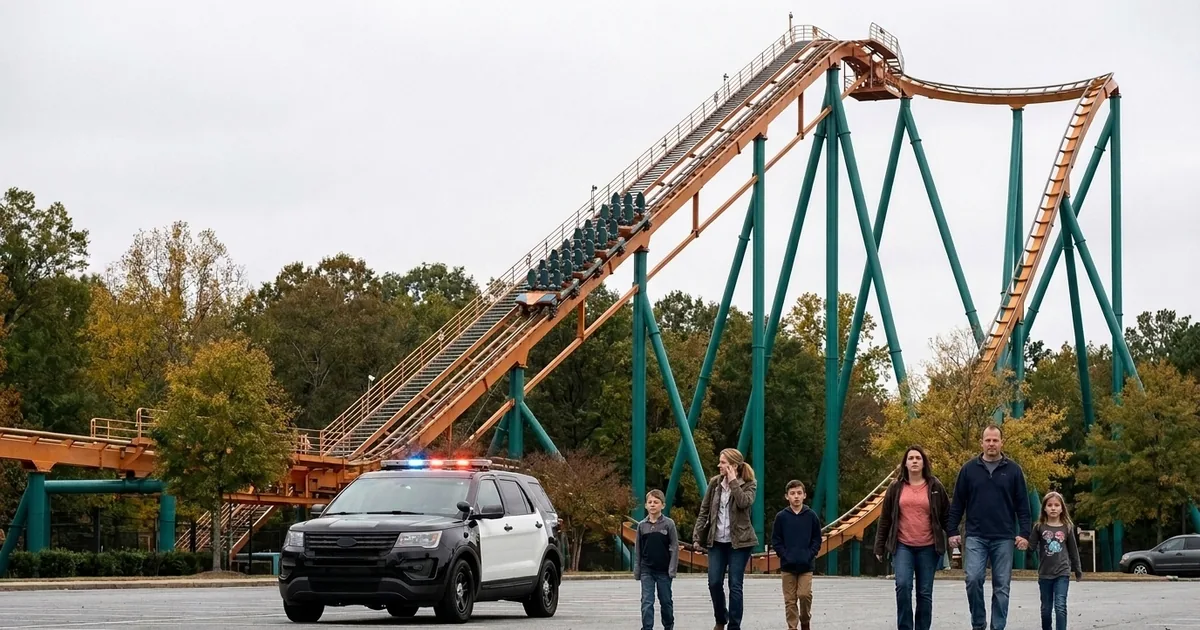
A rider fell from the Goliath roller coaster at Six Flags Over Georgia just before 4 p.m. on Monday, and Cobb County police confirmed that one person died and several others were hurt. Witnesses described the rider as a man; police have not released a name. The people now examining a 200-foot machine that runs at 70 miles per hour are county detectives and inspectors who work for Georgia’s insurance commissioner. No federal safety investigator is on the way, because Congress wrote rides like this one out of federal consumer safety law in 1981 and has never written them back in.
What Georgia said: “Safety inspectors and investigators are on the ground examining the equipment,” Insurance and Safety Fire Commissioner John F. King said Monday.
What nobody said: the Consumer Product Safety Commission can regulate a carnival ride that arrives on a truck. It has no authority over a coaster bolted to the ground.
The emergency call came at about 3:58 p.m. Brittany Landry, who had come in from Winder, was waiting to board the neighboring Georgia Scorcher, about 150 feet away by her own estimate, and said, “I just see somebody fly out and just fly into the woods.” Logan Conner was on the train itself. “The man started levitating in the air sideways,” Conner said. “We made direct eye contact with him.” A train stopped partway up the lift hill and its riders were walked down an emergency stairway, the park was cleared and closed for the day, and the Cobb County Police Department’s Major Crimes Unit took the case. Stalled trains are the coaster failure the country has learned to shrug at: in May, eight students sat for four hours on a stuck coaster at Galveston’s Pleasure Pier before crews got them down. Monday was the other kind. Six Flags answered it with a short statement that called a death on its ride “the guest incident at our park today” and closed by saying that, “out of respect for the family’s privacy,” it would share nothing more.
Start with the machine, because here the machine is the product. Goliath opened in 2006 and was built by the Swiss firm Bolliger & Mabillard. Each train carries 36 people, four across, and each rider is held in by a single padded lap bar, a design the industry calls a clamshell. There is no shoulder harness, and on a hypercoaster that is the selling point: the ride is marketed on a 170-foot first drop, a 175-foot second one and a run of bunny-hop hills built to float riders up against that bar. Nobody has said why this rider came out of the seat. It could be the hardware, the way the train was loaded and checked, the rider, or something medical, and anyone who claims to know tonight is guessing. That is exactly why it matters who gets to find out.
A $65 Inspection and No Federal Backstop
Georgia is one of the states that do inspect. Its rules require the Office of Insurance and Safety Fire Commissioner to examine every stationary ride before it opens to the public and at least once a year after that, for an annual fee of $65 per ride. King’s inspectors were at the park by Monday evening. That is a real program, and it is more than Texas had in July 2013, when a woman fell to her death from the Texas Giant at Six Flags Over Texas and the company led the investigation itself, because no state or federal agency had the job.
A state program stops at the state line, though, and it carries the whole load because of a choice Congress made. Federal law lets the Consumer Product Safety Commission police amusement rides only if they move. Ed Markey, then a House member, laid out the history in the Congressional Record in 2001: after “a series of legal challenges by several owners of large theme parks,” Congress in 1981 limited the commission’s authority to rides “not permanently fixed to a site.” So a carnival ride at the county fair is a federal matter. A 200-foot coaster in Cobb County belongs to whichever office a state legislature handed it to, and in Georgia that is an office named for insurance and fire safety. Markey, now a senator, said this after the Texas death:
“A baby stroller is subject to tougher federal regulation than a roller coaster carrying a child in excess of 100 miles per hour.”
The gap looks wider once you follow the hardware and the owner. Bolliger & Mabillard fits the same clamshell lap bar to every hyper and giga coaster it builds, and those run in parks from Virginia to Ohio. Six Flags runs parks in many states, and on September 29 it said it would permanently retire the X2 coaster at Magic Mountain in California, shut since July 12, amid lawsuits alleging traumatic brain injuries. Each of those rides answers to a different state office. If Georgia’s inspectors find a hardware problem on Goliath, no agency has the power to carry that finding to the next park and order the fix.
What Should Happen Before Goliath Reopens
The fix is a deletion. H.R. 1855, the National Amusement Park Ride Safety Act, strikes the words that exempt permanently fixed rides from the Consumer Product Safety Act and authorizes $11.5 million a year for the commission’s ride work. Rep. André Carson of Indiana introduced it in March 2025. It went to the House Energy and Commerce Committee and has not become law.
We think the exemption is indefensible. A machine that takes 36 people 200 feet up at a time should not sit outside the reach of the country’s consumer safety regulator because theme park owners won a fight in 1981.
Congress should pass the bill.
Georgia should publish Goliath’s inspection history and whatever its inspectors find.
Six Flags should keep the ride closed until the state signs off in public. Privacy protects a family’s name. A maintenance log has no such claim.
Cobb County’s detectives will work out how the rider died. Whether it can happen at the next park is, tonight, nobody’s job.