
Democrat Scott Colom led Republican Sen. Cindy Hyde-Smith by 1,138 votes in Mississippi’s Senate race as of Thursday morning, with about 96 percent of the vote counted and no call from the Associated Press. The 3,600 mail ballots still outstanding cannot erase that lead unless Hyde-Smith wins them about two to one, so the seat now turns on a stack of affidavit ballots nobody has sized, in a state with no recount law.
The claims
Hyde-Smith told supporters on election night: “I assure you, I will continue to be your U.S. Senator.”
Colom, early Wednesday: “I am confident we will ultimately flip this seat.”
The count
Colom 464,926 (49.0%). Hyde-Smith 463,788 (48.9%). Ty Pinkins 19,934 (2.1%). That is a lead of 1,138, about 0.12 percent of the 948,648 votes counted for the three candidates, in the AP tally from Wednesday evening. It was unchanged Thursday morning, when the Mississippi Free Press liveblog showed Decision Desk HQ at 1,818. The certified count will settle which scorekeeper was right.
Democrats have already flipped enough Senate seats to take the chamber, so Mississippi decides the size of the majority, not who holds it. For Mississippi it decides something older. Colom, a 43-year-old district attorney, would be the first Democrat the state has sent to the Senate since 1982 and its first Black senator since Reconstruction, in a state Donald Trump carried with 61 percent of the vote in 2024.
The Mail Ballots Cannot Close This Gap
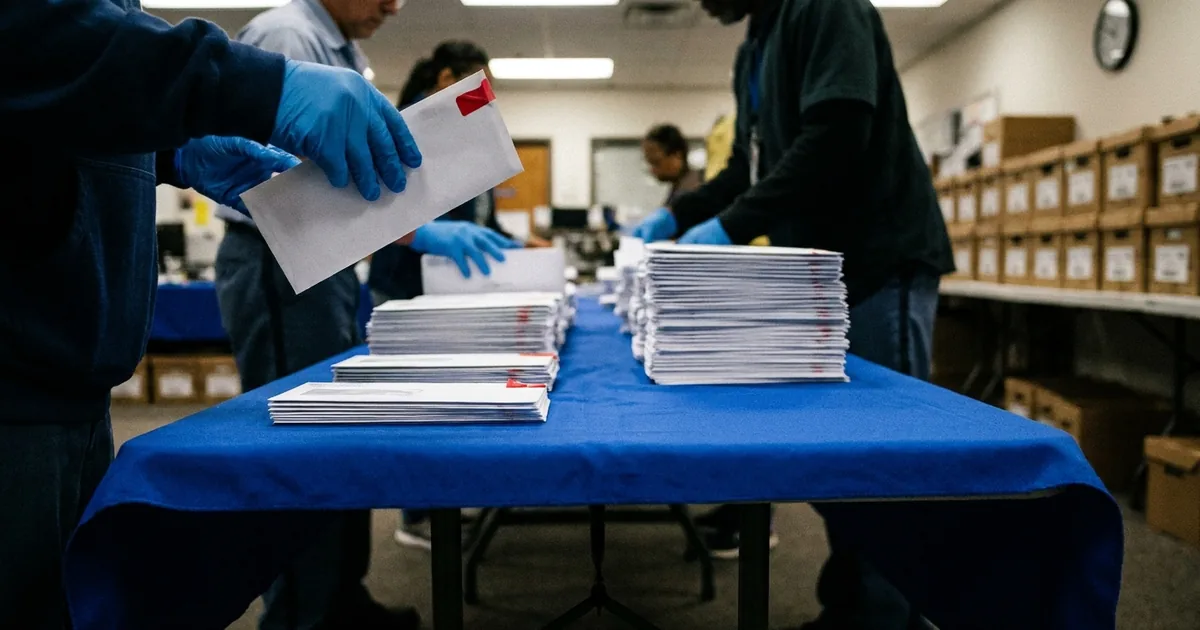
Secretary of State Michael Watson said Wednesday that about 3,600 mail ballots had not come back. Ballots postmarked by Election Day still count if they reach a county clerk by 5 p.m. on Nov. 10. We ran the arithmetic on the AP’s tally, and it is not close. To erase a 1,138-vote lead with 3,600 ballots, Hyde-Smith would have to win 65.8 percent of them, and that assumes every ballot comes back, arrives in time and gets counted. If half arrive, her required share climbs to 81.6 percent. The same math on the affidavit pile gives a very different answer, because that pile is so much bigger.
| Ballots still to count | Where the figure comes from | Hyde-Smith share needed to erase the lead |
|---|---|---|
| 3,600 mail ballots, all counted | Secretary of State Michael Watson, Wednesday | 65.8% |
| 1,800 mail ballots, half arrive | Our assumption | 81.6% |
| 15,000 affidavit ballots, all counted | Colom campaign estimate, unverified | 53.8% |
| 7,500 affidavit ballots, half counted | Our assumption | 57.6% |
Affidavit Ballots Are the Real Unknown
An affidavit ballot is a provisional ballot cast by a voter who lacked acceptable photo ID or did not appear on the rolls. It counts only after election officials verify the voter, and voters without ID have until Nov. 10 to bring it to the circuit clerk. Nobody has published how many there are. The Secretary of State’s office told ABC News it has no definitive number. Colom’s campaign said Tuesday night that about 15,000 could remain, a figure ABC could not verify. Counties began opening them Wednesday, so part of the pile may already sit inside the AP’s number, and no one has said how much.
Tuesday did not run smoothly everywhere. Jackson County Election Commissioner Danny Glaskox said his county ran short of voting equipment and that about 25 extra machines went unused: “We just didn’t have enough equipment out there.” About 9,000 ballots in Hinds County were still uncounted at midday Wednesday, and the Hinds County Commission chair asked residents on Thursday to be patient.
The calendar from here:
- Nov. 10, 5 p.m.: last day for mail ballots postmarked by Election Day to arrive, and the deadline for affidavit voters to show ID.
- Nov. 13: counties send certified results to the Secretary of State.
- Dec. 3: the Secretary of State declares the final result.
- Jan. 3, 2027: the Senate convenes.
A Rule Mississippi Took to the Supreme Court and Won
There are still ballots to wait for because of Watson v. Republican National Committee. The RNC and the Mississippi Republican Party sued to stop the state from counting mail ballots that arrive after Election Day, arguing that federal law sets a receipt deadline. The Fifth Circuit agreed. The Supreme Court reversed 5-4 on June 29, holding that “nothing in the federal election-day statutes requires ballots to be received by election day.” The petitioner on the caption is Michael Watson, Mississippi’s Secretary of State, the same official now reporting how many mail ballots are still due. Our earlier analysis of the 5-4 ruling covers how the majority got there.
Colom has said his side is “prepared to litigate.” Hyde-Smith’s campaign has not said it will challenge any ballot. Campaign manager Jake Monssen said the campaign is monitoring the count and that remaining ballots “must be processed and verified under Mississippi law.” Mail ballots that arrive by Nov. 10 are processed under Mississippi law, and the Supreme Court held in June that federal law does not stop the state from counting them. We think that settles the question for every ballot that meets the deadline. If the margin ends up depending on them, a challenge to those ballots would be a challenge to a ruling that a Republican committee lost, not to the count.
The Senate Is the Only Referee
Mississippi has no recount. The Secretary of State’s office told ABC News that candidates cannot request one and none triggers automatically, and the Mississippi Independent reported that a court can order one. After certification a candidate can ask to examine the ballot boxes and sue if problems turn up, but a University of Mississippi voting-law attorney told NBC News that doing it across 82 counties is “beyond the scope of feasibility.” The state election code has no procedure for contesting a general congressional election, election-law scholar Derek Muller noted, and its contest statutes cover party primaries and county offices.
The Legislature could have written one. Republican Rep. Timmy Ladner filed a mandatory-recount bill in 2024 and again this year. State records show HB 1443 died in committee on March 5, 2024 and HB 1026 died in committee on Feb. 3.
That leaves the Constitution. Article I, Section 5 makes each chamber the “Judge of the Elections, Returns and Qualifications of its own Members.” The Supreme Court held in Roudebush v. Hartke in 1972 that the Senate keeps that power even after a state recount. The closest precedent is New Hampshire in 1974, when the Senate deadlocked for seven months and finally declared the seat vacant. The Senate convenes Jan. 3 and Democrats are set to run it, so the body that would hear a challenge belongs to the party whose candidate leads.
We think the Senate should seat whoever Mississippi certifies on Dec. 3 and leave fights over individual ballots to the courts built for them. A 1974-style stall would punish voters for a Legislature that twice declined to write a recount law. A lead of 1,138 is thin. It is still a lead, and one produced by counting every lawful ballot under rules the Supreme Court has just upheld should not have to survive a Senate vote.
The number to watch is not the next AP update. It is the first official count of affidavit ballots, and how many of them clear verification by Nov. 10. Until then “too close to call” is accurate and incomplete: the mail ballots cannot flip this race, the affidavit pile can, and no one outside the county election offices knows how big it is.