
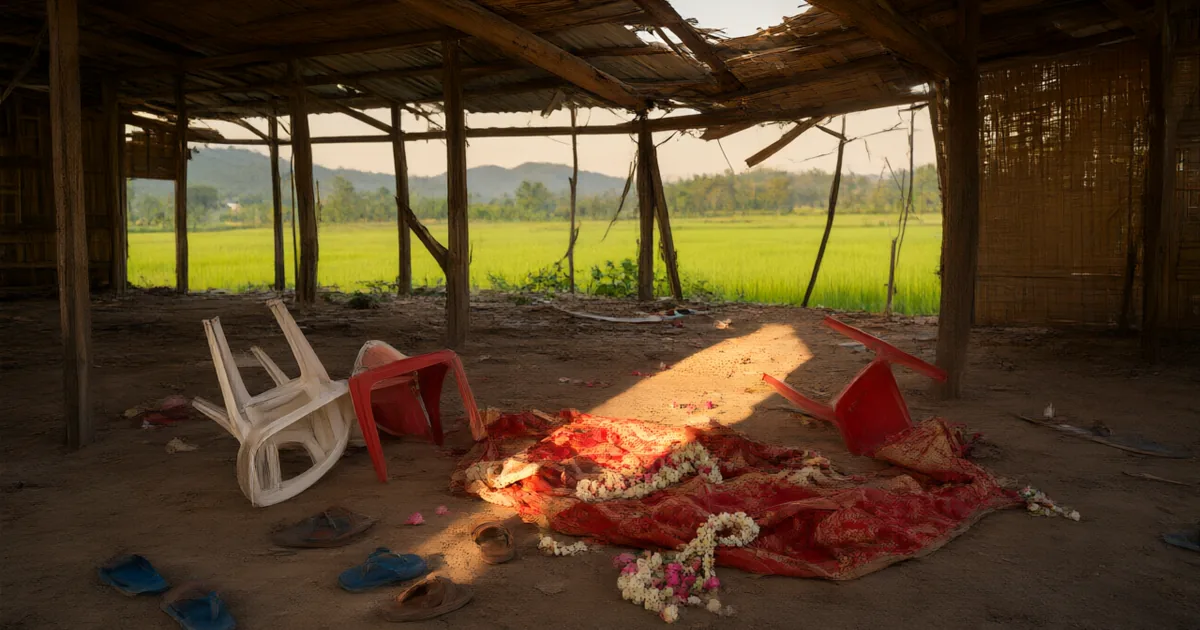
A man in Moe Bye, where many people have already been displaced by the war, heard an aircraft overhead on Saturday afternoon and thought it would not bomb his area. A Myanmar military airstrike then hit a venue where preparations were under way for two displaced people to marry, and rescuers say they have confirmed 21 dead, five of them children, with dozens more wounded.
It was the second mass-casualty strike in three days. On Thursday around 3 p.m., a school and monastery compound in Sinbaungwe township, in Magway region, was hit with four 500-pound bombs, 12 artillery shells and seven suicide drones, according to a joint statement from the opposition National Unity Government and a local rebel administration. The NUG says more than 20 civilians and nine fighters died, and Reuters reported a toll of at least 30 that includes an infant, while saying it could not verify any of the figures. The reports count the dead strike by strike. None of the ones we read sets those counts against the NUG’s own running tally of the air campaign, which Reuters carries without comment, and that tally changes how the two days read.
The military-aligned account
Pro-military Telegram channels said the Thursday strike hit a graduation ceremony and a gathering of rebel forces, following a tip that People’s Defense Forces members were holding a ceremony after training. The military itself had issued no official statement by Saturday afternoon.
The witnesses’ account
A teacher at the school said the dead included four female students, a novice monk and 15 parents who had come to collect their children after hearing the aircraft. A local witness said no clashes were under way. The NUG says nine of the dead were People’s Defense Forces fighters and has not said how they came to be there, beyond saying they were protecting civilians.
The Average Recorded Incident Kills Fewer Than One Civilian
The NUG’s records, as Reuters cites them, count 15,327 airstrikes in 6,653 separate incidents between February 1, 2021 and late October 2026, with 6,467 civilian deaths. We divided them. That is 0.97 civilian deaths per recorded incident, and spread over the roughly 2,100 days in that window it is about three incidents a day. At that average it would take about 42 ordinary incidents to kill as many civilians as the wedding and the school did between Thursday and Saturday, counting 21 at the wedding and the 20-plus civilians the NUG reports at the school. The tally belongs to one side in the war and has not been verified, so treat the arithmetic as scale rather than audit. Even so, it shows what the front-page days are: the heavy tail of a campaign the opposition logs at three incidents every day.
The witness at Moe Bye, who asked not to be named, found 17 bodies and filmed wounded women and children being loaded onto a motorcycle and a pickup truck; his videos could not be independently verified. The head of the Nway Oo Yaung Chi Foundation, which helps displaced people in camps, said a second bomb fell after rescuers arrived. He described the moment he reached the scene.
“I was shocked and didn’t know who to rescue first. But one wounded woman told me to get children out first.”
The International Court of Justice ruled on November 19, by nine votes to six, that Myanmar committed genocide against the Rohingya in its 2017 crackdown, and we reported the verdict when it came down. President Min Aung Hlaing, the general who led the 2021 coup and was installed as a civilian president this year after widely criticized elections, said his government would not comply with “inappropriate” aspects of the ruling, state media reported on Thursday, the day the school was bombed. Nothing in the reporting links the bombs to the verdict, and we do not claim they answer it. The timing does settle whether the ruling has changed anything on the ground: it has not.
We think the sequence shows the limit of what a judgment can do. A court can establish what an army did in 2017. It cannot ground an aircraft in 2026, and under the UN Charter enforcement runs through a Security Council in which any of the five permanent members can block action. The NUG’s statement points at a different lever: it urges the UN, ASEAN and neighbouring countries to halt the flow of aviation fuel, munitions and drone technology to the military. That is the one demand in these reports that reaches the supply side of the bombing, and whether anyone acts on it is a better test of the ruling’s weight than any statement of welcome.
The NUG says it is collecting evidence for future international legal proceedings. Gambia filed its genocide case over the Rohingya in 2019, and the judgment came seven years later. In the nine days since, the wedding and school strikes alone have killed at least 51 people by the figures rescuers and the opposition gave, and a third strike on a residential area of Mrauk-U in Rakhine state reportedly killed more than 10 more.