
Two Italian technicians who were servicing the radar of Kuwait’s air defense network died Thursday when drones hit the site, and by nightfall the governments involved had traded a firm accusation, a flat denial and a theory about Ukraine. Italy and Kuwait say Iran sent the drones. Iran says it did not, and that someone is trying to drag Europe into the war. None of the statements we read names a launch point or includes a claim of responsibility, which is the part that would settle it.
Wire copy lines up the accusation and the denial, notes that the war is nine months old, and files. What it skips is an accounting of how much each side has actually put on the table, so we built one below. The short version: everyone has asserted, and nobody has shown.
Who Was Killed, and What They Were Servicing
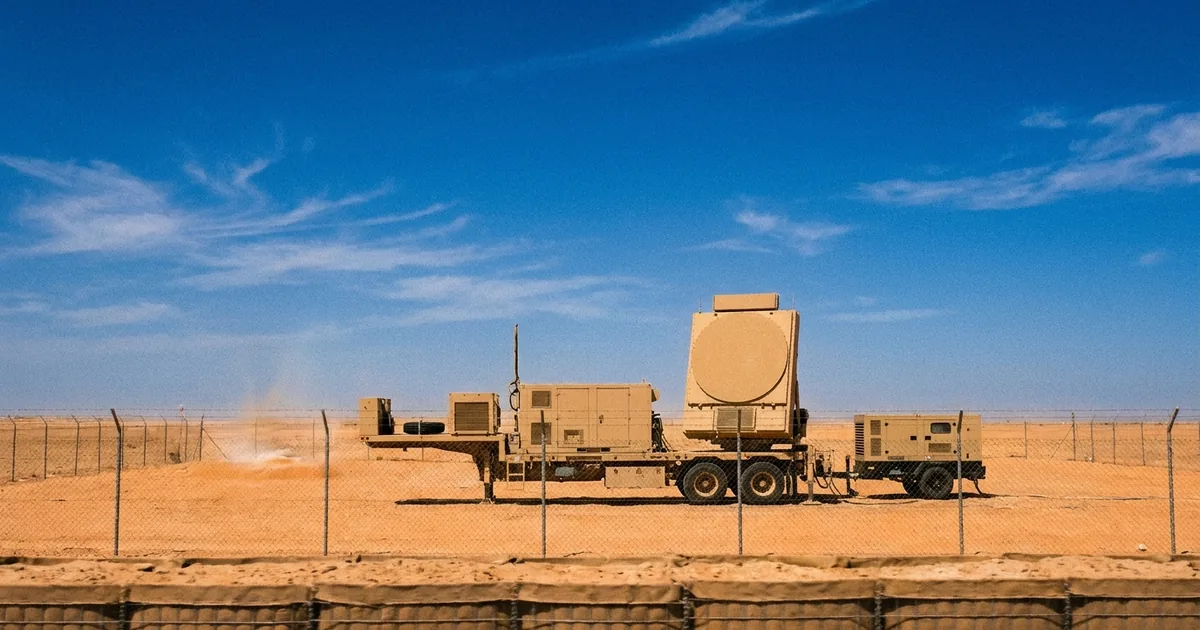
The two men worked for Rheinmetall Italia, the Rome-based arm of the German arms maker, and were doing maintenance on the detection antennas of the Skyguard air defense system that Kuwait’s armed forces use, Italy’s foreign ministry said. Il Sole 24 Ore named them as Antonio Saccoccio and Emanuele Lo Russo, aged 65 and 36. Kuwait’s defense ministry first said four people had been hurt by falling shrapnel after it detected and engaged several hostile drones, a Kuwaiti and a Pakistani among them, then confirmed that both Italians had died. Foreign Minister Antonio Tajani told the Senate in Rome that a “powerful explosion” killed them. In a statement he said several drones “of Iranian origin” targeted Kuwaiti military installations, including the air defense detection station where the two were working. Rheinmetall declined to comment.
One detail deserves a stop. Defense Minister Guido Crosetto told Parliament on Oct. 8 that Italian personnel in Kuwait under Operation Inherent Resolve were being moved to Saudi Arabia and elsewhere, and Il Sole 24 Ore says about ten servicemen remain. The soldiers left. The contractors who maintain the Kuwaitis’ equipment did not, which is one way a country that is not fighting this war ends up with two citizens dead in it.
What Each Side Has Put on the Table
Every claim below is quoted from the reporting linked in this piece, and the right-hand column is limited to what we found in that coverage.
| What was claimed | Who said it | What came attached |
|---|---|---|
| Drones “of Iranian origin” hit a Kuwaiti air defense station | Italy’s foreign minister, Antonio Tajani | The drone was built in Iran, he said. He also said pro-Iranian militias operate in the region and use such drones. |
| “Heinous Iranian aggression” against a “vital site” | Kuwait’s army | A statement of blame. No launch point or debris findings in what we read. |
| “No military or offensive operations whatsoever,” and a “false flag” | Iran’s armed forces spokesman, Abolfazl Shekarchi | No evidence for the false-flag claim. |
| The drone was “definitely not launched by the Iranian armed forces and did not take off from Iran” | Iran’s foreign minister, Abbas Araghchi, as relayed by Tajani | Secondhand. Araghchi also offered a joint inquiry with Kuwait and Italy. |
| Ukraine did it | Fars, citing an unnamed security source, and the commentator Seyed Mohammad Marandi, as reported by Il Sole 24 Ore | Nothing beyond the assertion. |
Iranian-Made Is Not Iranian-Launched
Tajani’s attribution has two halves, and they do not point the same way. The drone, he said, was manufactured in Iran. In the same remarks he added that “numerous pro-Iranian militias operate in the region,” and in Il Sole 24 Ore’s account he says those proxies use the same drones. Both can be true, and the second undercuts the first: a weapon’s maker is not its operator. “Iranian origin” is what a debris check would be expected to find on this drone either way, which makes it a statement about the hardware and not about whose finger was on the launch. We read it as the sentence a government writes when it wants to condemn Iran without committing to a response, and we cannot tell from this record whether Rome means more than that.
A Denial Is Not Evidence Either
Iran gets no free pass for being the accused. Shekarchi called the strike a false flag, the embassy in Rome repeated the language, and Araghchi called the incident “suspicious” and a “precooked recipe for war.” That is rhetoric with no evidence behind it, and it is the sentence Tehran would issue whether its forces flew the drone or not. The Ukraine theory is worse: a Fars “security source” and a commentator who says Kyiv wanted to impress Trump, with nothing offered in support.
The most interesting thing Iran said got the least attention. Araghchi offered to work with Kuwait and Italy on a joint inquiry to establish who launched the drone. That is a cheap offer to make if you are innocent and a costly one if you are not. We think Rome and Kuwait City should accept it or publish what they have, because “made in Iran” will not carry a war. In what we read, neither has taken the offer. Italy said it would lodge a complaint with Iran’s embassy, and Kuwait’s foreign ministry said it reserves “the full right to take all necessary measures.”
Seventeen Days After “Effectively Over”
Donald Trump told reporters on Nov. 9 that Iran was “effectively over” militarily and that the US was “just keeping it the status quo.” Nine days later Iran fired at Kuwait and Bahrain after the US struck Qeshm Island, and the BBC counts those as the first strikes on Kuwait in more than two months. Thursday’s deaths are, according to the Financial Times, the first reported fatalities from attacks attributed to Iran since Washington and Tehran resumed trading fire this month. It is day 271 of a war that began with US and Israeli strikes on Feb. 28, and day 135 of a US blockade restored July 14.
The status quo now includes two dead Europeans, and European Commission President Ursula von der Leyen saying “we must step up the pressure on Iran.” As of Thursday evening we found no statement from the White House, the State Department or the Pentagon, which is early. But the administration that declared the war effectively over owns the status quo it chose to keep.
Two men went to Kuwait to fix an antenna. Nobody has yet shown who sent the drone.
Questions Readers Are Asking
Has anyone claimed responsibility?
Not in the Italian, Kuwaiti or Iranian statements we read, and none of them names a launch site. Iran’s armed forces deny any operation. Italy’s foreign minister says the drone was made in Iran and that pro-Iranian militias operate in the region.
Is Italy at war with Iran?
No. Italy is not a party to the war. Its military presence in Kuwait was tied to Operation Inherent Resolve and has been largely withdrawn. The two dead were civilian technicians working on air defense equipment that belongs to Kuwait’s armed forces.
What happens next?
Italy has said it will lodge a complaint with Iran’s embassy. Iran has offered a joint inquiry with Kuwait and Italy. Kuwait has reserved the right to take “all necessary measures.” Nothing beyond those three statements is confirmed.