
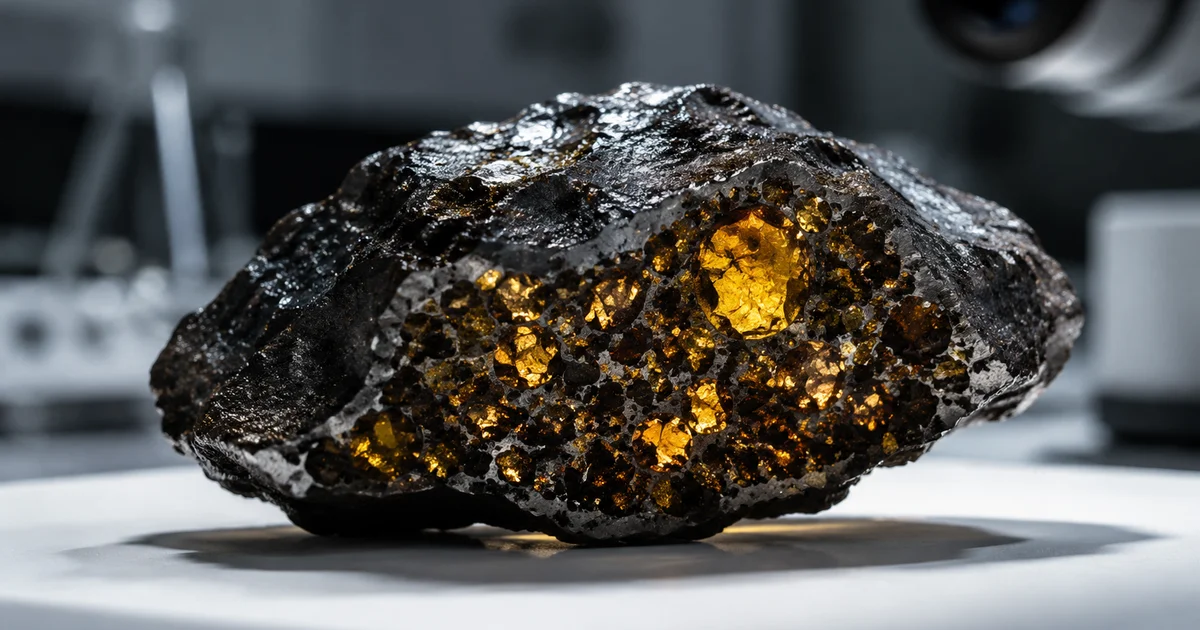
A rock from deep space punched through a suburban roof in Hillsborough, New Jersey, and scientists just confirmed it carried the chemical ingredients for life itself.
The newly published study makes this one of the most scientifically important meteorites ever recovered, and it arrived in the most mundane way imaginable: through someone’s ceiling.
Researchers from the SETI Institute and an international team of collaborators found that the meteorite, now officially named Hillsborough, contains preserved prebiotic molecules, amino acids, and compounds found in blood and used in photosynthesis. It is only the second observed fall of a CM1/2 carbonaceous chondrite, a rare and primitive class of space rock that has been minimally altered since the solar system’s formation.
What Makes This Rock So Rare
Most meteorites that reach Earth have been baked, irradiated, or chemically transformed beyond recognition during their long journey through space. Hillsborough is different. Its composition suggests it came from near the surface of a primitive asteroid where concentrated salty brines created molecules crucial to the origin of life on Earth.
That brine environment is significant. The high salt concentrations can produce organic compounds through a process not previously documented in this type of protoplanetary material. Scientists had theorized this pathway existed but never had physical evidence from a recovered meteorite until now.
The American Museum of Natural History in New York will receive fragments for its permanent collection, joining a handful of specimens that have reshaped our understanding of how chemistry becomes biology.
A Homeowner’s Quick Thinking Saved the Science
The meteorite struck the Hillsborough home in July 2024, and what happened next was almost as improbable as the impact itself. The homeowner, rather than treating the fragments as curiosities or debris, preserved them in glass jars using disposable gloves and aluminum foil. That instinct, whether driven by caution or intuition, prevented contamination that would have made the detailed chemical analysis impossible.
Scientists who studied the fragments described the preservation as exceptional. Meteorites begin degrading the moment they enter Earth’s atmosphere and environment, so every hour of unprotected exposure destroys data. The homeowner effectively ran a preservation protocol without being trained to do so.
Why This Matters Beyond the Lab
The question of how life began on Earth remains one of science’s deepest puzzles. One leading hypothesis, panspermia’s gentler cousin, suggests that meteorites delivered the raw organic chemistry that eventually assembled into living systems. Hillsborough provides direct physical evidence supporting that delivery mechanism.
It also reframes the way we think about asteroids. These are not just inert chunks of rock threatening future extinction events. Some of them are chemical libraries, carrying molecular recipes that predate the Earth itself. The specific compounds found in Hillsborough, amino acids and porphyrin-like molecules used in photosynthesis, are not just building blocks. They are the specific building blocks that terrestrial biology actually uses.
The timing is worth noting. NASA and other agencies are actively planning asteroid sample-return missions and planetary defense systems. Hillsborough landed for free, perfectly preserved by a civilian, and told researchers something genuinely new about solar system chemistry. Sometimes the most important space discoveries arrive without a mission plan.
The full study, published this week and covered by the SETI Institute, represents years of careful analysis on fragments that could have easily been swept up and discarded. Instead, a rock that traveled millions of miles ended up in exactly the right hands, after crashing through exactly the wrong roof. The universe, it turns out, has a sense of dramatic delivery.