
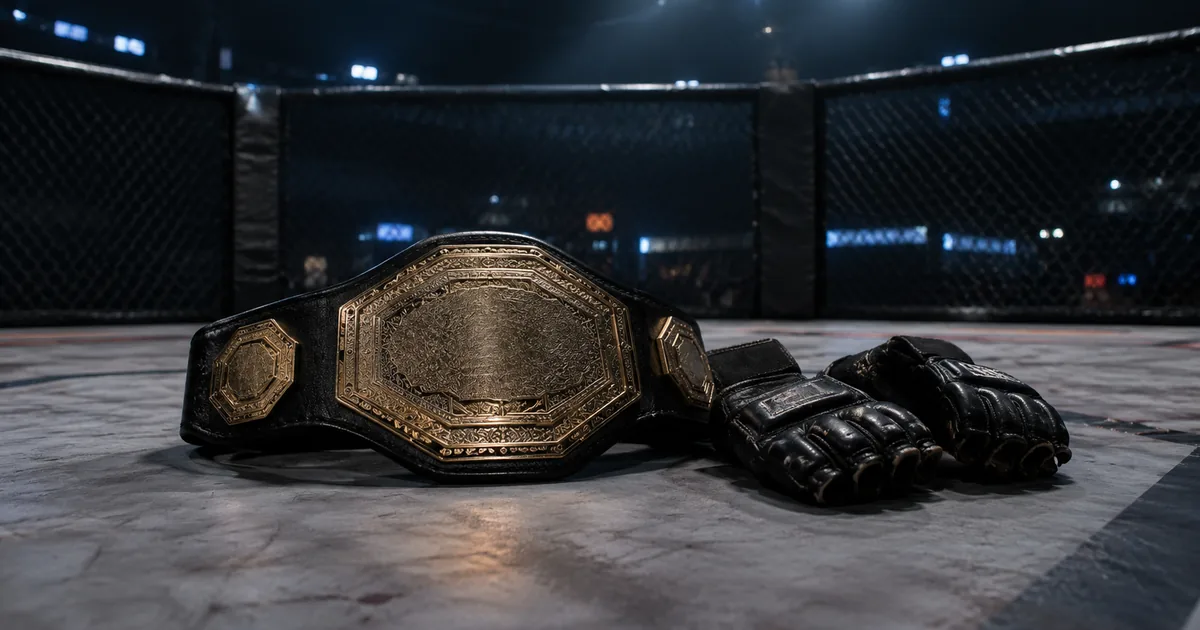
Tom Aspinall gave up the UFC heavyweight championship on Monday without ever defending it, eleven months after an opponent’s fingers went into both of his eyes. Every account of it published today runs the same shape: his statement, the word “gutted,” a line about his recovery, and nothing at all about the piece of equipment the promotion designed to prevent exactly this and then threw away.
That is the part worth saying out loud. In June 2024 the UFC made a new glove mandatory across the roster, built in large part to stop fighters from extending their fingers into an opponent’s face. By November of that year the promotion had pulled it, reverted to the old open-finger design, and never replaced it with anything. Twenty-two months later the open-finger glove has cost the heavyweight division its champion, and the division has no champion at all.
What Happened to His Eye
Aspinall was making his first defense as undisputed champion at UFC 321 in Abu Dhabi on October 25, 2025, having been elevated to the belt after Jon Jones retired. Four minutes and thirty-five seconds into the opening round, Ciryl Gane’s fingers caught him in both eyes. He was given five minutes to recover, told referee Jason Herzog he still could not see, and the bout was ruled a no contest, the first time a UFC title fight had ended that way on an accidental foul.
Multiple surgeries followed. He had reportedly agreed a return date before a further accident in training damaged the right eye again, which is what prompted Monday’s announcement. He was clear that vacating is not retiring. “I’m not done,” he wrote. “Stepping away from the title is not stepping away from the sport or the dream.”
Read against the calendar, that is a man who held the sport’s most prestigious belt for the better part of two years and was physically able to compete for none of it.
The Gloves the UFC Made, and Unmade
The redesign was real and it was serious. It was the first significant change to UFC gloves in more than a decade, and the stated goals were to cut down on cuts, illegal grabs and eye pokes. Seams moved to the palm side. Padding was reshaped so a fighter’s hand would sit in a more natural, closed position rather than splayed open with the fingers pointing forward.
It lasted roughly five months. ESPN’s account of the reversal documents 21 UFC events plus ten Contender Series cards before the promotion went back to the old model ahead of UFC 309 in November 2024. Fighters disliked them, loudly and specifically. Jon Jones said the curve was uncomfortable. Renato Moicano said the material felt cheap. Erin Blanchfield said the tight fingers made it harder to close her hand. Dana White’s summary was that there had been good intentions and a lot of money spent, and that it did not work out.
The reversal also coincided with a report from the data scientist Nate Latshaw finding knockout rates had dropped about 8.5 percent under the new glove.
“I don’t think they did anything for eye pokes.”
That was Angela Hill, one of the fighters wearing them. It is the most damning line in the whole episode, because it is probably true, and because nobody used it as a reason to build a second version.
The Man Who Poked Him Now Holds the Interim Belt
The sequence from here is genuinely strange. In June, at the UFC’s White House card, Ciryl Gane stopped Alex Pereira in the second round to claim the interim heavyweight title for the second time in his career. With Aspinall’s belt now surrendered, the fighter whose eye poke ended the reign is the obvious candidate to inherit what is left of it.
No fault attaches to Gane. Eye pokes are accidents, which is the entire point. The fault sits with a sport that has known for years that its glove design puts four extended fingers in front of an opponent’s face and has treated the resulting injuries as weather.
Our View
The UFC does not need to be blamed for an accident. It should be blamed for what it did after building a solution.
A promotion that spends two years and real money developing safety equipment, deploys it across 31 cards, and then withdraws it inside five months on the strength of fighter comfort complaints has revealed what it actually optimizes for. The fighters’ objections were sincere and a redesign was clearly warranted. What was not warranted was abandoning the project entirely with no successor, no published injury data, and no timeline for a second attempt. Safety equipment is uncomfortable at first. That is not a reason to stop, it is a reason to iterate.
The knockout figure makes the incentive problem impossible to ignore. We are not claiming the UFC scrapped the gloves to protect its finish rate, and White gave a different reason. But a promoter whose product is highlight-reel stoppages should never have been the sole authority deciding whether equipment that reduced stoppages by 8.5 percent was worth keeping. That is a conflict of interest sitting in plain view, and the fix is not complicated: glove standards belong with the athletic commissions that already sanction these bouts, the same way they set rules on wraps, weight and drug testing. A commission has no revenue tied to knockouts.
Aspinall is the argument. He won a belt, never got to defend it, lost most of two years of a short career, and has now handed it back because of an injury the sport had a prototype fix for and shelved.
What Happens Next
The UFC has not said how it will fill the vacancy, and Gane is not the only name available. The division will get a champion soon enough, which is how this usually ends: a new belt, a new build-up, and the underlying problem left exactly where it was. The question worth holding the promotion to is whether anyone inside it is working on a second glove. Nothing in the public record suggests they are.