
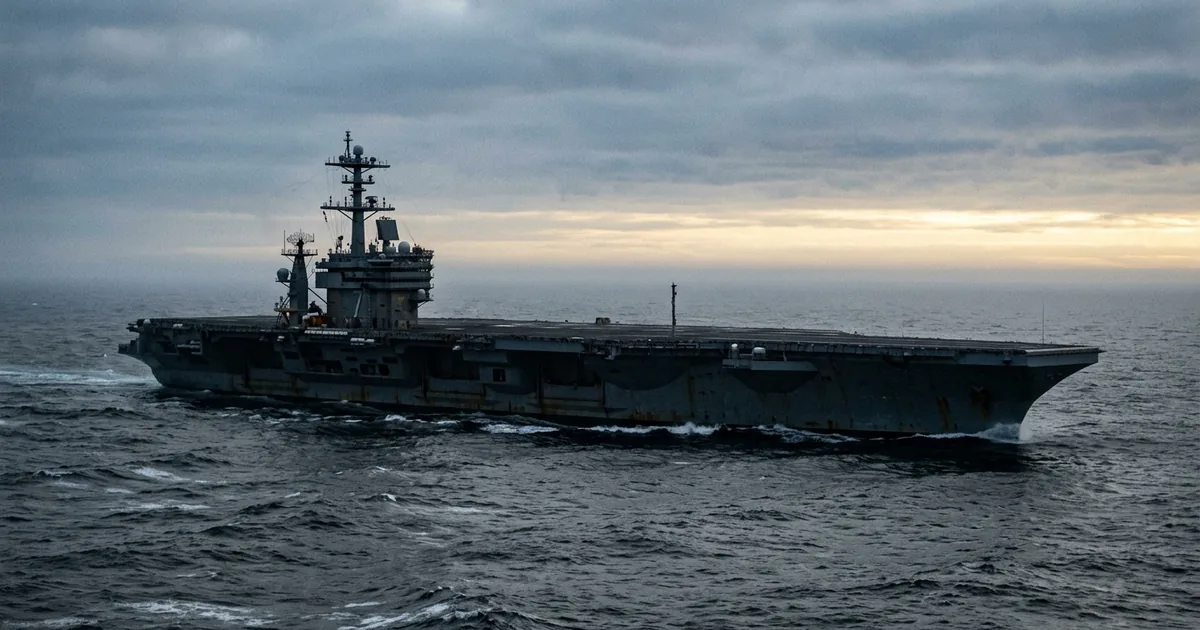
The aircraft carrier USS Abraham Lincoln is somewhere between the Middle East and California right now, roughly 13,000 miles of open water from the pier at North Island, carrying about 5,000 sailors and Marines who have not set foot on dry land since a single day in Guam last December.
The Navy has spent months telling everyone that conditions aboard that ship were misrepresented, and it has about three weeks left to decide whether it still wants to say that with the families standing on the dock.
What 272 Days Actually Looks Like
The Lincoln left San Diego before Christmas on what was scheduled as a routine deployment of roughly six months. In January the war with Iran started, the carrier was rerouted to the Middle East, and the deployment was extended. Then it was extended again. By the time the USS George Washington arrived in the region to relieve it, the Lincoln had been continuously underway for more than 270 days without a port call, a stretch Newsweek counted at 272 days and the longest sustained underway run for an American carrier in decades.
That number deserves a second look, because “deployment length” and “days without touching land” are not the same statistic and the Navy tends to quote whichever one sounds better. The USS Gerald R. Ford was deployed longer in total. Nobody has kept a crew at sea this long without a port visit. Port calls are not a perk. They are the mechanism by which a floating city of 5,000 people resets: mail, fresh food, replacement parts, medical care that is not triage, and roughly 48 hours in which a 22-year-old can stop being a watch stander and go be a person.
Strip that out for nine months and things break in a predictable order. San Diego’s ABC affiliate reported that the crew was heading home after a record-breaking deployment in which the ship became the center of gravity for US combat operations against Iran. What the Navy has been slower to discuss is what that centrality cost the people doing it.
The Reports the Pentagon Called Fake News
Complaints from families surfaced in April. The Navy denied them. Defense Secretary Pete Hegseth dismissed the reporting outright, and later revised that to say conditions aboard the Lincoln had been completely misrepresented.
Then the specifics arrived. CNN reported that a sailor went overboard from the Lincoln in August amid deteriorating mental health across the crew, and that a shipmate pulled another sailor back onto the deck before they could go over the side. Newsweek reported that the Navy was responding to accounts of multiple sailors attempting to jump. A dozen families described moldy showers, food shortages, plumbing failures, water contamination, disrupted mail, and fatigue that had stopped being ordinary tiredness.
A denial is a claim about facts. When the facts keep arriving anyway, the denial stops being an answer and becomes part of what needs investigating.
None of this is a story about weak sailors. It is a story about what happens when an institution decides that the cheapest way to solve a scheduling problem is to spend the crew.
Six Lawmakers and One Inspector General
The congressional response has been unusually specific, which matters, because vague concern is how these things normally die. Senators Alex Padilla and Adam Schiff joined Representatives Scott Peters, Juan Vargas, Mike Levin and Sara Jacobs in a letter to the Department of Defense Office of Inspector General asking for an independent review of the decisions behind the Lincoln’s extended deployment. They did not ask the Navy to look into itself. They went to the IG.
The questions are the right ones: what the supply situation actually was, what mental health support existed for a crew on a deployment nobody planned for, and what the strike group’s readiness looks like on the other side of this. KPBS reported that the delegation wants an independent review rather than an internal one, and Jacobs has pushed for the House Armed Services Committee to hold a field hearing in San Diego, where the families are.
A field hearing is a different animal from a Washington markup. It puts spouses and parents in the room with a microphone.
The Force Structure Problem Nobody Wants to Name
Here is the part that gets lost in the outrage cycle. Extending a carrier deployment is not primarily a failure of compassion. It is an accounting maneuver.
The United States has committed itself to continuous carrier presence in more places than its deployable carrier fleet can cover, and an open-ended air campaign against Iran consumed that margin entirely. When the relief is not ready and the mission does not end, somebody has to absorb the gap. Extending the ship already on station costs nothing that shows up on a budget line. It requires no supplemental appropriation, no vote, no press conference. The cost is real, but it is paid in a currency that does not appear in any Pentagon ledger: nine months of a 20-year-old’s life, a marriage under strain, a chief who stops sleeping.
That is why this keeps happening, and it is why the gap in how the Pentagon tracks the human cost of the Iran war is not a clerical detail. What does not get counted does not get budgeted, and what does not get budgeted gets extended. Congress has struggled to assert itself here at all, having already failed to force a binding war powers vote as the conflict widened. An inspector general letter is what oversight looks like when the larger levers have already been tried and did not move.
What Happens at the Pier
The homecoming will look the way homecomings always look. There will be a banner, a first kiss chosen by lottery, children meeting fathers they have not met. The Navy will put out photographs and the photographs will be genuinely moving, because they always are.
The test is what happens in the weeks after the cameras leave, when the same sailors have to decide whether to reenlist and the Navy has to explain to the next crew why this will not happen to them. The Daily Beast called it a deployment from hell, which is good copy but slightly misses the point. Hell would be an accident. This was a series of decisions, each defensible on its own, that added up to something nobody would have approved if they had been asked to approve it all at once.
The inspector general can find out who made them. Whether anyone acts on the finding is a separate question, and the answer usually depends on how loud the pier is.