
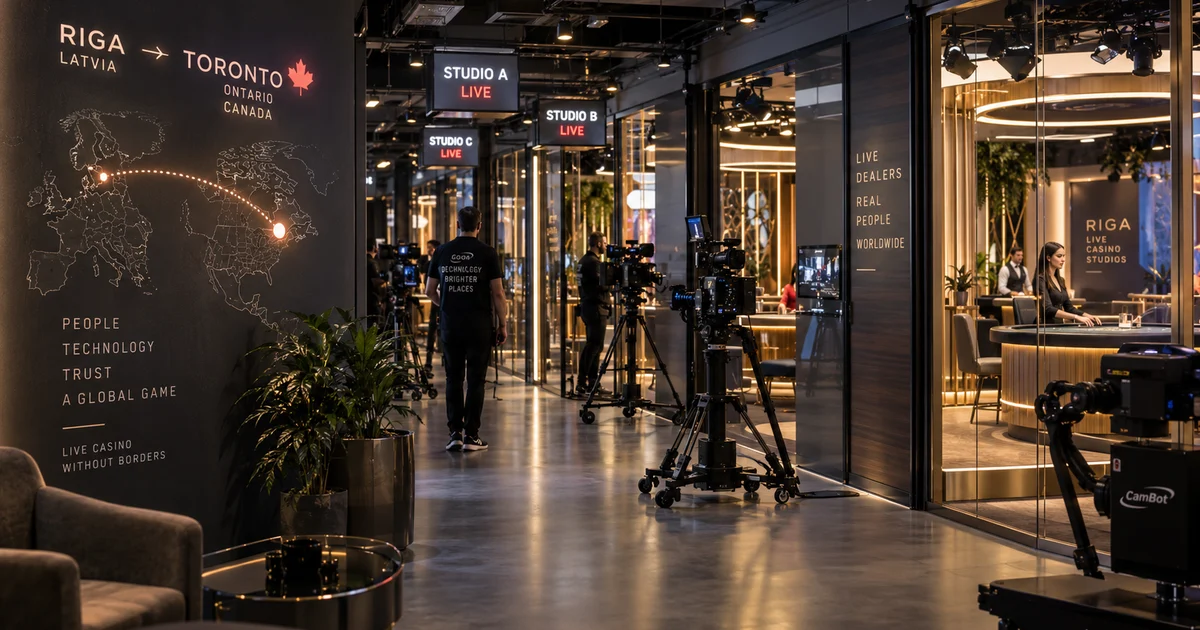
A blackjack hand played in Ontario may begin on a table in Riga. The cards are physical, the dealer is on camera and the wager is placed through a provincially regulated platform thousands of kilometres away. That arrangement supplies live casino without requiring a studio in every market.
It also helps explain how live casino ontario services can offer large live-dealer catalogues while keeping the customer-facing operation local. The studio may sit in Europe, but the account, payments, geolocation checks and eligibility rules sit with the Ontario operator.
From Riga to Ontario
Inside a live studio, dealers run blackjack, baccarat and roulette tables much as they would on a casino floor. Cameras cover the table, software records each result and the video feed is delivered through the operator’s interface. The player sees a live hand or wheel spin and places a digital wager against the recorded game state.
A 2023 Riga project shows the model at its most tailored.The studio was built for an Ontario-facing operator rather than as a generic feed shared across many casino lobbies. Its launch included roulette, baccarat and two blackjack formats. The confirmed commercial market was Ontario; access elsewhere depended on provincial regulation.
Why Riga Makes Operational Sense
Live casino depends on production discipline as much as dealing skill. A studio needs trained dealers, supervisors, secure game systems, reliable streaming, controlled lighting and enough floor capacity to keep tables running across long operating windows.
Riga already has that production base. Existing infrastructure lets suppliers add tables, change presentation and serve regulated markets without recreating the entire operation in each jurisdiction. Faster deployment, dedicated branding and scalability are the central advantages.
The economics are straightforward: the expensive physical layer is concentrated in one place, while distribution can extend to licensed markets. Local obligations remain with the operator serving the customer.
Ontario Lobbies Now Function as Content Gateways
ToonieBet Ontario offers an example of what sits at the Canadian end of that chain. Launched in 2024 for Ontario, the platform lists more than 3,000 casino games across slots, table games and live-dealer products, alongside its sportsbook.
A catalogue of that size changes the operator’s role. The lobby becomes the point where supplier content is organised, filtered and presented. Search, mobile navigation, table categories and placement determine whether a live game is easy to find or buried among hundreds of alternatives. In practice, visibility becomes part of the product strategy, not just an interface choice.
Dedicated studio feeds matter because they give operators more control over presentation. Custom tables, backgrounds and configurations can distinguish a live section without requiring the operator to own the production facility.
Why the Same Table Games Keep Appearing
Blackjack, baccarat and roulette suit remote production because their action is legible on camera. In blackjack, cards and dealer decisions provide a clear sequence. Baccarat requires limited input after the wager. Roulette reduces the outcome to a visible spin and landing position.
That makes the games easier to standardise across multiple tables. Limits, seating formats and presentation can change while the core procedure remains familiar. The Riga launch reflected that pattern, relying on roulette, baccarat and blackjack variants.
A European Studio Does Not Create a Canadian Licence
The most important boundary is regulatory, not technical. An overseas studio can transmit a game, but Ontario-facing access still requires age and identity verification, geolocation, technical oversight, audit records and responsible-gambling controls.
That is why “across Canada” needs qualification. The Riga arrangement included the possibility of reaching additional provinces, but only where local rules allowed it. Broadcast reach and legal market access are separate questions.
ToonieBet operates within Ontario’s regulated framework through registration with the Alcohol and Gaming Commission of Ontario and an operating agreement with iGaming Ontario. Online gambling in Ontario is restricted to those aged 19 and over and should be treated as entertainment rather than a source of income or a way to recover losses. Spending and time limits, breaks and self-exclusion tools should be used when needed, and support is available through ConnexOntario.
The Baltic model is less about exporting a casino than dividing its functions. The dealer and production floor can be in Riga; the account, permissions and consumer protections remain tied to the province where the wager is placed.