
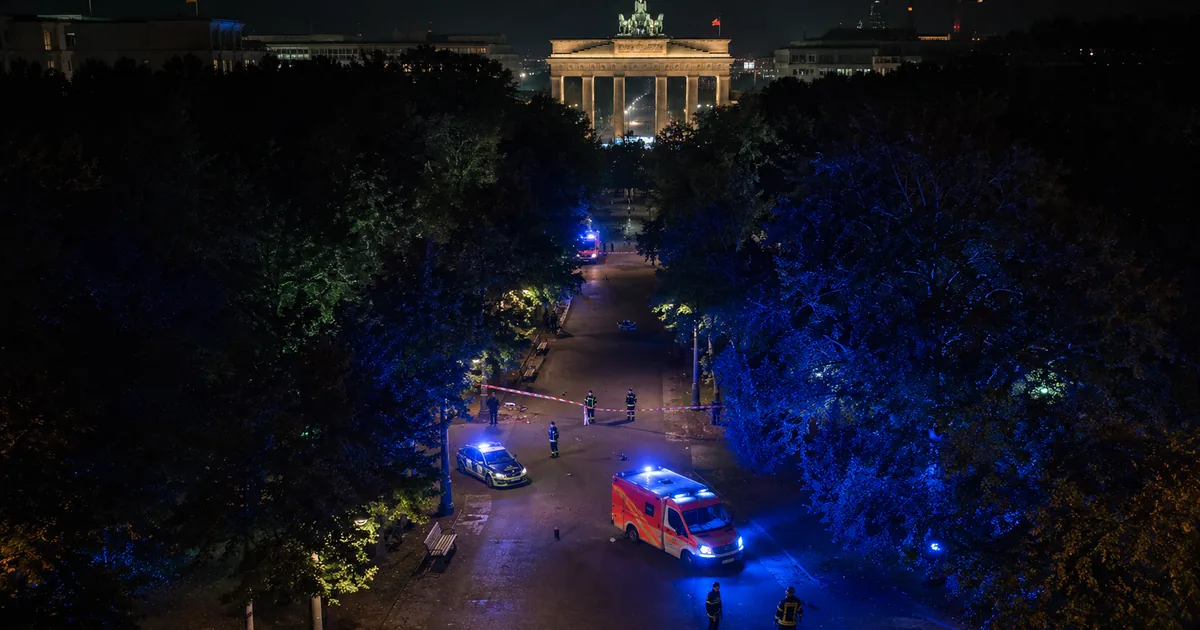
A van plowed into a crowd gathered for Berlin’s Christopher Street Day celebrations on Saturday evening, killing one person and injuring at least 17 others in what Berlin Mayor Kai Wegner called an attack on “our free and cosmopolitan society.” Police immediately cancelled the Pride festivities at the Brandenburg Gate and launched what they described as an intensive search for one or more suspects still at large.
The attack struck at the heart of one of Europe’s largest LGBTQ+ celebrations, an event that had drawn hundreds of thousands of people and featured roughly 80 floats parading through the German capital earlier in the day. What should have been a night of celebration turned into a crime scene in Tiergarten park, the sprawling green space adjacent to the parade route.
What Happened in Tiergarten Park
According to CBS News, the vehicle drove into the park around 10:15 p.m. local time (20:15 GMT), striking multiple people before the driver abandoned the van at the scene. Emergency services rushed to treat the injured, some of whom Berlin police confirmed had sustained life-threatening injuries.
Officers cordoned off a wide area between Potsdamer Platz and the southern Tiergarten tunnel, illuminating the park with floodlights as forensic teams scoured for evidence. The Pride celebration at Brandenburg Gate was shut down immediately, with a band’s performance on stage cut mid-set and attendees urged to evacuate.
Police spokesperson Alexander Klute told reporters that investigators had “at this point” no information about possible motives, a deliberate hedge that suggests authorities are weighing multiple scenarios while the manhunt continues. The distinction matters: Germany has faced a wave of violent attacks in public spaces in recent months, and each new incident sharpens the debate over how open societies protect the gatherings that define them.
Berlin’s Leaders Call It an Attack on Freedom
The political response was swift and unequivocal. German Chancellor Friedrich Merz said the incident would be “fully investigated and punished,” language that signals Berlin is treating this as a deliberate act rather than an accident, even before a motive is established.
Mayor Wegner went further, framing the violence in explicitly political terms. “Berlin is the city of freedom, and our freedom has been horribly attacked today,” he said. For a city that has positioned itself as one of the world’s most welcoming capitals for LGBTQ+ people, the attack lands as both a physical assault and a symbolic one, striking during the single event most associated with that identity.
Attendee Julian Miethig, who was at the celebrations when the attack occurred, called it “a dark day for the community,” a sentiment that captures the immediate emotional weight but undersells the security questions the incident raises.
The Security Gap That Keeps Repeating
The harder question, the one German officials will face in the coming days, is why vehicle-ramming attacks at large public gatherings remain so difficult to prevent. Tiergarten park is an open green space bordering one of Berlin’s busiest corridors. Bollard infrastructure and vehicle-exclusion zones have expanded across European cities since the 2016 Berlin Christmas market attack and the Nice truck attack that same year, but parks and open-air gathering spaces remain structurally harder to fortify than pedestrian plazas.
NPR reported that Christopher Street Day had proceeded peacefully for hours before the attack, with the parade itself attracting massive security deployment. The gap between parade-route protection and the after-party gathering in the park is the kind of soft-target vulnerability that security planners have warned about but cities have struggled to address without militarizing public space.
This is also a story about the targeting of LGBTQ+ communities at a moment when anti-LGBTQ+ violence is rising across Europe. Whether or not this specific attack was motivated by animus toward the Pride celebration, the fact that it occurred during the single most visible LGBTQ+ event in Germany’s capital will shape how it is understood and how communities assess their safety at future gatherings.
What Comes Next
The immediate priority is the manhunt. With the suspect or suspects still at large and the vehicle abandoned, Berlin police face a forensic and intelligence challenge that will unfold over hours and days. The van itself, the point of abandonment, surveillance footage from one of the most camera-dense corridors in Berlin: these will be the investigative threads.
For the broader public, the attack reopens a conversation that never fully closes in European capitals: how open societies protect the gatherings that define them without surrendering the openness that makes those gatherings meaningful in the first place. Berlin’s Christopher Street Day is not just a parade. It is a statement about what kind of city Berlin intends to be. Saturday’s attack was a direct challenge to that statement, and how Berlin responds will matter far beyond the investigation itself.
This is a developing story. Details may change as German authorities release new information.