
The claim. When the Supreme Court decided Citizens United in 2010, the majority wrote that “independent expenditures, including those made by corporations, do not give rise to corruption or the appearance of corruption.”
The number. Corporations gave $12.8 million to outside groups that year. In the 2026 midterms they have given $737.3 million, and 19 cents of every corporate dollar went to the super PAC named for the sitting president.
Corporate money in the midterms has hit $737.3 million. Public Citizen put the figure out Thursday from the October federal filings, and it is 60 percent higher than corporations spent on the 2024 presidential race.
The headline traveled. The arithmetic did not. So we did it.
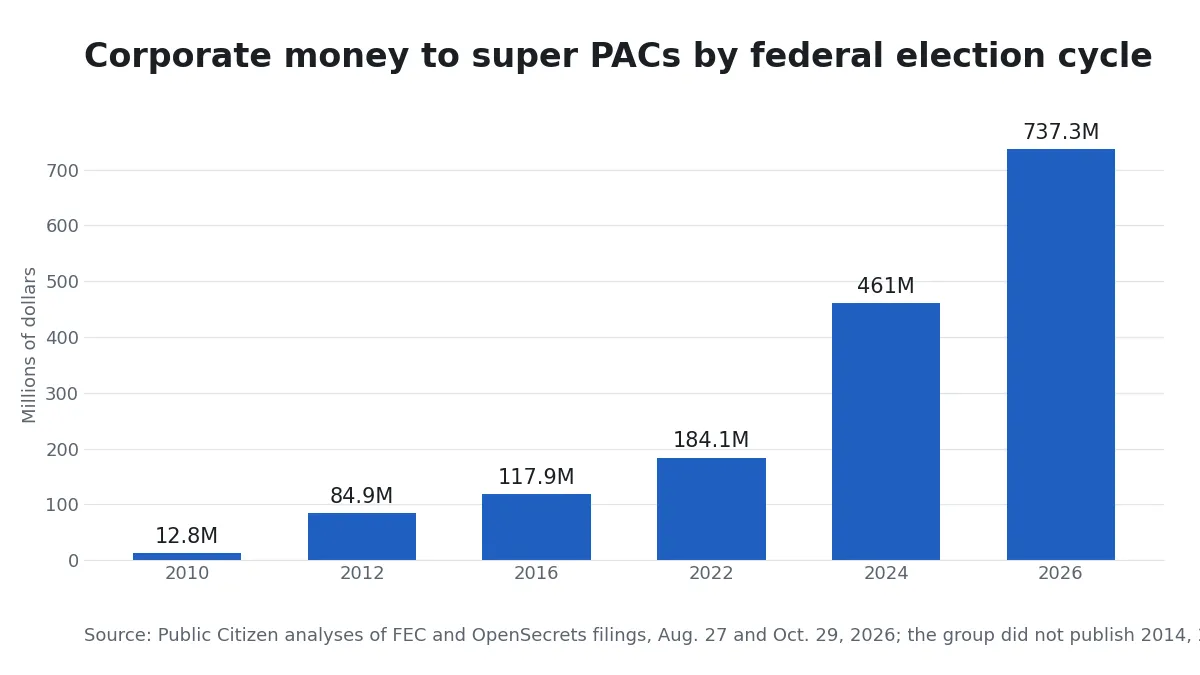
Start with the cycles the group has published. Corporations gave $12.8 million in 2010, $84.9 million in 2012, $117.9 million in 2016, $184.1 million in 2022 and $461 million in 2024. This cycle’s $737.3 million is 57.6 times the 2010 figure and 1.6 times 2024, and 2024 had a presidential race on the ballot. Midterms are supposed to be the cheap year.
Then the share. Public Citizen counts $1.8 billion in corporate giving to super PACs since 2010. This one cycle is $737.3 million of it, two-fifths of sixteen years of spending, in one year.
Then the concentration. Cryptocurrency, online betting and Big Tech, which the group defines to include AI and data-center companies, account for $391 million. Divide by $737.3 million and you get 53 percent. Three industries, one of which did not exist in 2010, are more than half the corporate money in American politics.
The report that matters is the August version, because that is where the names are. Through the second quarter, crypto had given $206 million, online betting $76 million and tech $62 million.
The second-quarter checks tell you who is buying. Koch Inc. and a subsidiary sent $20 million to Americans for Prosperity. DraftKings sent $14.5 million to Win for America. Gemini Trust Company, the Winklevoss exchange, sent $10 million to MAGA Inc. FanDuel sent $7.5 million to Win for America. bet365 sent $5.5 million there too. Reynolds American, the tobacco company, sent $5 million to MAGA Inc. Jump Crypto sent $4 million to its own vehicle.
The recipients, cumulative: MAGA Inc. $401 million. Fairshake, the crypto super PAC, $137.4 million. Americans for Prosperity $92 million. Leading the Future, the AI super PAC, $75.8 million. Win for America $72 million.
Read those two lists together and the pattern is not ideological. It is transactional.
Ask what each of those industries needs from government in the next two years and the giving explains itself.
The sportsbooks want prediction markets stopped. Win for America is funded by DraftKings, FanDuel, Fanatics and bet365, and it spends in state races, not federal ones, in places like Texas and Georgia where sports betting is not yet legal. The bet, as the industry’s own trade press reads it, is that state lawmakers will not want to lose licensed-gambling tax revenue to federally regulated event contracts that pay no state cut. Fox’s reporting put the industry’s midterm outlay at more than $72 million by July, with DraftKings at $34 million and FanDuel at $27 million.
The crypto exchanges want the regulatory map they got in 2025 to survive a Democratic House. Fairshake’s $137 million is the price of making every member of Congress aware that opposing the industry is expensive.
The AI companies want the states kept out of model regulation. Leading the Future, seeded with $12.5 million each from OpenAI’s Greg Brockman and his wife and more from Andreessen Horowitz, is spending through two affiliates in both parties’ primaries. Its counterweight, the Anthropic-aligned Public First network, is doing the same from the other side of the AI-safety argument, which tells you the fight is over which companies write the rules, not whether companies do.
And the tobacco company and the Koch network want what they have always wanted. They are just paying more for it, because the price went up.
Corporate money is the smaller story inside a bigger one. Democracy Now’s morning rundown of the same filings has super PACs reporting $4.2 billion from 515 donors who each gave at least $1 million. Elon Musk alone is at $445 million this cycle, after a quarter billion in 2024. We covered what that money does to a party when its biggest donor decides to go to war with its president.
The $737 million is different in kind, though, because of who writes the check. A billionaire spends his own money. A corporation spends its shareholders’ money, and it spends it on the regulators who decide what it can sell. That is the distinction Citizens United waved away in 2010, and it is the one this cycle makes impossible to wave away again.
Consider the single largest line: MAGA Inc. took 19 percent of all reported corporate giving. MAGA Inc. exists to support Donald Trump. Donald Trump runs the executive branch that regulates Gemini Trust, Reynolds American and every other company on that donor list. The court’s theory was that independent expenditures could not corrupt because the candidate did not control them. A super PAC that carries the president’s name and raises money from the companies his agencies oversee is not a loophole in that theory. It is a refutation of it.
Public Citizen’s co-president Robert Weissman says the cycle “shows beyond any doubt that we desperately need a constitutional amendment to overturn Citizens United.” We think that is the right diagnosis and the wrong prescription. A constitutional amendment needs two-thirds of a Congress that is being financed by the people the amendment would restrain. It is not coming.
What is available is smaller and real. Disclosure first: the group’s own totals are an undercount by its own admission, because money routed through nonprofits never reaches the FEC, and a Congress willing to require that every dollar be traceable to a corporate treasury within 48 hours would change the math of the 2028 cycle. Shareholder votes second: a company sending $10 million to a presidential super PAC should have to ask the people who own it. And the courts third, because the same Supreme Court that decided Citizens United just loosened the coordination rules between parties and candidates, which means the independence that was the entire legal basis for unlimited corporate spending is now a fiction the court itself has stopped pretending to enforce.
None of that requires an amendment. All of it requires a Congress that owes less to the donor list above than this one does.
The filings behind the $737 million figure stop in mid-October. The final weeks of giving, when the money is heaviest, come after that. The 2026 number will be bigger when the books close, and the 2028 number, with a presidency on the ballot and three industries now trained to buy one, will make this cycle look like the cheap year it was supposed to be.