
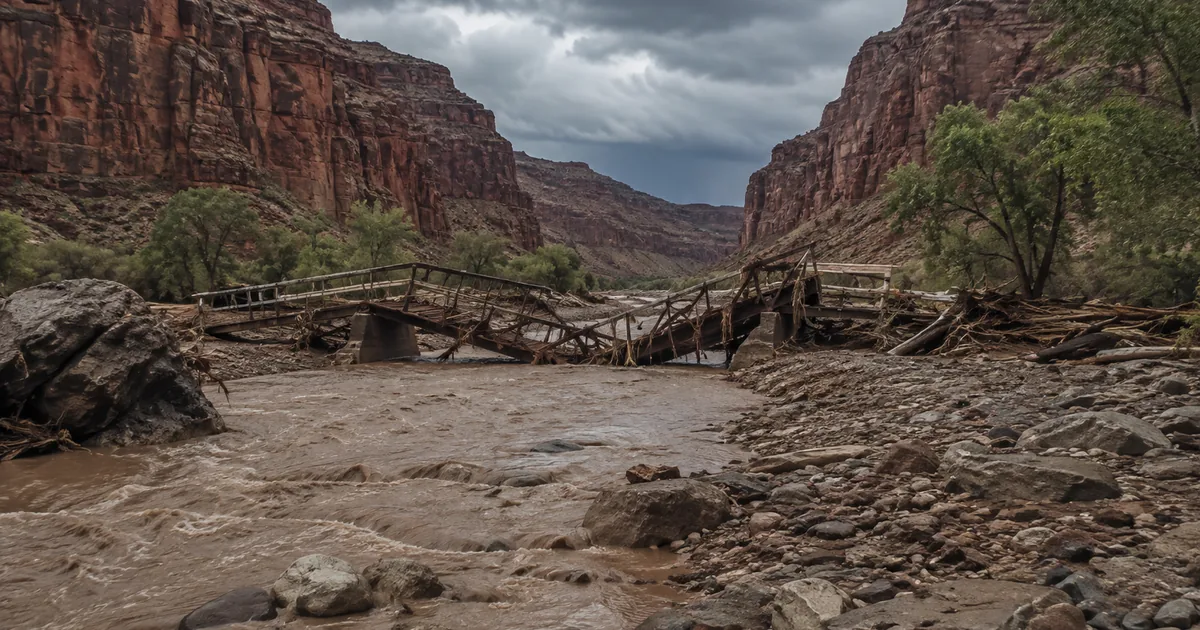
A flash flood tore through Bright Angel Canyon on Saturday afternoon, killing one man and leaving about 15 people unaccounted for in the deepest part of Grand Canyon National Park.
It also severed a water line the Park Service has been warning about for fifteen years, which is why every hotel on the South Rim closes to overnight guests today.
Almost every account of this story is running the same three numbers: one dead, fifteen missing, sixty-two evacuated. Those numbers are correct and they are not the whole story. The flood took out the Transcanyon Waterline, a 12-and-a-half-mile pipe built in the 1960s that carries the South Rim’s entire drinking water supply, and that pipe has been failing on a schedule for more than a decade. The park is not closing its lodges because a storm damaged the rim. It is closing them because a single afternoon of rain finished off infrastructure that was already the most expensive known problem the park had.
What Happened in Bright Angel Canyon
The flooding began at about 2:30 p.m. local time on Saturday, according to the National Park Service, in Bright Angel Canyon and the area around Phantom Ranch. Roughly half an inch to an inch of rain fell in about thirty minutes onto steep rock that had nowhere to put it. National Weather Service meteorologist Justin Johndrow told CBS News that “most of it ran off instantly.”
What came down the creek was not water so much as a moving pile of the canyon. It carried boulders, metal structures and wreckage into the Colorado River, widened the creek bed, and appears to have created a new rapid. Nearly all of the footbridges spanning Bright Angel Creek were destroyed, which in a corridor where the trail crosses the water repeatedly means the route itself is gone, not merely damaged.
By Sunday morning, 62 people had been airlifted out of Phantom Ranch and the lower North Kaibab Trail and taken to the Maswik Lodge cafeteria on the South Rim, where the American Red Cross set up. A 46-year-old man’s body was recovered Sunday along the Colorado River near Crystal Rapids. The Park Service has not released his name.
The count of the missing has moved. Officials initially put it above 20, then revised it to roughly 15 just before 3 p.m. Sunday. Those people are unaccounted for, which is not the same as dead, and in a canyon where a hiker can be perfectly safe and completely unreachable the distinction matters.
“It was like a whirlpool in there, with all the debris circling around. I think it would have been game over.”
That was David Gregory, describing the scene and what he believes would have happened without an immediate evacuation.
The Pipe Was Already the Park’s Biggest Known Problem
Here is the part the casualty count leaves out. The Transcanyon Waterline pulls water from Roaring Springs on the North Rim and pushes it across and up to the South Rim, where it supplies essentially everything: the lodges, the campgrounds, the restaurants, the fire suppression system. There is no second line. NBC News described it accurately as the sole water pipeline serving tourists and residents at the park.
It was built in the 1960s. Arizona public radio station KNAU reported in February 2024 that the line had suffered 85 major breaks since 2010, and that the Park Service had a roughly $200 million replacement under way that it did not expect to finish until 2027. Eighty-five breaks in fourteen years is not a run of bad luck. It is a structure past the end of its life, held together by a maintenance crew and a budget cycle, waiting for something big enough to finish the job.
On Saturday something big enough arrived. The Park Service now says flatly that the waterline “is currently not operational, leaving the park with limited water reserves and requiring significant water conservation measures.”
Our read: the Park Service did not get unlucky at the Grand Canyon this weekend. It ran out of a fifteen-year grace period on a pipe that everybody involved, at every level, knew was going to fail. The replacement project is real and it is funded, and it is also arriving in 2027 for a line that broke in 2026. That gap between knowing and finishing is the actual failure here, and it is a familiar one: this is the same shape as New York’s flash floods in July, where the storm was the news and the infrastructure that could not absorb it was the story. Deferred maintenance does not announce itself. It waits for weather.
What Closes, and When
The consequences landed on Monday. Stage 4 water restrictions took effect at noon on the South Rim, and the Park Service closed overnight accommodations across the park with no announced reopening date. Specifically:
- Xanterra’s El Tovar, Bright Angel Lodge, Maswik Lodge and Phantom Ranch stop taking overnight guests.
- Delaware North’s Yavapai Lodge and Trailer Village do the same.
- Only dry camping is permitted. Campground spigots on the South Rim are shut off, though bathroom faucets still work.
- No fires are allowed on the South Rim or in inner canyon areas.
- Phantom Ranch, Bright Angel Campground and the entire North Kaibab Trail are closed until further notice, as are the Black Bridge and Silver Bridge over the Colorado River.
Hotels in Tusayan, outside the park boundary, are unaffected. The San Francisco Chronicle noted that no reopening date has been set, which for a park heading into its shoulder season is a real economic event for the concessionaires and everyone who works for them.
A Park That Has to Ask the Public Who Was in It
One more thing deserves saying plainly, because it has gone almost unremarked. The Park Service has published a phone number, 888-653-0009, and an email address, nps_isb@nps.gov, asking anyone who was in the inner canyon along the Bright Angel Creek corridor on Saturday, or who held a campground reservation there, to get in touch.
Think about what that request means. Phantom Ranch takes reservations. Bright Angel Campground takes reservations. Overnight travel in the inner canyon requires a backcountry permit. The park sells, issues and records all of it, and it is still asking the public to help reconstruct who was down there. That is why the missing figure moved from twenty-plus to about fifteen inside a single afternoon: it is not a headcount being refined, it is an estimate being assembled.
Nobody should read that as negligence by the rangers running this response, who spent the weekend flying people out of a canyon in monsoon season. It is a systems problem, and it is fixable. A park that can tell you to the dollar what a Phantom Ranch bunk costs should be able to tell searchers, within an hour, who booked one for Saturday night. The families waiting on the fifteen deserve better than a call-in line.
The flood watch for northern and central Arizona ran through Monday evening, and more storms are in the forecast. The search continues, the bridges are gone, and the pipe that makes the South Rim habitable is lying somewhere under the debris, roughly a year short of the replacement that was supposed to save it.