
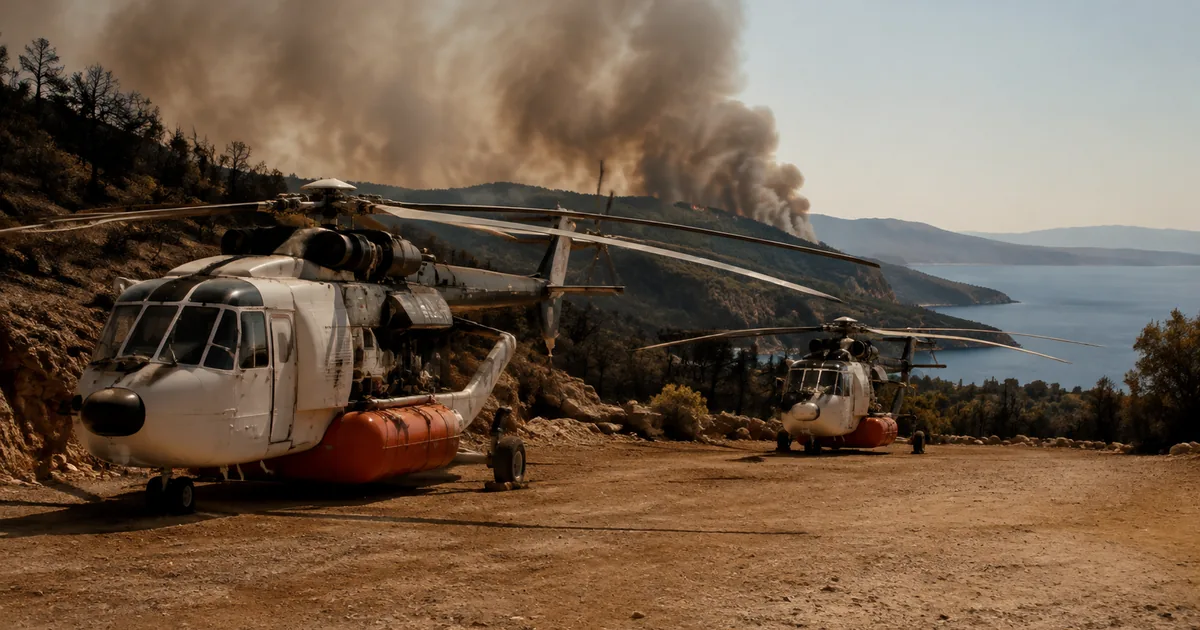
Two Bell 214ST helicopters collided in the air over Psatha on Sunday afternoon, killing a Danish pilot and a Greek fire service liaison officer whose aircraft caught fire and fell into a ravine roughly 65 kilometers west of Athens.
Greece grounded every Bell in the country within hours, which is the safety protocol doing exactly what it was written to do and also the moment a fire that had been burning since Friday lost a slice of the aircraft still fighting it.
The crew of the second helicopter survived. A British pilot and a Greek coordinator brought it down in an emergency landing with minor injuries, and BBC News reported that both were kept in hospital for 24 hours of observation. Prime Minister Kyriakos Mitsotakis said the loss “fills us all with grief.”
The Formation Broke, and That Is the Part Under Investigation
The collision was caught on video, which is rare for this kind of accident and is why the footage moved faster than the facts did. What it shows is one aircraft striking the other during a descent toward the fire, and the struck helicopter going down burning.
Faidon Karaiosifidis, an aeronautical engineer quoted by the Greek daily Protothema, said the second helicopter appears to have hit the first, which was leading the formation. The question the inquiry is actually chasing is not the impact. It is what put two loaded aircraft that close together on the way down. Downdraughts, crosswinds and mechanical failure are all still live possibilities, and Karaiosifidis was careful to say that every scenario remains open and that responsibility should not be assigned before the investigation finishes.
That caution deserves to be honored, because Psatha is the environment that makes aerial firefighting lethal in the first place. Crews fly low and heavy over terrain that generates its own wind, above a fire that is busy manufacturing more of it. Formation flying in those conditions leaves very little room for a correction, and the margin that disappeared on Sunday is the same margin every one of these crews works inside all summer.
Grounding the Fleet Is the Right Call and a Real Cost
Pulling the Bells is not a controversial decision. When two aircraft of the same type collide and nobody yet knows whether the cause was the air, the aircraft, or the pattern they were flying, you stop flying that type until you do. A civil protection ministry source told the BBC the grounding applied nationwide, per protocol.
The uncomfortable part is the timing, and it is worth saying plainly rather than filing under tragedy. The fire near Agios Vasileios started Friday and pushed toward Porto Germeno and the forested hills west of Athens. CBS News reported that the response had close to 500 firefighters and 23 aircraft committed to it. Sunday’s decision took an entire airframe type out of that number while the fire was still running.
Greece did not lose its air campaign. Erickson Air-Cranes, Chinooks and Canadair water bombers kept working. But a fleet that thin does not have a bench, and the aircraft that stayed up are now covering the gap left by the ones that cannot.
Greece Rents Most of Its Firefighting Air Force
Here is the structural fact underneath the accident, and it is the one that will still matter after the inquiry reports. Both helicopters were leased. Protothema identified the operator as McDermott Aviation, an Australian contractor, and the crews reflected that arrangement: a Danish pilot, a British pilot, Greek fire service personnel flying as liaison and coordinator. The BBC noted that the British pilot was on private hire rather than any UK to Greece state exchange.
This is how a lot of European aerial firefighting works now. Governments face a fire season that has outgrown their permanent fleets, and leasing lets them scale up for the months they need without carrying the aircraft, the maintenance and the crews for the other nine. On a spreadsheet it is the efficient answer.
It also produces a capability that behaves very differently from a state fleet when something goes wrong. Leased capacity arrives by type and by contract, so the fleet is less varied than a national air arm would be, and a grounding order that follows an accident therefore takes a bigger proportional bite. The crews are international and rotate through, which is why an accident west of Athens produces a Danish fatality and a British survivor. Nobody chose brittleness. It is what you get when peak demand is met by short-term rental and the peak keeps getting longer.
Two Ways to Lose the Same Fleet in Three Days
This is the second time in three days that Greece’s aerial firefighting has gone partly offline, for two unrelated reasons. On Friday the wind did it, the same day this fire started: we covered Greece pulling people off beaches by boat while gusts grounded its firefighting aircraft. On Sunday a collision did it, and this time the aircraft are down by order rather than by weather.
Those are different failures with the same practical result, which is the part worth watching. A fire season that reliably produces conditions too violent to fly in, and now an accident inside those conditions, is not a run of bad luck. It is a capability being asked to operate at the edge of what it can do, repeatedly, for longer stretches each year.
The wider picture supports that reading. Greece was also fighting blazes on Kefalonia, at Nea Tenedos in Halkidiki, on Crete, where two firefighters were killed earlier this season, and in the Peloponnese. Fires in France and Spain have displaced around 330,000 people, a scale this site has been tracking since Bordeaux forced France’s largest peacetime evacuation since the Second World War. More than 3,860 square miles burned across Europe in 2025, on a continent that has warmed at more than twice the global average since the 1980s.
What the Inquiry Actually Has to Answer
The investigation will produce a cause, and it will probably be a specific and technical one: a gust, a failure, a closure rate that nobody in either cockpit could see in time. That answer matters for the families of a Danish pilot and a Greek officer who went to work on Sunday and did not come home.
The question it will not answer is the one Greece has to answer anyway. If the aerial capacity that fire seasons now demand can be removed by a single accident, or by an afternoon of wind, then the fleet is sized for a fire season that no longer exists. The Bells will fly again once the inquiry clears them. The harder call is what gets bought, and owned, before the next one.