
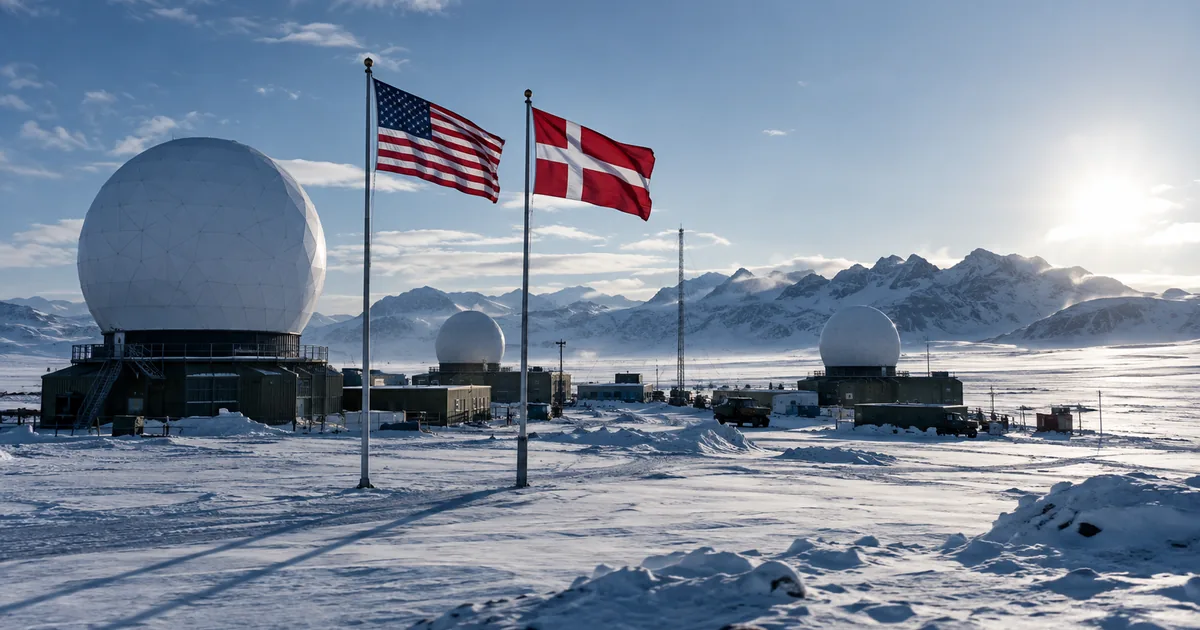
President Trump announced on Friday that the United States had reached an agreement with Denmark and Greenland giving Washington “permanent control over security, and all other needs” on the island, and said the country would immediately begin developing a large military presence there.
He called it an Infinite Life agreement, said it came at no cost, and described it as a dream come true.
PBS NewsHour ran a segment the same evening explaining what is actually in the agreement. The core provision, the one every outlet led with, is permanent basing, access and overflight rights for the US military. What that segment does not mention, and what almost none of Friday’s coverage mentioned, is that the United States has held nearly total basing and overflight rights in Greenland since April 27, 1951, under a defense agreement that is still in force and was last updated in 2004.
That omission is doing an enormous amount of work, because it is the difference between a historic reordering of the Arctic and a renegotiation of a Cold War treaty that was already renegotiated twenty-two years ago.
What the 1951 Agreement Already Gave Washington
The Defense of Greenland Agreement was signed under the NATO framework and it is not a narrow document. Under it, and under the supplemental arrangements that followed:
- The United States operates within designated “defense areas” and holds broad basing and operational rights inside them, including the base at Thule that was renamed Pituffik Space Base in 2023.
- Washington has exclusive jurisdiction over its own facilities, with the Danish flag flown alongside the American one.
- A classified technical schedule signed the same day demarcated the defense areas in which the US was free to develop and operate bases, and the agreement allowed for more where NATO deemed them necessary.
- Since the 2004 update, the US has been able to increase troop deployments on the island provided Danish and Greenlandic authorities are told in advance.
- In exchange, the United States recognized the sovereignty of the Kingdom of Denmark over Greenland, in the text of the treaty itself.
Read that list against Friday’s announcement and the permanent access, basing and overflight rights turn out to be the continuation, not the concession. The one meaningful constraint in the old arrangement was procedural: new sites required agreement with Copenhagen rather than a unilateral American decision. Whether the new text removes that constraint is the single most consequential question about this deal, and it is not answerable yet, because the text is not public.
The Part That Is Genuinely New Is Not About Bases
Two provisions in Friday’s announcement have no 1951 ancestor, and they are the ones worth the attention that permanent basing rights are currently soaking up.
The first is a ban on non-NATO military presence, which in practice means Russia and China. The second is investment screening. Trump’s own framing was that no US adversary can ever have a base, a military presence, or make sensitive investments in Greenland “without our express written approval.”
That last clause is not a defense provision. It is an American veto over who may put money into the economy of a self-governing territory of 57,000 people. Greenland’s rare earth deposits and its shipping lanes are the reason anyone is having this conversation, and this is the clause that touches them.
The bases were never really the argument. The minerals were.
Denmark’s prime minister, Mette Frederiksen, said the agreement recognizes the sovereignty and territorial integrity of the kingdom and the right of the Greenlandic people to self-determination. Greenland’s prime minister, Jens-Frederik Nielsen, said it strengthens the territory’s security. Trump said it gives the United States permanent control over security and all other needs. Those are not competing spins on one document so much as three governments describing three different documents, and none of them has signed anything. The signing is scheduled for next week at the UN General Assembly, and it then requires parliamentary approval in both Copenhagen and Nuuk.
Where We Come Down
Frederiksen did well here, and it is worth saying plainly given where this started. In January, Denmark was warning that a move on Greenland would end NATO and the White House was refusing to rule out force. Landing on a security agreement that leaves the island Danish, preserves the path to independence, and transfers no territory is a serious result against that baseline. The threat was real and she absorbed it without giving up sovereignty.
Trump is overselling what he got, and the press is helping by taking “permanent control” at face value and skipping the treaty that has governed this ground for seventy-five years. A reporter who read the 1951 agreement before Friday’s deadline would have asked one obvious question: which of these rights did we not already have? Nobody asked it, which is how an announcement about procedure becomes a dream come true.
The provision that deserves scrutiny is the investment veto, and it deserves it precisely because it is being presented as a security measure. Telling Greenlanders they retain an unconditional right to choose independence while requiring express American written approval for foreign investment describes two different futures. Copenhagen and Nuuk should publish the full text before either parliament votes on it, and anyone covering the signing next week should arrive having read what 1951 already said.
Greenlanders have spent the better part of two years being discussed as terrain. The agreement that decides what they may do with their own ground is still unwritten as far as the public is concerned, and it is being ratified on a schedule set by a UN summit.