
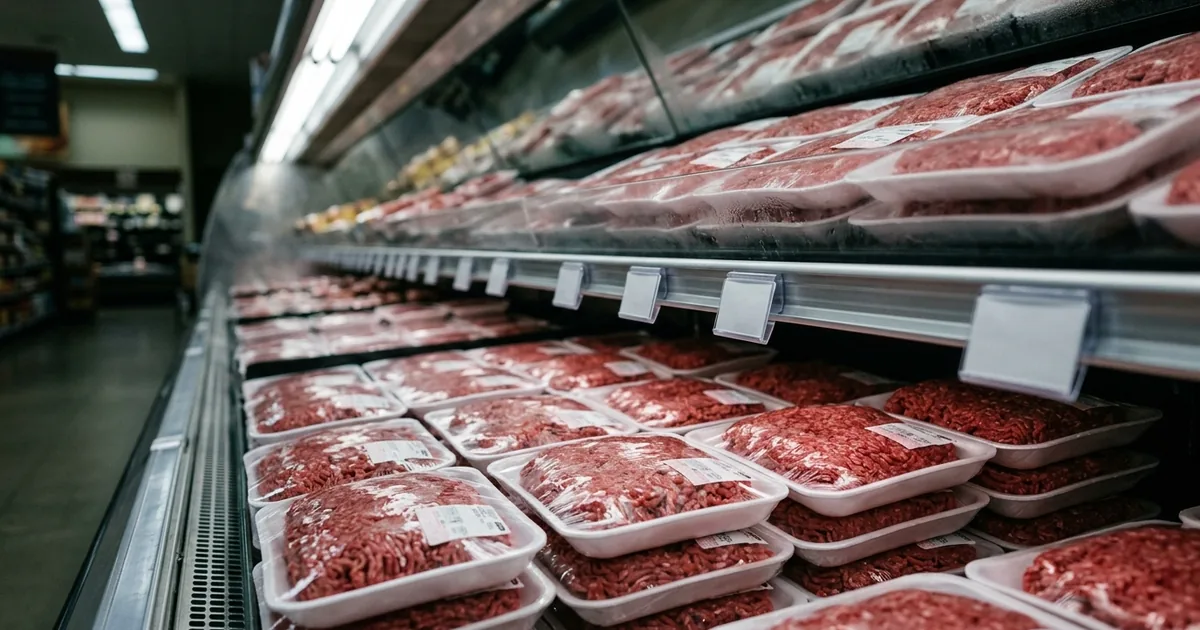
A House Republican, speaking anonymously about his party’s midterm prospects, told MS NOW that this is “a gasoline and ground beef election.”
Then he put numbers on it: “when you’ve got ground beef at $9 a pound and diesel at $6.50 to $7.50. We’re getting screwed.” The quote traveled everywhere this week. As far as we can tell, nobody checked it, which is strange, because the federal government publishes both prices and one of them comes out weekly.
Here is what the data says. The most expensive ground beef series the Bureau of Labor Statistics tracks, all uncooked ground beef, averaged $7.158 a pound in August. Regular 100 percent ground beef was $6.923. Ground chuck was $6.774. The lawmaker’s $9 is roughly 26 percent above the highest number the government has.
Diesel is closer but still wrong in the same direction. The Energy Information Administration put the national on-highway average at $6.285 a gallon for the week ending September 14. Even the floor of his $6.50 to $7.50 range sits above the actual national price.
The Real Numbers Are Bad Enough To Make The Fake Ones Believable
That is the uncomfortable part, and it is why the quote sailed through unchallenged. August’s $7.158 was an all-time high, up from $7.116 in July, and Bloomberg reported it running 7.9 percent above a year earlier. There is no ground beef series at BLS that is not at or near a record. The American cattle herd, as Chicago’s public television newsroom reported last week, is still near a historic low, which is a supply problem measured in years, not quarters.
Diesel is the one where the lawmaker’s instinct is better than his arithmetic. On September 1 the national average was $5.599. Two weeks later it was $6.285. That is a 12 percent move in a fortnight, and diesel is not a consumer price so much as an input price. It moves every truckload of produce, beef and packaged goods in the country, and it shows up on grocery shelves four to eight weeks behind. Regular gasoline, for comparison, sat at $4.319 the same week.
So: he exaggerated the thing that is already at a record, and understated how fast the thing behind it is moving.
Why This Particular Exaggeration Matters
Ordinarily a politician rounding a grocery price up is not worth a word. This one is, for three reasons.
- It is a member of the governing party describing the economy his own party runs, in terms worse than the official statistics. That is not spin. Spin runs the other way.
- The price he picked has a policy history his party owns. When beef hit records this summer, the administration’s answer was a 300,000-ton import waiver, and its own ranchers in red states broke ranks over it. You cannot campaign against a price you have already tried and failed to fix.
- It became a fact by repetition. A number attributed to an unnamed lawmaker, printed without a check, is now the number people quote about beef.
Our View
The press half of this is the easier call. Quoting an anonymous source’s price data without spending ninety seconds on the BLS website is not neutrality, it is stenography, and it is how a wrong number gets laundered into the record. The fix costs nothing. Two of the three prices in that quote are a single click apart.
The political half is more interesting, and we will say plainly where we come down. The affordability argument that put this Congress in power is now being made against it by its own members, and they are making it in numbers they have not bothered to verify because verification is not the point. The point is that voters already believe it. When your own caucus is privately telling reporters “we’re gonna get crushed” and reaching for a grocery price to explain why, the exaggeration is not a lie so much as a tell. They are describing a feeling and grabbing the nearest number to hang it on.
But feelings do not exempt anyone from the record. This party spent 2024 promising to bring grocery prices down, has held the House, the Senate and the White House since, and beef has gone up 7.9 percent in the last twelve months while the cattle herd shrank and diesel climbed 12 percent in two weeks. The honest sentence a Republican member could say on the record is: we did not fix it, here is why, here is the plan. Instead they are saying $9 anonymously and hoping the number does the work.
Democrats should be careful about how they use this too. The temptation is to run the same quote back at the GOP, which would mean repeating a figure that is 26 percent wrong and inviting the correction. The stronger version is the real one. Records are records without inflation.
What To Watch
The September CPI release will update the beef series, and given the July-to-August trajectory and a herd that has not recovered, another record is the base case rather than a surprise. Diesel is the faster signal, and the EIA posts it every Monday afternoon. If it holds above $6.25 into October, the grocery effect lands right as early voting starts, which is a timing problem no import waiver fixes in six weeks.
And watch whether anyone in either party says $7.16 out loud. The true number is the one that survives a fact-check, which makes it the more useful weapon. Nobody seems to want it.