
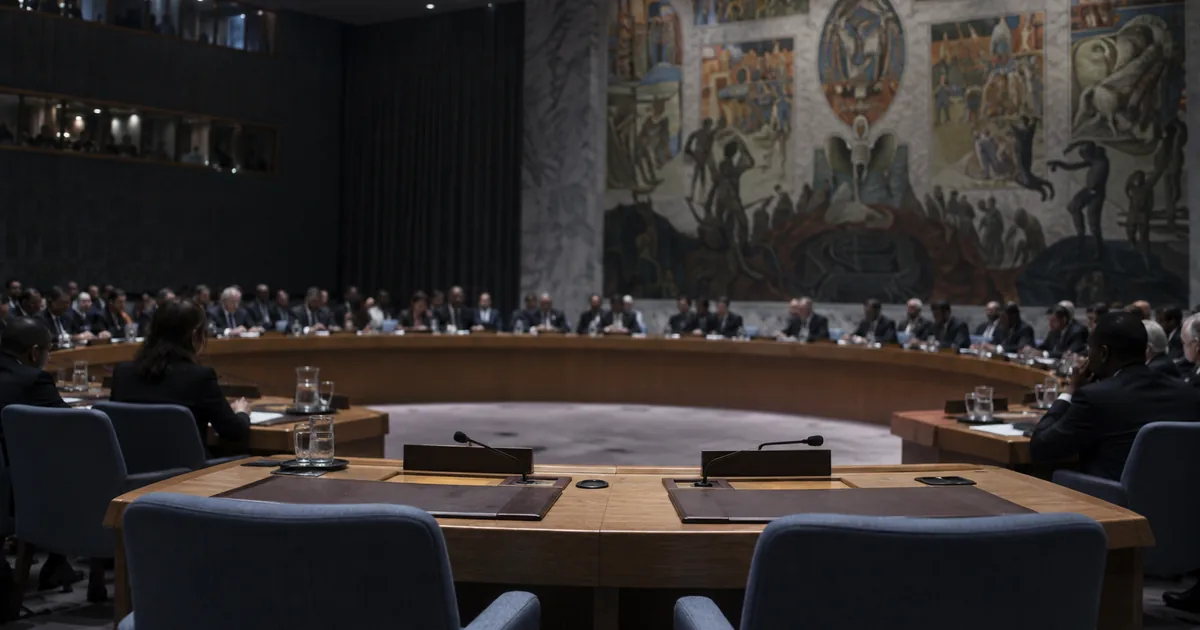
Russia and China killed a United States resolution on Thursday that would have kept United Nations experts monitoring the sanctions reimposed on Iran, on a Security Council vote of 11 to 2 with Pakistan and Somalia abstaining.
The American ambassador warned that the Council had just lost its only impartial source of evidence on sanctions violations, which would be a stronger warning if that source had produced anything in the past twelve months.
That is the part the coverage is skipping. Almost every account of the veto runs the American framing unchallenged: two authoritarian powers have opened a monitoring gap and Tehran is the beneficiary. The gap is real. It is also roughly a year old, and it was made in the Council chamber, not in Moscow or Beijing. As Al Jazeera reported, more than nine months into 2026 the Council still has not agreed on who chairs its subsidiary bodies, which has left the Iran sanctions committee without a head and unable to conduct any work at all. The panel of experts whose mandate was just vetoed had been sitting idle because the Council could not agree on who should be on it.
So Thursday’s vote did not switch off the monitoring. It formalised a shutdown that the Council, including the United States, had already allowed to run for most of a year.
A Mandate Nobody Was Exercising
The mechanics matter here, because they explain why the vote broke the way it did. Sanctions on Iran came back on September 27, 2025, when France, Germany and the United Kingdom triggered the snapback provision written into the 2015 nuclear deal. That restored the Security Council’s sanctions committee and authorised a panel of experts to report on whether member states were complying.
Russia has never accepted that the snapback was valid. Its ambassador, Vassily Nebenzia, told the Council after the vote that because the snapback was illegal in Moscow’s reading, a resolution extending the panel’s mandate was, in his words, deeply flawed and without legal basis. Then he said the part that gives the game away.
Sanctions against Iranian proliferation remain fully in force, binding on each and every UN member state.
Read that alongside the veto. Russia’s position is that the sanctions are simultaneously in force and illegitimate, binding on everyone and unreviewable by anyone. It is not a legal argument so much as a preference for a world in which the rules exist on paper and nobody is assigned to check them. China went along with it.
The United States, for its part, spent nine months unable to staff the committee that would have done the checking, and then arrived at the Council to argue that losing the panel would be a catastrophe for oversight. Both things are true. Neither side has been serious about the monitoring for a while.
Meanwhile, Tehran’s President Is Flying to New York
The same week, the Trump administration approved visas for Iranian President Masoud Pezeshkian and Foreign Minister Abbas Araghchi to attend the General Assembly’s high-level week, seven months into a shooting war between the two countries. NBC News reported that the State Department granted them consistent with host country obligations, then wrapped them in restrictions: the delegation is confined to the areas strictly necessary to get to and from the UN headquarters district, and barred from buying luxury goods or, in a detail that reads like satire, wholesale club memberships.
State Department spokesperson Tommy Pigott framed it as a refusal to let the Iranian regime’s elites turn the General Assembly into a luxury retail splurge paid for by the suffering of ordinary Iranians.
This is where the two stories meet, and the meeting is not flattering. On Thursday the United States told the Security Council that independent verification of Iranian sanctions compliance was indispensable. On the same file, in the same week, its public posture toward the Iranian delegation was about shopping. One of those is a foreign policy. The other is a press release.
Trump addresses the General Assembly on Tuesday. Pezeshkian speaks on Wednesday. Trump has said publicly that he is weighing full-scale attacks. Both men will speak from the same building, three blocks apart, in a city where the Iranian delegation is not allowed to leave the route.
Where We Land on This
The veto was cynical and Russia should be named for it. A permanent member that insists sanctions are binding while blocking the only mechanism that would show whether they are being honoured is not making a legal argument, it is buying a client state some room. China’s vote was worse in one respect, because Beijing has no comparable investment in the snapback dispute and simply declined to spend anything on the outcome.
But the United States does not get to be the wronged party here. If the panel of experts were genuinely the indispensable oversight instrument the American delegation described on Thursday, it would not have been allowed to sit chairless and unstaffed since January while the Council haggled over committee assignments. Washington is a permanent member with more leverage over that process than anyone. It spent that leverage elsewhere. Arriving nine months later to mourn an institution you let go dark is the diplomatic equivalent of reporting a theft from a building you never locked.
What should happen next is unglamorous and entirely achievable: the Council should agree its subsidiary body chairs, which requires no new resolution and cannot be vetoed, and the states that voted yes on Thursday should publish their own compliance findings in the panel’s absence. Eleven governments just went on record saying the monitoring matters. There is nothing stopping them from doing it.
We have been here before on this file. Last week the IAEA referred Iran to a Security Council that had already reimposed every sanction on the table, a referral to a body that had run out of things to add. Thursday was the same shape. The institution keeps performing steps whose substance was hollowed out months earlier, and the performance is starting to be the point.
What to Watch Next Week
Pezeshkian’s speech will be covered as spectacle, and the spectacle is genuinely remarkable: a head of state addressing the General Assembly from the territory of the country currently bombing his. The more useful thing to track is quieter. Watch whether any of the eleven yes votes turns Thursday’s position into an actual reporting commitment, and watch whether the Council fills the committee chairs it has been unable to fill since the start of the year. If neither happens by the time the session ends, then the veto changed nothing, which was always the most likely reading of it.