
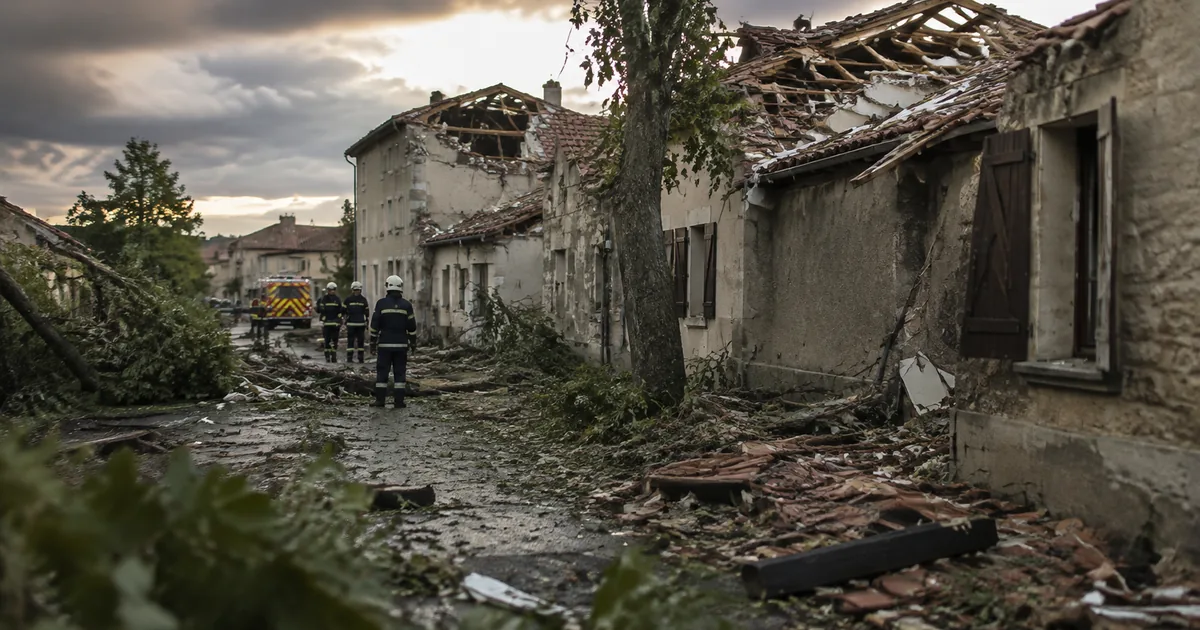
A supercell tornado came down on Pomas, a village of about a thousand people in France’s Aude department, at 5:20 on Monday afternoon, and by nightfall the count of injured had climbed to 41 with roughly 300 homes damaged.
Asked what was left of the commune he runs, the mayor told a reporter to go and find a photograph of California.
The Count Moved All Evening
The first official figures were not the ones that stood at midnight. The Aude prefecture initially reported 26 people hurt, none of them life-threateningly, five of whom were taken to hospital, and put the damage at around a hundred homes, which is the tally Euronews was still carrying late into the evening. Agence France-Presse later put it at 41 injured and about 300 damaged homes, 15 of them hospitalised. One was a pregnant woman whose house came down on her. Her husband told AFP that a sofa took the weight of it.
Numbers climbing through the first night is ordinary after a tornado, and the notable thing about this one is what has not appeared in any tally: nobody has been reported killed. Météo France measured gusts of 117 kilometres per hour, about 73 miles per hour, at Arquettes-en-Val, a neighbouring commune also caught in the storm’s path. Around 2,800 households across roughly ten communes were still without electricity at half past seven. More than 120 emergency workers went in, among them urban search and rescue specialists working with a dog team, and the prefecture opened shelters for the night at Pomas and Limoux.
The Warning in Force Was for Thunderstorms
Southwestern France sat on orange vigilance on Monday, the third rung of Météo France’s four-colour scale, issued for violent thunderstorms: torrential rain, large hail, lightning, damaging gusts. It was lifted at seven in the evening, an hour and forty minutes after the funnel had already crossed Pomas.
Nothing in that alert told anyone in the Aude to expect a tornado, and that is not a failure by the forecasters who were on duty. France’s vigilance system warns by hazard category, and tornado is not one of the categories. Tornadoes are folded into the thunderstorm heading alongside hail and gusts, which is a defensible way to run a warning system in a country where the tornadoes are usually weak, brief and rural. It is a much less defensible way to run one on an afternoon when a mature supercell parks over a department and produces something closer to what the American plains get in May.
Emmanuelle Plantier Lemarchand, secretary general of the Aude prefecture, named the problem without quite naming it. “C’est surtout un effet de surprise qui est majeur,” she said. It is above all the surprise factor that is major.
Put up a photo of California, it’s the same, that’s all I can tell you.
That is Hervé Giné, the mayor of Pomas, describing his own village to the regional broadcaster ICI. It is worth sitting with what he did there. A French mayor standing in a French village reached past every reference point his own country could give him and borrowed an American disaster image, because the domestic vocabulary for this does not really exist.
Tile Roofs and No Basements
Fabien, a resident, described his street to ICI in the flattest terms available. “Il n’y a plus de tuiles, il n’y a plus de toit,” he said: there are no tiles left, there is no roof left. “Les maisons qui ont un étage l’ont perdu.” The houses that had an upper floor lost it.
That is the shape of the damage, and it follows from how the Aude is built. Village housing here is stone and terracotta tile, roofs laid rather than strapped, and basements are rare. There is no safe room, no storm cellar, no drill anyone has ever practised. Our read is that 41 injured is roughly the number you get when a population with no tornado protocol is indoors at teatime in buildings that shed their roofs before they shed their walls. The absence of deaths looks less like adequate preparation than like the margin between a tornado at 5:20 in the afternoon and the same tornado at three in the morning.
The Same Cell Stopped a Grand Tour
The same weather system ended a stage of the Vuelta a España. Riders were 15 kilometres from the finish of Monday’s 174-kilometre stage from Gruissan-Aude to Font Romeu, climbing toward the Col de Mont-Louis, when hail hit the peloton hard enough that the stage was abandoned outright. Race leader Tadej Pogačar was the rider who waved the peloton over to the side of the road, and the field took shelter in a hotel while hailstones that some riders put at half the size of a golf ball came down on the climb. “For the security of the riders, stage three has been cancelled due to hail and severe weather,” the organisers said. Pogačar kept the red jersey, nine seconds up on Wout van Aert.
The bike race is the part of Monday that the rest of the world actually watched, and it is the least consequential part of it. The same system delayed trains, closed roads and disrupted flights at Bordeaux, Marseille, Nice, Toulouse and Paris.
What Happens to the Number Now
Expect the toll to move again. The injured figure will be revised once every damaged house in Pomas has been walked through properly, and the housing number will move more than once, because “damaged” is doing an enormous amount of work in a village where some roofs have lost their tiles and some houses are simply open to the sky.
The longer question is whether any of the alerting changes. France has spent this summer running one extreme-weather emergency after another, including the Bordeaux wildfire that forced the largest peacetime evacuation the country has ordered since the Second World War. Those had a warning category attached to them. This did not, and the prefecture’s own secretary general has already told the public that surprise was the biggest factor in what happened. A warning system built around the tornadoes France used to get is a choice, and it remains a perfectly defensible choice right up until the afternoon that it isn’t.