
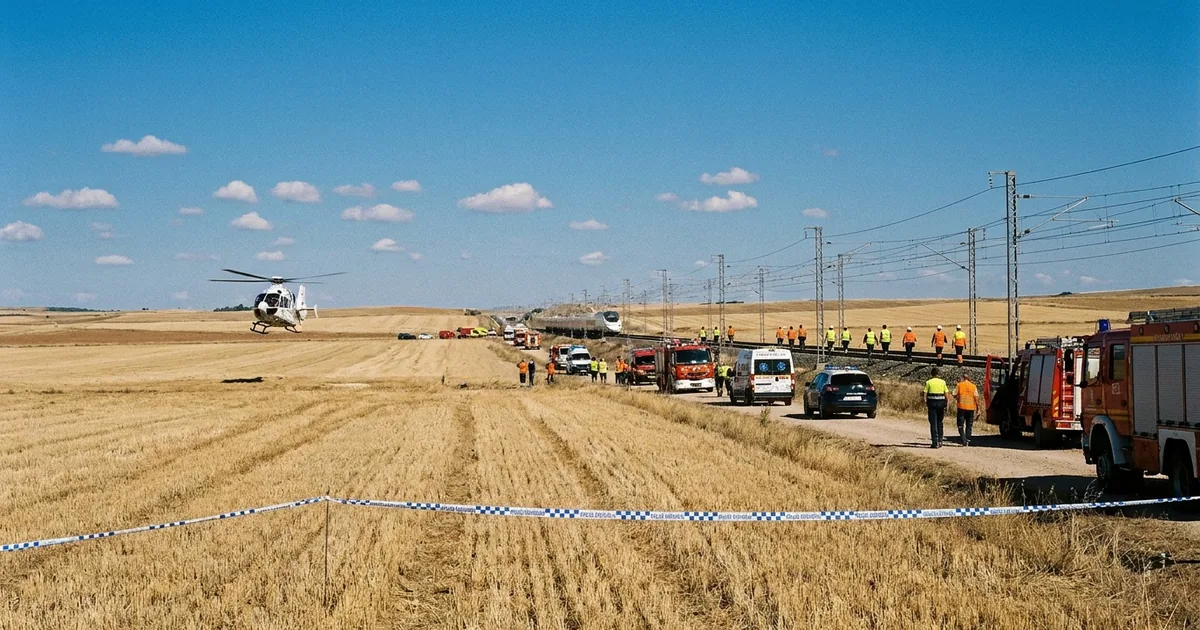
Two high-speed passenger trains, one run by Renfe and one by Iryo, collided in Toledo province at about 9 a.m. Wednesday and at least 10 people are dead, 283 days after another Renfe train and another Iryo train collided near Córdoba and 45 people died.
Here is what is established:
- Castilla-La Mancha’s regional government has confirmed at least 10 deaths, and spokeswoman Esther Padilla said the number “will surely continue to increase.”
- Adif, the state infrastructure manager, placed the collision between Mora, Orgaz and Urda, at kilometre point 118 of the Madrid-Seville line, and suspended all traffic on the Madrid-Andalusia high-speed route “following a rear-end collision between two trains.”
- Transport Ministry sources told Europa Press that the Renfe AVE may have hit the Iryo train from behind, and that two Iryo cars left the rails.
- Prime Minister Pedro Sánchez posted his “affection, solidarity and support” for the victims and their families.
- No cause has been given.
Treat every figure above 10 with suspicion, including the ones that sound official. Sky News reported 39 dead later in the morning, citing local authorities, and other outlets have put 39 on Castilla-La Mancha emergency services and 46 on Civil Protection. None of those numbers has turned up in a statement from a named official, and 46 is uncomfortably close to the toll some references now give for January’s crash. We are using 10 because it is the figure Padilla put her name to.
Rail disasters count upward through the morning, so 10 is a floor and not a verdict. In January the first reports said at least 20, and the count climbed to 45. Expect this one to be out of date by lunch, in one direction.
Here is what the early copy leaves unsaid. On a high-speed line, signalling and automatic train protection exist for one reason, which is that one train must not be able to run into the back of another. A rear-end collision, which is Adif’s own description, means that layer failed, was overridden, or was not in use. That is our reading and not a finding, and nobody has yet said which it was. Early accounts do not even agree on which train was standing still.
January was a different mechanism. Spain’s rail accident commission said in a preliminary report that the rail had likely fractured before the Iryo train passed, and that the cause of the break had not been established. A broken rail and a train catching another from behind are not the same failure, and nothing reported so far connects them. What connects them is smaller and harder to wave off: the same two operators, the same Madrid-Seville line, the same infrastructure manager in Adif, and 283 days.
| January 18 | October 28 | |
|---|---|---|
| Where | Adamuz, Córdoba province | Between Mora, Orgaz and Urda, Toledo province (km 118) |
| Line | Madrid-Seville high-speed line | Madrid-Seville high-speed line |
| Operators | Iryo and Renfe | Renfe and Iryo |
| What happened | An Iryo train derailed and was struck by a Renfe train coming the other way | Ministry sources say a Renfe AVE may have hit an Iryo train from behind; two Iryo cars derailed |
| Dead | 45 at the last count NBC cites; some references now say 46 | At least 10 confirmed; 39 and 46 reported, unconfirmed |
| Cause | Preliminary finding: the rail fractured before the Iryo train passed; why it broke was not established | None given |
| Madrid-Andalusia service | Suspended, reopened February 17 | Suspended |
Our view is that Adif and the Transport Ministry should not wait for an investigation timetable to say in public whether the protection system between those two trains was working. That is a plain fact that train recorders and signalling logs should be able to settle far faster than a full inquiry settles why. In January the line stayed shut until February 17, roughly 30 days. It should stay shut now until someone with a title can say, in specifics, what stood between these trains and what it did.
Four things to watch. Castilla-La Mancha’s consolidated count, which will replace every number in this piece. Whether Adif or the Ministry explains why one train was stopped on the line at that hour. Whether investigators publish a first timeline in days or in months. And how long Madrid-Andalusia service stays suspended, which will show how seriously Adif is taking the question.