
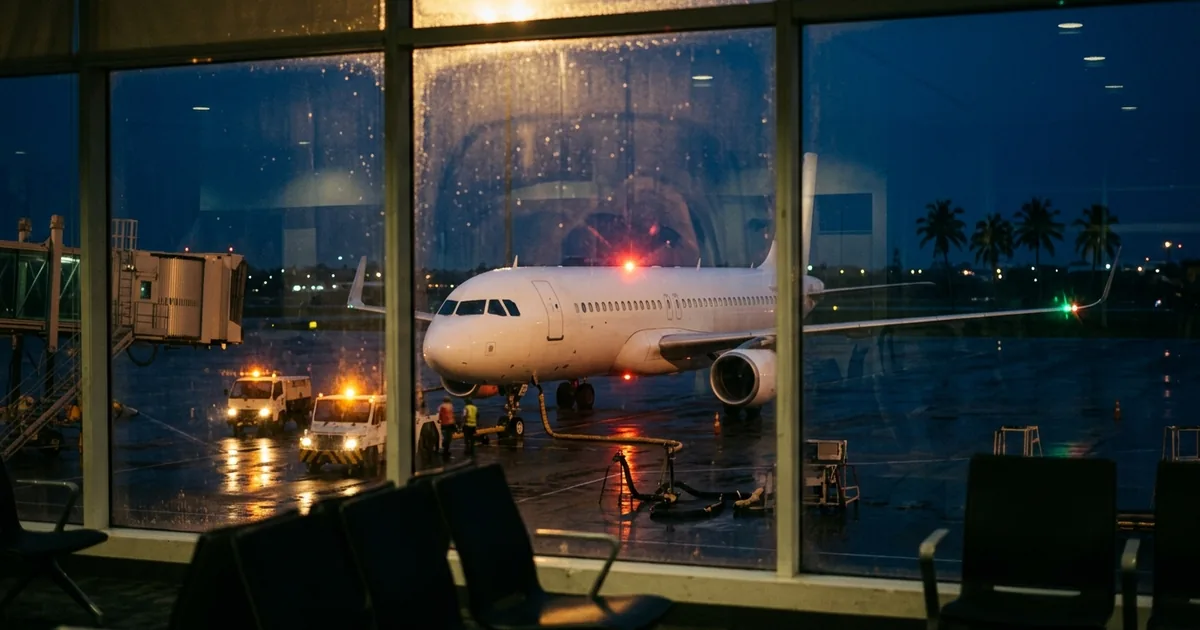
Alaska Airlines Flight 305 had already pushed back from its gate at Miami International on Sunday, bound for Seattle, when the flight attendants came forward with something no crew wants to relay: passengers on board were threatening them, and one of them said they were going to take the aircraft over.
The pilots stopped the taxi, called for police, sealed the flight deck, and had the 737 towed back to gate E6. Everyone got off. Then the two people at the center of it were put on a different flight.
That last sentence is the one worth sitting with.
The Sequence on the Taxiway
The details are unusually well documented because the crew was talking to the tower the entire time. The pilots reported that flight attendants had relayed threats from multiple travelers, requested law enforcement support, and then told controllers they intended to put the aircraft into a lockdown. The plane never took off. Miami-Dade Sheriff’s Office Airport District deputies met it at the gate and deplaned the entire cabin so the aircraft could be searched and the passengers interviewed.
The finding, as CBS Miami reported on the customer disturbance and threats, was that no credible threat existed. The two disruptive passengers were removed from Flight 305, and because deputies had formally concluded there was nothing credible to charge, they were legally free to fly. So they were booked onto another departure.
What a Cockpit Lockdown Actually Is
The word “lockdown” gets used loosely in coverage of airline incidents, so it is worth being precise. Since the post-9/11 hardening rules, the flight deck door on a commercial airliner is a reinforced barrier designed to resist forced entry and small-arms fire. In normal operation it can be opened from the cabin side through a keypad and interphone procedure, with the pilots able to grant or deny access.
A lockdown means the crew has disabled that pathway entirely. Nobody in the cabin can get in, by any code, for any reason, until the pilots decide otherwise. It is a procedure that exists specifically for the scenario where the threat is understood to be inside the passenger compartment rather than outside the aircraft.
Pilots do not reach for it casually. Reaching for it on a stationary aircraft that has not yet taken off, with the tower listening, means the crew had decided the situation could plausibly escalate to an attempt on the flight deck. Whatever the sheriff’s office concluded ninety minutes later, the people actually in the room made a real-time assessment and acted on it.
“No Credible Threat” Is a Charging Decision, Not a Character Reference
Here is where the coverage of this incident has mostly stopped, and where it should start.
A local sheriff’s office finding of no credible threat is a criminal-law determination. It answers a narrow question: is there enough here to arrest and charge someone today, under Florida statute or federal law, with a reasonable expectation it survives a prosecutor’s review? Deputies concluded no. That is their call to make and there is no obvious reason to second-guess it from a keyboard.
But it answers only that question. It is not a finding that nothing happened, it is not a finding that the crew overreacted, and critically, it does not close the matter, because the criminal track is not the only track.
Interfering with a flight crew is also a civil-enforcement matter for the Federal Aviation Administration, and the FAA runs that process independently of whether local police make an arrest. Under the zero-tolerance policy the agency adopted in January 2021, the FAA skips warning letters and goes straight to proposed fines, which it explains on its unruly passengers page can now reach $43,658 per violation, with a single incident capable of generating several. The agency has also built a referral pipeline to the FBI, having sent more than 310 of its most serious cases over for possible criminal prosecution since late 2021.
So the honest read on Sunday is not “nothing to see here.” It is that one of the two enforcement systems declined to act on the spot, and the other one has not weighed in yet and operates on a timescale of months.
There is a third layer, and it is the one passengers actually experience. Airlines maintain their own internal no-fly lists, and those decisions are commercial rather than legal. Alaska can bar someone from its aircraft without any court’s permission. What it cannot do is stop that person from buying a ticket on Delta, because carriers do not share those lists with each other. A federal shared no-fly list for unruly passengers has been floated repeatedly by the industry’s own unions and has never been created, largely because handing airlines a cross-carrier travel ban with no due-process mechanism is a genuinely hard problem, not because nobody thought of it.
The Part That Should Reassure You, and the Part That Should Not
The reassuring context is that this behavior is far less common than it was. The FAA says the rate of unruly passenger incidents has fallen by more than 80 percent from the record highs of early 2021, when mask confrontations were producing multiple incidents a day. The system responded to a genuine crisis with fines, publicity and prosecution referrals, and the curve bent.
The unreassuring part is that averages are not the risk here. The relevant number is not how often something happens on a random flight, it is how the system handles the small number of incidents at the severe end, the ones involving explicit statements about taking control of an aircraft. On Sunday the crew handled that end of the distribution correctly and quickly. The question the crew cannot answer, standing at gate E6 watching two passengers walk toward a different departure board, is what happens the next time those two get on a plane.
The FAA has not said whether it is investigating. If it is, nobody will hear about it for a while. That is how the civil track works, and it is why the local finding on Sunday afternoon is the beginning of this story rather than the end of it.