
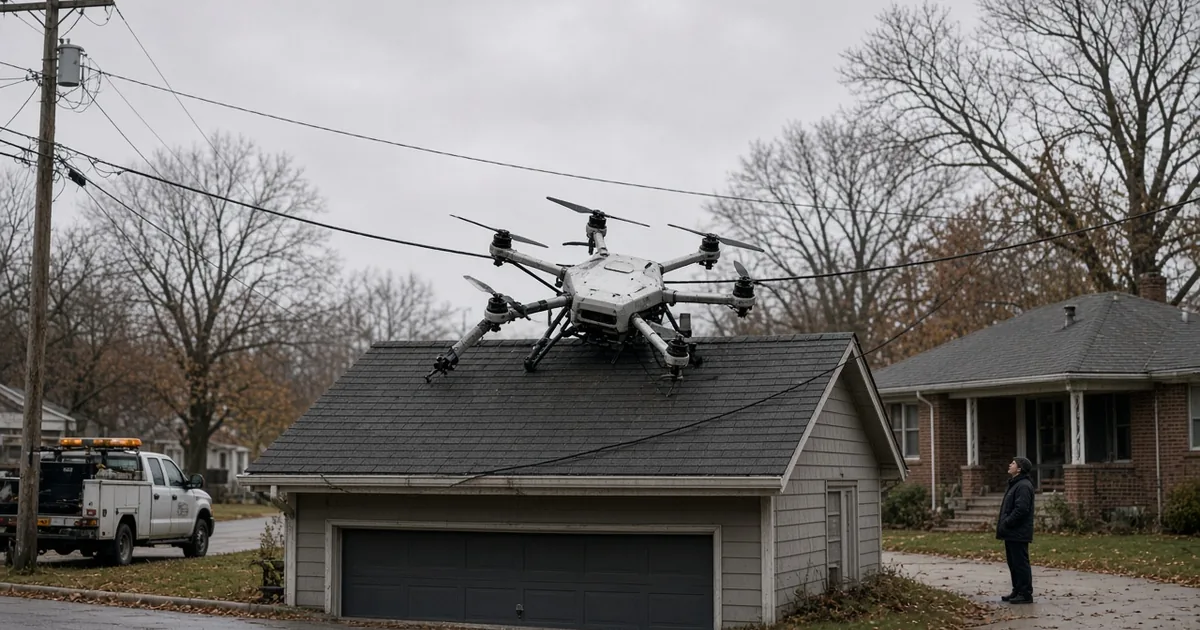
The shampoo arrived. The drone that brought it did not make it home.
On Friday afternoon in Huntington Woods, a suburb north of Detroit, an Amazon Prime Air MK30 dropped a bottle of shampoo at James Brennan’s house, climbed out, and hit a fiber-optic line on takeoff. The FAA’s preliminary report says it “struck a fiber cable, a residential garage, and became entangled in power lines.” Nobody was hurt. Most coverage stopped there, filed under quirky.
It should not be filed there. Lined up by date, this is at least the sixth crash event for Amazon’s MK30 since December 2024, and in five of those six the drone hit something in its path.
| Date | Place | What happened |
|---|---|---|
| December 2024 | Pendleton, Oregon | Two MK30s crash at Amazon’s test site, one catches fire; Amazon pauses Texas and Arizona deliveries for software changes |
| October 1, 2025 | Tolleson, Arizona | Two MK30s strike the same crane boom minutes apart; NTSB investigates |
| Late 2025 | Waco, Texas | A drone brings down an internet cable; federal investigators open a probe |
| February 4, 2026 | Richardson, Texas | An MK30 hits the side of an apartment building, debris falls on a public sidewalk |
| July 29, 2026 | Darlington, England | An MK30 comes down in a garden after what Amazon says was contact with an object above a moving vehicle; the UK’s AAIB opens an investigation |
| November 20, 2026 | Huntington Woods, Michigan | An MK30 hits a fiber line on takeoff and lands on a neighbor’s garage roof |
Two cables. A crane. A building. Whatever sits above a truck. The failure mode is not random. It is the drone meeting the clutter of a real neighborhood at low altitude, exactly where people live.
After Tolleson, Amazon said it had added “enhanced visual landscape inspections.” A fiber line strung between two houses is the kind of landscape those inspections exist to catch.
The Man Who Ordered the Shampoo
Brennan did not set out to be a test case. His household ordered shampoo and expected a truck, until a notification said it was “coming by drone in seven minutes,” he told KCRA. He said he never asked for drone delivery at all.
He watched it go. “It swayed a couple of times, and then it swayed over the top of the garage,” he told NBC News. “It kind of laid down and died.”
Neighbors briefly lost internet. DTE crews came out because the aircraft sat pinned between the garage roof and an electrical line, Brennan told WXYZ. His neighbor Logan Coomes got scuffed shingles, a corner that may now leak, and a $100 Amazon gift card.
Brennan’s verdict was plainer than anything Amazon has said: “Until they develop better technology to spot these kinds of things, this is going to continue to happen.” His house is now on a no-drones list.
Amazon’s line is that “safety is our top priority and incidents are extremely rare.” The company says Prime Air flies nearly 6,000 deliveries a day and is aiming for close to 500 U.S. cities and towns by year’s end, roughly a sixfold jump.
Here is where we land. “Extremely rare” is a per-flight number, and per-flight numbers shrink as the fleet grows. The table above is the number that matters: the same kind of failure, wires and structures near the ground, repeating across three states and two countries after Amazon said it had fixed it. Multiply the flights by six and that pattern lands on six times as many garages.
The FAA is investigating. The NTSB is still deciding whether to open a probe. Neither should be a formality. Before Prime Air scales into hundreds of new towns, Amazon should have to show regulators, in public, that the MK30 can now see a fiber line it is about to fly into.
This time it was shingles and a gift card. The next town may not be so lucky about what sits under the wire.