
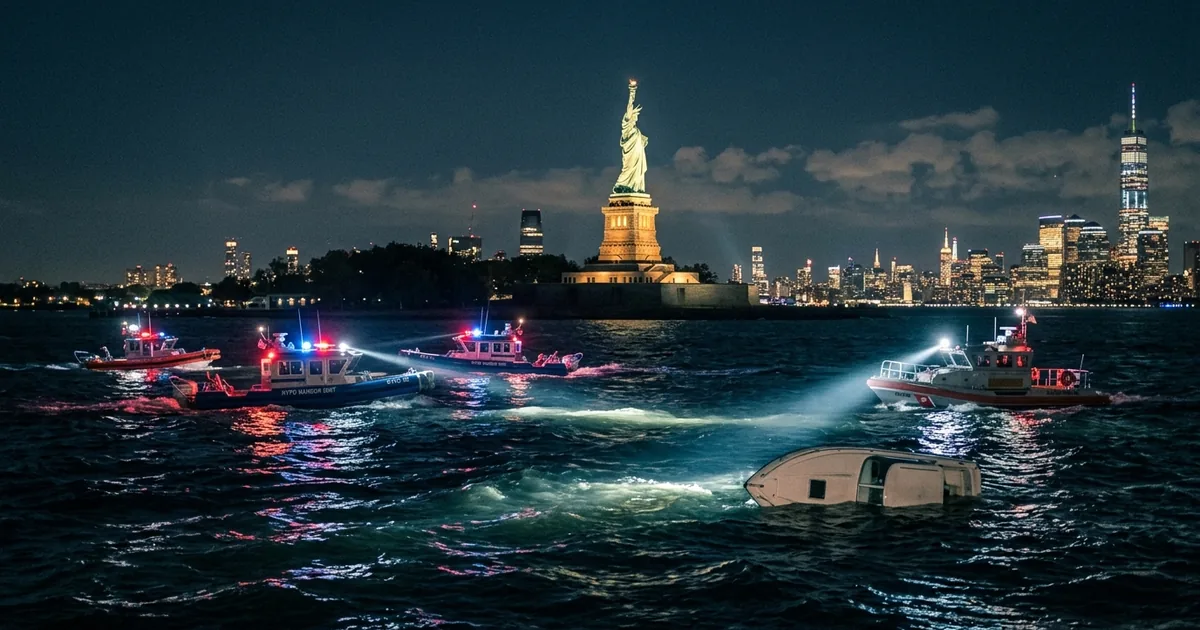
A 22-foot pleasure boat carrying roughly 14 people capsized in New York Harbor late Saturday night, killing a 27-year-old woman and a 5-month-old girl within sight of the Statue of Liberty.
The man police say was operating it now faces 13 counts of reckless endangerment, a number that tracks the other people investigators place on a hull manufacturers typically rate for 10 to 12.
That gap between the boat’s rated capacity and the number of bodies in the water is not a detail. It is most of the story, and it points at something most of the coverage has treated as a footnote: the Coast Guard is investigating whether the trip was operating as an illegal charter.
What Happened Off Liberty Island
Police received a 911 call at about 10:25 p.m. Saturday reporting an overturned vessel near Liberty Island. NYPD harbor, scuba, and aviation units responded alongside the FDNY and the Coast Guard, and divers pulled a 27-year-old woman and a 5-month-old girl from the water. Both were taken to NYU Langone Hospital in Brooklyn in critical condition, where they were pronounced dead.
Twelve people had already been pulled from the water by the time police arrived. ABC7 New York reported that the survivors were taken to area hospitals with minor injuries. Police have not released the names of the two who died, pending family notification, and have not formally confirmed the relationship between them, though several outlets have reported them as a mother and her infant daughter.
Manuel Hernandez, 46, of Manhattan, was arrested at about 2:30 a.m. Sunday, and NBC News reported that he was charged with 13 counts of reckless endangerment. Those charges are allegations. Nothing in the public record yet establishes what put the boat over.
The Arithmetic of a 22-Foot Bowrider
The vessel has been described as a 22-foot bowrider, the open-front recreational powerboat that fills every marina on the Eastern Seaboard. NBC New York identified it as a Bayliner. A boat in that class is generally rated for 10 to 12 people, and the rating is not a suggestion about legroom. It is a stability calculation.
A bowrider sits low. Its freeboard, the distance from the waterline to the top of the hull, is measured in inches, and the open bow is built to shed spray, not to hold standing water. Load it past its rating and two things happen at once. The hull settles deeper, so less wave height is needed to put water over the rail. The center of gravity also climbs, because additional passengers sit and stand up high rather than distributing low in the hull. An overloaded bowrider does not degrade gently. It behaves normally until a wake, a hard turn, or a cluster of people shifting to one side carries it past a threshold, and then it goes over fast.
Do that at 10:25 at night, in the wake-churned water of New York Harbor, with an infant aboard, and the margin for error is close to nothing.
The Question the Coast Guard Is Actually Asking
The Coast Guard Investigative Service is examining whether the trip was an illegal charter. That is a specific and consequential allegation rather than paperwork trivia. Federal rules require a credentialed mariner to run a captained charter carrying six or fewer paying passengers, and carrying more than six for hire pushes the vessel itself into an inspection and certification regime that a recreational bowrider cannot satisfy.
Here is where the economics turn ugly. A licensed, inspected vessel costs real money to operate and caps the number of seats an operator can legally sell. An unlicensed operator with a recreational boat carries almost no fixed cost, submits to no inspection, and has every financial reason to load more people than the hull is rated for, because each additional passenger is nearly pure margin. The safety rule and the profit motive run in opposite directions, and only one of them is checked at the dock.
Coast Guard officials in New York have been describing this failure mode for years. Covering a Sector New York enforcement push in 2022, CBS New York quoted Derek Severns, then the sector’s acting operations officer, saying that “the greatest danger is over capacity, not having the correct safety gear.” Lieutenant Hayden Veech, a marine investigator, told the station in the same report that illegal operators advertise on peer-to-peer booking platforms including Sailo and Boatsetter, sometimes claiming capacity and safety certifications they do not hold. That reporting is four years old and it describes precisely the scenario investigators are now testing against Saturday night.
A Harbor That Keeps Producing the Same Accident
What lifts this above a single bad night is that the pattern repeats. The same 2022 enforcement push followed a Hudson River capsizing that July which killed a 7-year-old child and a 47-year-old woman, with overcrowding cited as a possible factor. Different borough, different boat, identical physics, identical question about who was aboard and why.
Three weeks ago we covered a family’s memorial service in San Francisco Bay that ended with a capsized boat near Alcatraz, one person dead and three missing. The common thread in these cases is rarely a storm or a mechanical failure. It is a small recreational hull asked to do the work of a passenger vessel.
Enforcement is largely reactive. The Coast Guard runs periodic safety patrols and terminates voyages when it catches violations, but no agency can inspect a harbor the size of New York’s boat by boat on a warm Saturday night. Illegal charters get booked through apps and direct messages, they leave from ordinary docks, and they look exactly like a group of friends heading out on the water, because from the outside that is what they look like.
What Would Actually Change Anything
The case against Manuel Hernandez will answer one question about one operator on one night. It will not reach the booking platforms carrying the listings, the absence of any capacity check at the point of sale, or the plain fact that someone booking a harbor cruise has no practical way to verify that the person taking their money holds a credential.
Two people are dead, one of them five months old, in the most photographed stretch of water in the country. The investigation will eventually produce a cause. The harder question is whether anything upstream of it changes before the next warm Saturday night.