
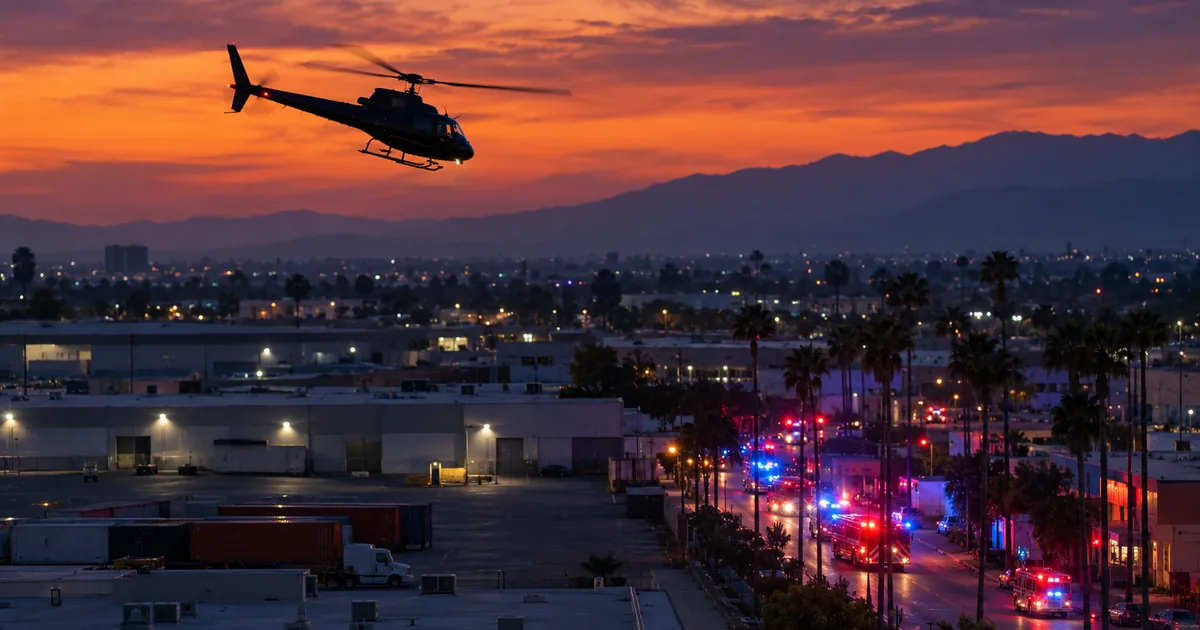
A Los Angeles news helicopter sent to film a deadly bus collision in Chatsworth went down in a parking lot roughly two hours later, killing both crew members and a person on the ground who had nothing to do with either wreck. The coverage since has been careful, accurate and sympathetic, and almost none of it has asked why the aircraft was over that neighborhood in the first place.
That is the question Tuesday evening actually raises. Several news helicopters were working the same stretch of the San Fernando Valley, all of them chasing the same overhead picture of a traffic collision that every station in the market was already covering from the ground. One of them came down between two commercial buildings and burned. The reporting has the names and the timeline right. What it has not touched is the part where a local traffic story pulled a small fleet of aircraft into low airspace over a dense neighborhood, and a person standing in a parking lot was killed by one of them.
What Happened on Mason Avenue
The first crash came just after 5 p.m. at Nordhoff Street and De Soto Avenue, where an SUV struck a Metro bus hard enough to end up partially inside it. NBC Los Angeles reported that three people were killed and six hospitalized, with a Los Angeles Urban Search and Rescue team cutting trapped passengers free.
Just before 7 p.m., a Eurocopter AS 350 B2 built in 2004 and operated by Angel City Air went down in the 9100 block of North Mason Avenue. The station confirmed the aircraft as NewsChopper4, which supplied aerial coverage for both NBC4 and Telemundo 52. It struck shipping containers and parked cars, caught fire, and damaged four vehicles and two storage containers. Pilot George Marciniw and aerial photojournalist Eliana Moreno, both Angel City Air employees who had flown together since 2023, were killed. So was one person on the ground. At least two more people were taken to hospital.
Los Angeles Fire Captain Brandon Silverman described what crews found: “From the helicopter itself, it’s pretty well destroyed. So we are going to have to go through the rubble.” The National Transportation Safety Board is leading the investigation, with the Federal Aviation Administration and Los Angeles police involved. NBC News reported that an NTSB investigator was due on scene Wednesday morning.
Six people died in one Valley neighborhood over the course of a single evening, and three of those deaths happened because the first three were being filmed.
“There are serious questions about what happened tonight,” said Los Angeles County Supervisor Lindsey Horvath.
The Person Who Was Not Working the Story
Most accounts give the third victim a single clause. Not a journalist, not a bus passenger, not the driver of the SUV, and as of Wednesday morning not yet publicly named. Just someone standing in a parking lot in Chatsworth when a helicopter came down.
That detail breaks the frame the industry has always used to talk about this risk. Aerial newsgathering deaths get discussed as an occupational hazard, something crews knowingly accept in exchange for the shot, mourned inside the business as the price of the job. It is a coherent argument when the only people exposed are the two in the aircraft. It stops working entirely when the aircraft is orbiting at low altitude over commercial blocks where people are walking to their cars, because those people never agreed to anything and were never told a calculation was being made on their behalf.
Why the Sky Over an LA Traffic Crash Fills Up
Los Angeles is the most helicopter-saturated news market in the country, and the reason is competitive rather than journalistic. The overhead picture is a differentiator: a station that owns the live aerial gets the cleaner broadcast, the segment other outlets have to credit, and the clip that travels. Because no station will accept a rival’s feed as its own, a single newsworthy street incident draws multiple aircraft into the same pocket of airspace, each one flown to get an angle nobody else has.
There is a second structure underneath it. Moreno and Marciniw did not work for NBC4. They worked for Angel City Air, the contractor that owns and flies the aircraft the station brands as NewsChopper4. That arrangement is standard across local television, and it has an obvious effect: the newsroom gets the footage and the branding, and the vendor absorbs the operating risk, the insurance and the liability.
Our position is that the flight should not have happened. The aerial shot of a bus collision that was already surrounded by fire crews, ambulances and ground reporters told viewers nothing they did not already know. It was product differentiation, not reporting, and it is worth saying plainly that a fatal traffic wreck on Nordhoff Street did not require anyone to be in the air. Contracting the flying out does not move that decision. The assignment desk that wants the picture is the party that puts an aircraft over a neighborhood, whoever signs the pilot’s paycheck, and this is the moment for Los Angeles news directors to decide which routine incidents are genuinely worth an airframe overhead.
Seventy Deaths and One Question Nobody Asks
This is not a freak event in a safe field. At least 70 pilots and journalists have been killed in aircraft crashes involving US television and radio stations since the 1960s, nearly all of them in helicopters, according to a WFAE review of the industry’s record. The 2007 Phoenix collision, in which two competing news helicopters covering a police chase flew into each other and killed all four people aboard, happened live on television. In 2022, WBTV meteorologist Jason Myers and pilot Chip Tayag died near Interstate 77 in Charlotte on a flight to shoot practice video over a simulated news scene, a crash federal investigators later blamed on inadequate inspections of the rotor control hardware.
Phoenix produced real reforms. The NTSB’s report on that collision pushed news pilots toward concentrating on flying instead of broadcasting while they fly, and stations added high-visibility rotor striping and strobe lighting. Those fixes, and the maintenance findings out of Charlotte, all answer the same kind of question: how to fly more safely around a story. None of them asks whether the story required flying at all, which is the only question that would have kept three people alive on Tuesday.
Compare what happens when a state treats a fatal helicopter collision as a systemic problem rather than an individual tragedy. When a midair crash killed two aircrew over Psatha this summer, Greece grounded its Bell fleet while it worked out what went wrong. American local news has no equivalent mechanism, because no single body owns the decision to launch. Each station makes its own call, in a competitive market, several times a day.
The NTSB will spend a year or more establishing what failed on NewsChopper4, and that finding matters to the families and to everyone still flying these aircraft. It will not address the thing that put a helicopter over Mason Avenue on a Tuesday evening. That decision was made in a newsroom, in seconds, the way it is made every day, and no federal investigator has the standing to review it.