
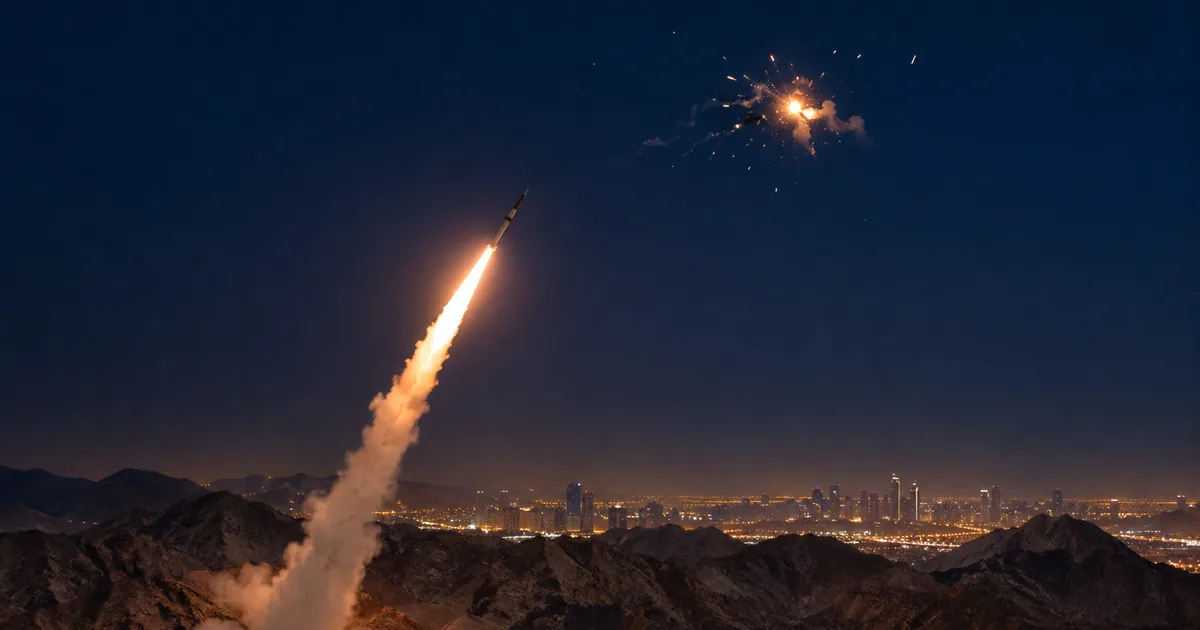
Royal Saudi Air Defence Forces destroyed a drone before it crossed into restricted airspace over Mecca on Tuesday evening, setting off the first security alert in Islam’s holiest city since 2017. Saudi Arabia called the attempt a red line, collected condemnations from across the region, and then declined to use the one instrument it built for exactly this moment.
Six weeks ago, on August 7, the kingdom signed a mutual-defense agreement with Turkey and Pakistan modelled on NATO’s Article 5, under which any armed attack on one of the three states is treated as an attack on all of them. The three governments named it the Mecca Defence Alliance. On the night a drone was aimed at Mecca, Riyadh did not invoke it. Officials in Ankara and Islamabad told the Associated Press that no Saudi request for support ever arrived. Nearly every account of Tuesday night carries the interception, the denial and the condemnation. The pact that went untouched is the part nobody is reporting, and it is the part that tells you what the alliance is actually for.
What the Kingdom Says Happened
Saudi-led coalition spokesperson Turki al-Maliki said air defenses intercepted and destroyed the drone before it reached restricted airspace, with debris coming down south of the city. Authorities switched on alerts in Mecca, Taif and Jeddah, then lifted them within minutes. Al-Maliki called the attempt an effort to frighten worshippers and harm civilians, and said the security of the two holy mosques and pilgrims is a “red line.”
Al Jazeera reported that this was the first time in almost a decade the Houthis have been accused of targeting Mecca, the last attempt being a ballistic missile intercepted in 2017. The city sits roughly 1,100 kilometers, or 680 miles, from the Yemeni border.
The Houthis deny all of it. Military spokesman Brigadier General Yahya Saree said the group’s targets were Saudi oil facilities and military bases “far removed from the holy places.” A Houthi military source put it more flatly to the SABA news agency: “We categorically deny that there is any threat from Yemen directed at the city of Mecca or any other holy sites.”
An Alliance That Has Never Been Switched On
Tuesday was not the pact’s first opportunity. It was at least its fourth.
The Mecca Defence Alliance was signed on August 7. Two days later the Houthis put a drone into Saudi Aramco’s Jazan refinery on the Red Sea coast, and NBC News reported the strike started a fire at a plant the Saudi energy ministry says processes 400,000 barrels of crude a day. NPR carried the group’s claim of responsibility the same day, and Saudi authorities said the fire was extinguished without casualties. The Houthis then claimed a second strike on the same refinery within the week, and a third on August 18. Riyadh has confirmed very little about the damage in any of them.
Four attacks on Saudi territory in six weeks, three of them on critical energy infrastructure, and the mutual-defense clause has never been triggered once. This is not a pact that failed a test. It is a pact that has never been put into one, by the deliberate choice of the only country in a position to ask.
The skepticism is not hindsight, either. Writing in Foreign Policy on August 25, Vasabjit Banerjee, an associate professor of political science at the University of Tennessee, Knoxville, argued the alliance was built in a way that invites its members to pass the buck, noting that it “does not establish a central command system, any paths to achieve greater interoperability, or clear obligations in terms of defense spending and procurement.” Then he named the scenario almost exactly.
A similar situation could arise if Iran attacked Saudi Arabia: Turkey and Pakistan would find that the costs of intervening outweigh any benefits.
Three weeks later a drone flew toward the city on the pact’s letterhead, and neither partner was asked to find out.
Why Riyadh Never Made the Call
The easy reading is that the alliance is hollow. Our read is less comfortable for anyone hoping it stabilizes the region: the pact is behaving exactly as designed, because what it was designed to do is sit there.
Invoking a mutual-defense clause over an intercepted drone would set the activation bar absurdly low, and it would commit a NATO member and a nuclear-armed Pakistan to a shooting war with the Houthis at a moment when the United States is already at war with Iran. Neither Ankara nor Islamabad wants that bill. Riyadh knows it. Asking and being turned down would convert a useful ambiguity into a documented failure, and the deterrent value of a paper alliance lasts only as long as nobody checks the paper. So Saudi Arabia did the rational thing and reached for the phrase “red line” instead, which costs nothing and commits no one.
That is the structural answer to why the kingdom keeps absorbing these strikes alone, and it is why the rhetoric did the work the treaty was supposed to do. A security guarantee that cannot be used without being destroyed is a diplomatic signal wearing a treaty’s clothes. The three governments are selling it as something sturdier, and they should be held to the difference.
The Denial Is Narrower Than It Sounds
Read Saree’s statement again. The Houthis are not denying they fired at Saudi Arabia on Tuesday. They are denying that the target was Mecca, and volunteering that the targets were oil facilities and military bases.
Both claims can be true at once. Jeddah’s port and refining complex sit on the same western corridor, and a drone tracking toward that coast passes near the restricted airspace that tripped the alert. Saudi Arabia shifted a large share of its export capacity west specifically to get out of Iranian reach in the Gulf, which, as we reported this month, walked that infrastructure directly into Houthi range. The kingdom has an obvious interest in describing a strike on that corridor as a strike on the holy city, because one of those is an energy story and the other is an offense against nearly two billion Muslims.
The skepticism cuts both ways. The Houthis have an equally obvious interest in denying a charge that would cost them standing across the Muslim world, and they have misrepresented their own operations in both directions before. Saudi Arabia has offered no public evidence beyond the coalition’s account. The honest position on Tuesday night is that the interception is well attested and the intended target is contested, and the outlets flattening that into “Houthis attacked Mecca” are doing Riyadh’s framing for it, free of charge.
What to Watch
The Houthi campaign has already pushed well past Yemen’s borders, including a claimed strike on a nuclear plant in the UAE, and the wider war has since closed the Strait of Hormuz and tightened the squeeze on the Bab al-Mandeb. The question for the coming weeks is not whether the Mecca Defence Alliance gets invoked, because it will not be. It is how long Saudi Arabia is willing to keep paying the price of holding it in reserve.
There is a point where absorbing repeated strikes on refineries, and now on the approach to Mecca, while three governments maintain a treaty everyone can watch going unused, stops reading as strategic patience. It starts reading as a bluff that has already been called quietly, four times, without anyone having to admit it.