
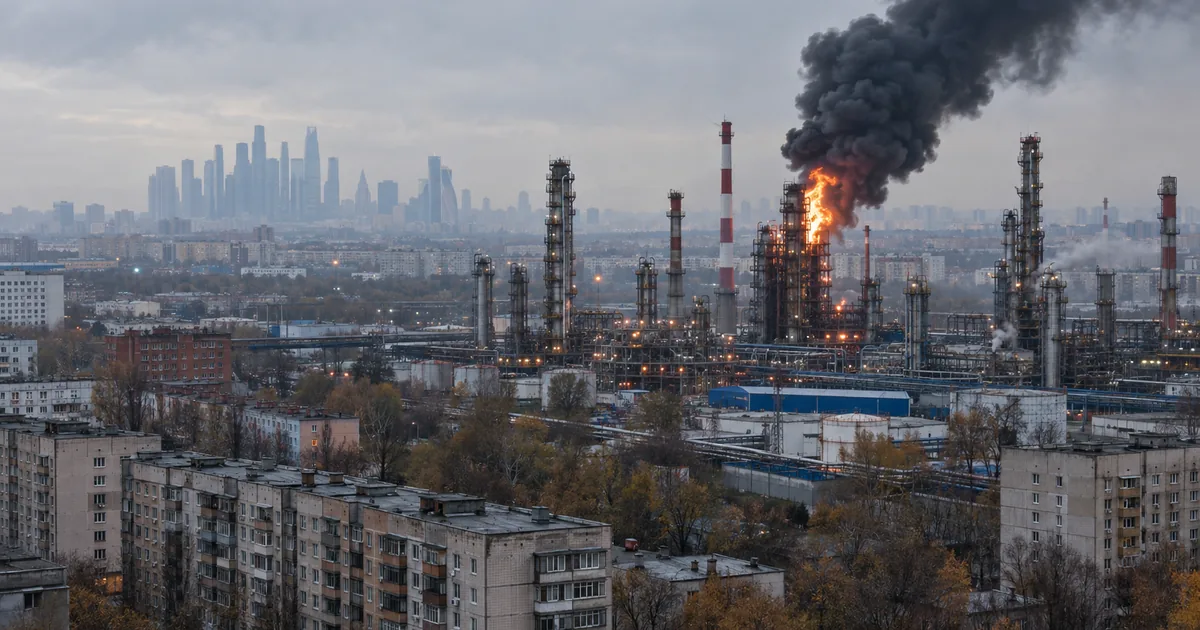
Ukrainian drones set fire to the Gazpromneft refinery in Moscow’s Kapotnya district early Sunday, hours before polls closed on the third and final day of Russia’s parliamentary election. The strike is being reported nearly everywhere as a number, and the number is the least reliable thing in the story.
Every major outlet led with a count that Russia supplied and nobody outside the Russian Defence Ministry can verify: 1,110 drones downed overnight, or more than 1,600 since Saturday. Almost none of them went back three months to what Reuters established about this specific plant in June, which is that it needed at least six months of repairs and was unlikely to produce anything again this year. Either that assessment was wrong, or Russia repaired the plant quietly and fast, or Ukraine spent its largest barrage of the year burning a facility that was already dark. Those are three very different stories. The drone count does not distinguish between them, and today nobody is trying to.
The Count Came From the Country That Got Hit
Start with what is actually being claimed, and by whom, because the figures moving around Sunday came from three different officials describing three different things.
- Russia’s Defence Ministry said it intercepted and destroyed 1,110 Ukrainian drones overnight, the largest single-night figure the ministry has ever published.
- Moscow Mayor Sergei Sobyanin said more than 1,600 had been shot down across Russia since Saturday, of which 450 were heading for the capital.
- Ukraine’s General Staff said the main target was the Gazpromneft-Moscow refinery, and the Ukrainian official Andriy Kovalenko said plainly that the plant “supplies fuel to their capital city.”
Only the last of those is a statement of intent rather than a claim of success. The first two are interception totals published by the government whose territory was struck, during an election it was running, and they are unfalsifiable by design. A drone that is shot down and a drone that reaches its target both disappear from the sky. Russia has an obvious interest in the larger number, because a record barrage repelled is a story about air defence working rather than a story about a refinery burning nine miles from the Kremlin.
We would rather report what was hit than what was allegedly stopped, and on that question there is evidence that does not depend on anyone’s press release. NBC News geolocated footage showing a drone flying into a plume of smoke above Kapotnya, with the plant already burning beneath it and air-defence rockets firing at the drone before it came down. That is a verified image of a refinery on fire, which is a different class of fact from a tally of interceptions.
On the target itself the reporting is unusually consistent. Ukrainska Pravda and other outlets covering the fire identified the Kapotnya plant, which supplies roughly 40% of Moscow’s fuel market and about 70% of the surrounding region’s demand for petrol and aviation fuel. Sobyanin confirmed that several drones struck the refinery’s territory and that a facility was damaged, and said nobody there was hurt.
Kapotnya Was Already Broken Once
Here is the part that changes the meaning of Sunday, and that the wire coverage skipped.
This refinery was hit twice in June, and between them the two strikes accounted for all of it. The June 16 attack damaged a distillation unit responsible for 53% of the plant’s capacity, and the June 18 attack damaged the newer Euro+ unit that carries the other 47%. Reuters reported on June 24, citing two sources familiar with the matter, that repairs would take at least six months and the refinery was unlikely to resume production before the end of the year. Early assessments of Sunday’s strike point to the ELOU-AVT-6 unit, disabled in June, being hit again.
So the present-tense framing running through Sunday’s coverage, that Ukraine struck the refinery supplying 40% of Moscow’s fuel, quietly assumes a plant that Reuters’ sources said would not be refining anything this year had gone back to work. That may well be true. Russia has moved faster on refinery repairs than Western analysts expected more than once, and a return to partial throughput would itself be the more interesting story: it would mean the sanctions regime on refining equipment is leakier than advertised.
But nobody Sunday said which it was. The 40% figure is being recycled from the plant’s nameplate role rather than measured against its actual output, and the difference between a strike that removes 40% of a capital’s fuel supply and a strike that re-breaks an already broken unit is not a rounding error. It is the whole question of whether this campaign is accomplishing what Kyiv says it is.
Voting Day Was the Point
Timing is the one thing in this story nobody has to infer. Ukraine put its largest barrage of the year over Russia on the third and final day of a parliamentary election, and President Volodymyr Zelensky did not pretend otherwise, saying Ukraine’s long-range responses “had a very significant impact in the Moscow region last night.”
“One of Russia’s key oil industry facilities and the aggressor’s logistics facility were hit. These are billions.”
That is the strategy stated out loud. The goal is not to take Moscow’s lights out, which Ukraine cannot do. It is to make the war expensive in a currency the Kremlin cares about, and to make it visible to the roughly twelve million people in a city that has spent four years experiencing this war as something happening to other Russians. Four Moscow airports, Vnukovo, Domodedovo, Zhukovsky and Sheremetyevo, sat under flight restrictions overnight before reopening Sunday morning. That is the message: not casualties, but inconvenience to the capital’s professional class on the morning it votes.
This is continuous with a campaign LNC has tracked all year, from the 556-drone barrage in May that first brought the war home to Moscow, through July’s strike on the Moscow-region oil depot at Noginsk, to August’s deep strike on the Taneco refinery at Nizhnekamsk that killed 13. The pattern is not random terror. It is refining capacity, methodically, because refining is the chokepoint. Russia can pump crude it has no way to process, and fuel is what runs both the war and the economy underneath it.
What It Cost
Two people died in the Moscow region overnight, according to regional governor Andrey Vorobyov: a 44-year-old woman and an elderly man, killed in separate strikes on residential areas at Sofino and in the Orekhovo-Zuevsky district. ABC News reported that Vorobyov put the injured toll at 20 and that 400 people were evacuated from a burning apartment block in the Ramensky district.
The same night, Russia sent 138 drones into Ukraine, of which Ukraine’s air force said it intercepted or suppressed 101. In the Kyiv region, Al Jazeera reported that a woman and two three-year-old children were killed when a Russian drone hit their home, with a girl later dying in hospital; Ukraine’s State Emergency Service had earlier counted three dead.
Our position is that these two columns are not morally equivalent, and that saying so is not the same as pretending the first column is empty. A refinery that produces fuel for an invading army is a legitimate military and economic target, and Ukraine hitting it is not terrorism. An apartment block in Sofino is not a legitimate target, and a 44-year-old woman is dead in one. Both things are true, and the honest way to judge this campaign is by what it aims at and what it repeatedly hits, not by whose interception count you find more flattering. On that test Ukraine’s record on Sunday is better than Russia’s, which killed two three-year-olds in a house the same night, and still not clean.
What would settle the open question is throughput data rather than another barrage. If Kapotnya was already offline, Sunday bought Kyiv a headline on Russia’s election day and not much else. If it was running again, the more consequential finding is that Russia is repairing strategic refineries in three months, and the campaign that has defined Ukraine’s summer is a treadmill rather than a ratchet.