
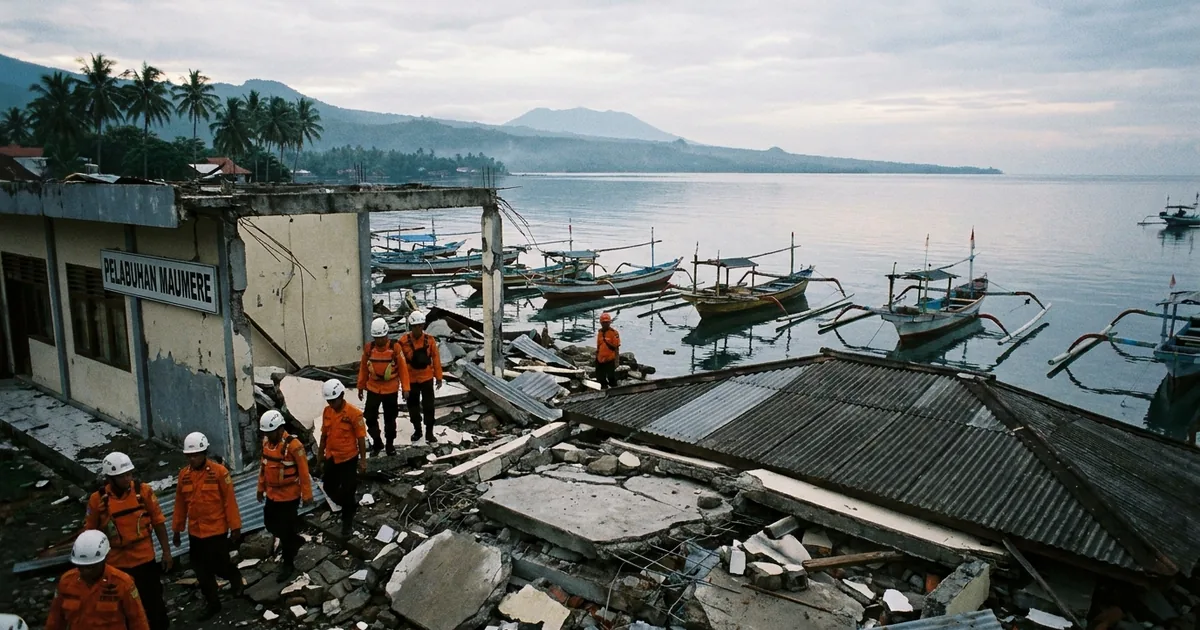
A magnitude 7.7 earthquake ruptured the seafloor north of Indonesia’s Flores Island at 5:58 on Saturday morning, bringing down a port terminal in Maumere, cracking open buildings across the Sikka district, and killing two people.
That number is the whole story, because the last time a quake this size hit this same stretch of coast, it killed roughly 2,500.
Sunrise, a Collapsing Roof, and Two Deaths at the Port
The U.S. Geological Survey put the epicenter 68 kilometers north-northwest of the city of Ende in East Nusa Tenggara province, at a depth of 10 kilometers. Shallow and close to shore are the two variables that decide whether a large number on a seismograph becomes a large number in a morgue. Both were working against Flores on Saturday.
The dead, a man and a woman, were at the Maumere port when the terminal’s waiting room came down, Al Jazeera reported, citing the local search and rescue agency. Two other people were hurt. Reuters verified footage from the port showing a building disintegrating into rubble while people screamed and ran.
Some of the most vivid damage was at St. Peter Major Seminary in Sikka, where students and nuns were partway through morning Mass when the assembly hall roof gave way. Rev. Guidelbertus Tanga, the seminary’s rector, said his students and nuns “ran out in panic beneath a collapsing roof.” One priest broke a leg. Yohanna Embu, a Sikka resident, told reporters that many buildings in the area were damaged and that she had watched the port terminal waiting room collapse.
Three aftershocks followed inside half an hour, at magnitudes 5.9, 5.6 and 6.1. USGS modeling estimates that more than half a million people on Flores felt very strong shaking, with millions more across the wider region feeling moderate to strong shaking. Hospital patients were moved outdoors as a precaution.
The Same Coastline Wrote a Very Different Ending in 1992
On December 12, 1992, a magnitude 7.7 earthquake struck this same seismic zone north of Flores. The shaking was not what killed most of the victims. The 1992 Flores earthquake and tsunami sent waves ashore with run-up heights reaching 26 meters, tall enough to go over a seven-story building. The village of Riang-Kroko was wiped off its headland, killing 137 of the people who lived there. The total death toll came in somewhere between 2,080 and 2,500, and researchers attribute roughly half of it to the water rather than the ground.
Maumere, the town where two people died on Saturday, was among the places 1992 hit hardest.
So: the same coastline, the same magnitude, and a difference of more than a thousandfold in the body count. That gap is worth understanding precisely, because the wrong explanation for it is both comforting and dangerous.
The Warning Went Out, Then Came Back Down
Indonesia’s Meteorology, Climatology and Geophysics Agency, known as BMKG, issued a tsunami warning within minutes for East Nusa Tenggara, West Nusa Tenggara, South Sulawesi and Southeast Sulawesi. Abdul Muhari of the national disaster agency BNPB gave coastal residents an instruction with no ambiguity in it.
Move away from the shore, either by going more than two kilometres inland or by moving up into hilly areas more than 10 metres high.
The warning was lifted a few hours later after monitoring showed no significant change in sea level. Australia’s tsunami warning centre found no threat to the Australian mainland or its territories. By the time the sun was properly up, the story had become one of collapsed buildings rather than drowned towns.
It is tempting to file this as a system working. That reading does not survive much scrutiny.
Indonesia’s Detection Layer Has Been Broken Since 2012
Indonesia built its tsunami early warning network after the 2004 Indian Ocean disaster, and a central piece of it was a set of 22 deep-ocean buoys designed to detect a wave in open water and confirm it before it reaches land. Every one of those buoys has been out of service since 2012, lost to a combination of vandalism, salvage theft and a maintenance budget the government never funded. The annual upkeep bill runs around $2.3 million. It has repeatedly gone unpaid.
The consequences were on full display at Palu in 2018, when a magnitude 7.5 quake generated a wave that killed thousands in Central Sulawesi. CNN documented how the warning system failed that day: no functioning buoys anywhere, and the nearest tide gauge sitting 125 miles from the city it was supposed to protect. The alert was stood down while water was still moving toward the shore. Vice’s reporting on the network described it bluntly as broken, stripped and stolen.
Nothing about that has been fixed in the years since. So when BMKG lifted Saturday’s warning after reading tide gauges, it was doing so with the same degraded instrumentation it had at Palu.
There is a harder physical problem underneath the funding one. A quake 68 kilometers offshore produces a near-field tsunami, and a near-field tsunami arrives in minutes. No buoy network on earth confirms a wave and pushes an alert through a bureaucracy fast enough to matter at that range. For the people on the Maumere waterfront, the only warning system with a useful response time was the shaking under their own feet, which is exactly why Muhari’s instruction was phrased as a distance and an elevation rather than a promise to tell them when.
What Actually Spared Flores
The honest answer is the seafloor. A rupture’s ability to generate a tsunami depends on how much water it displaces vertically, and this one appears not to have displaced much, whatever it did to the buildings above it. That is a fact about geology on Saturday morning, not a fact about Indonesian disaster policy.
This arc keeps testing the question. A magnitude 7.8 quake hit Mindanao in the Philippines in June, and a 7.3 off Chiapas triggered a tsunami alert that was later stood down in July. Each time an alert is issued and then withdrawn without incident, the public lesson tends to be that the alert was overcautious. The actual lesson is that the system has not been tested yet.
Saturday’s toll may still climb. Crews from the national search and rescue agency were working through debris in Maumere as the day went on, and outlying villages on a mountainous island take time to reach. But two deaths from a 7.7 on this coast is a genuinely good outcome, and it is worth being clear-eyed about why: Flores got a break from the ocean floor, not from the $2.3 million a year nobody has spent.