
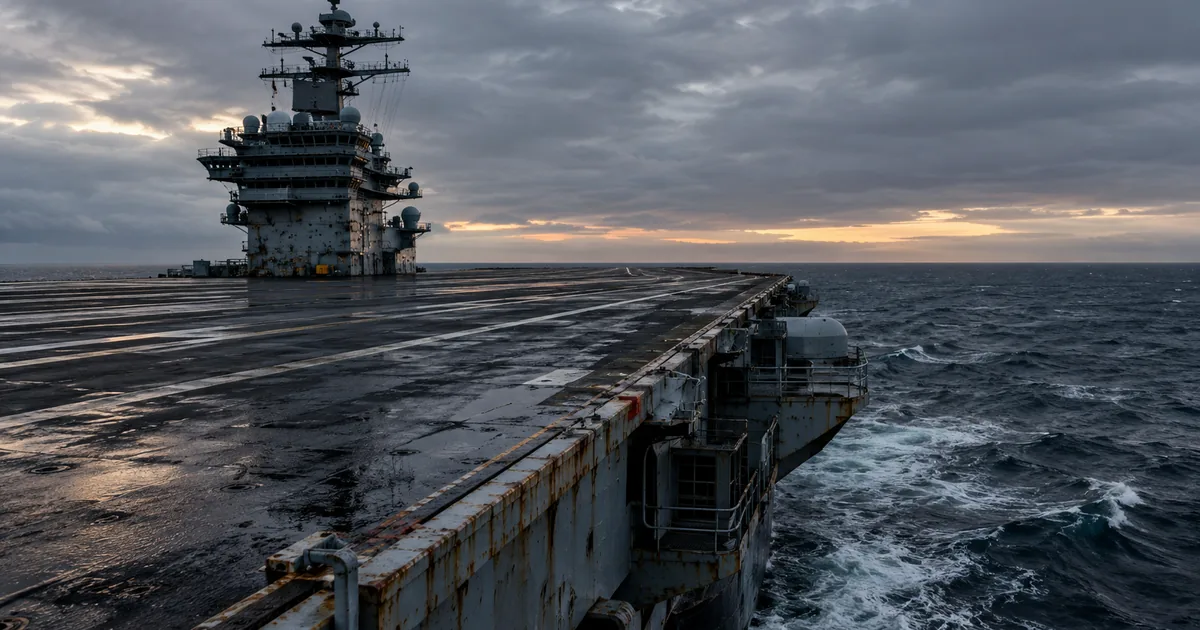
In March, a sailor aboard the USS Abraham Lincoln tried to go over the side and his shipmates pulled him back. The Navy spent the months that followed assuring reporters and crew families that nothing unusual was happening aboard that ship, and on Tuesday it told the Senate there had been eight suicide attempts across the strike group.
What the Navy said this summer: it had “not observed an increase in suicidal ideations or attempts aboard the ship.” A separate official said the service did not believe deployment length correlated with self-harm. Admiral Brad Cooper called the reporting on conditions “old news,” resolved months earlier.
What the letter says: eight suicide attempts across Carrier Strike Group Three since the deployment began last November. Two sailors went into the water while the Lincoln was in the Middle East. No specifics were offered on the other six. Nobody died.
Both of those things came from the same institution, weeks apart, and only one of them arrived voluntarily. The number surfaced because Senator Kirsten Gillibrand submitted written questions to Acting Navy Secretary Hung Cao about the morale and mental health of the crew, and Cao answered them in a letter obtained by NBC News. That is the part of this story worth sitting with. The Navy did not hold a briefing, publish a readout, or correct its earlier statements. It filled out a form because a member of the Senate Armed Services Committee made it fill out a form, and the answer contradicted what the service had been saying in public for two months.
The Sequence Matters More Than the Number
Reporters had been asking about the Lincoln since the summer. Families held a town hall in August describing moldy showers, sailors running out of soap and toothpaste, food and water shortages, broken plumbing and disrupted mail. Eleven members of Congress wrote to the Pentagon about crew endurance and readiness. A sailor from the air wing went into the water in early August and was recovered by a search and rescue helicopter, which is how much of this reached the public in the first place. Through all of it the Navy’s position held: conditions were manageable, support was available, and there was no rise in attempts.
That position was not a guess. The service keeps this data. Someone knew the count while the statements were going out, which means the August denials were not the Navy being wrong about its own ship. They were the Navy declining to say what it knew, to the press and to the families of the roughly 5,000 people aboard.
LNC flagged the collision coming in late August, when the gap between the Navy’s account and what crew families were describing had already become the actual story. The letter closed that gap in the direction everyone expected.
Two Ways to Make Eight Sound Normal
The Navy has since offered a statistical defense: the rate of attempts across the strike group is roughly consistent with the active duty Navy’s rate for 2024, the most recent year the Pentagon has published. That is a real number and it is also a choice about which denominator to use. Spread eight attempts across every sailor in the strike group over ten months and you get something unremarkable. A military official gave CNN the other benchmark, the operational one: recent carrier strike group deployments have seen one or two attempts a year, and eight is, in that official’s word, incredibly high. Worth noting that the man signing the letter is an acting secretary, installed after the president fired his predecessor mid-war, which is not a position from which anyone picks fights with the Pentagon’s preferred framing.
Both comparisons can be arithmetically true. Only one of them is the question Congress asked. Gillibrand did not ask whether sailors in this strike group hurt themselves at the same rate as sailors ashore in San Diego. She asked what nine months at sea did to this crew. The service-wide rate answers a different question, and it answers it in a way that makes the deployment disappear from the explanation.
What the Deployment Actually Was
The Lincoln left San Diego in late November and has been out ever since, with only a handful of port calls: a stop in Oman in July, and a single day at Naval Base Guam on September 19 that was the crew’s first time on American soil in nine months. At one point it ran more than 200 consecutive days at sea, breaking a modern Navy record set by the USS Dwight D. Eisenhower during the pandemic. Carriers normally pull into port every 30 to 45 days. That cadence exists for maintenance, resupply and rest, and the Lincoln did not get it.
The Navy’s own position is that deployment length and self-harm are not correlated. It has just run the longest carrier deployment in modern memory and logged eight attempts. At some point a service that collects this data owes Congress a study, not a shrug.
Say the Obvious Thing
Here is where LiveNewsChat lands. The Navy misled the public about conditions aboard a ship whose crew was in visible distress, and it kept misleading until a senator put questions in writing. The eight attempts are a tragedy that nobody died of, and the near miss is not a defense of the institution’s conduct. It is luck, plus shipmates who were paying attention in March and a helicopter crew that was fast in August.
Cao posted a video over the weekend, with his wife alongside him, saying the Navy must confront the rising tide of suicide head on. Two days later his letter went to the Senate. If the message is sincere, and there is no reason to assume otherwise, it sits badly next to a press operation that spent the summer denying the specifics. Gillibrand’s framing is the right one: what the administration waved off as fake news turned out to be serious and deteriorating. The Lincoln is still weeks from San Diego. The Navy should publish the full count, the dates, and what changed aboard the ship after March, before the pier is full of families and the story becomes a homecoming photograph.
If you or someone you know is struggling, the 988 Suicide and Crisis Lifeline is available by call or text. Veterans and service members can press 1.