
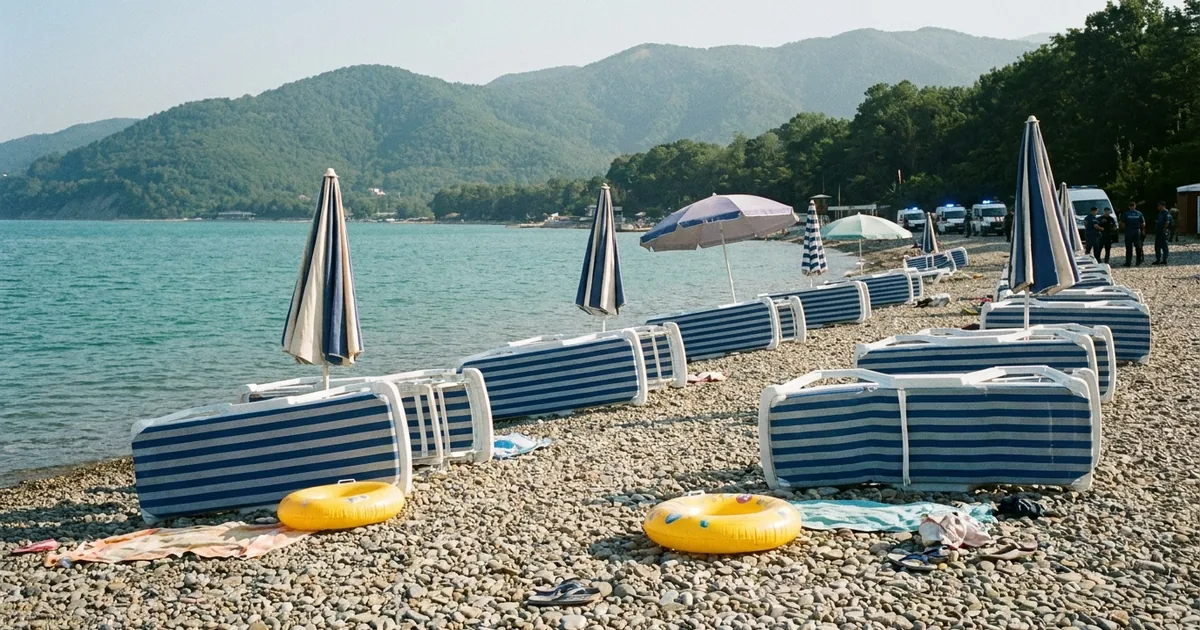
Seven people, three of them children, were killed on a crowded pebble beach at Arkhipo-Osipovka on Monday morning, roughly ten minutes after the local authorities announced the drone threat had passed.
The village has a warning system, and the people on that beach say it never made a sound.
The Ten Minutes That Matter
The sequence is the story here, and it is unusually well documented for a first-day account. Alexey Bogodistov, who heads the Gelendzhik municipality that includes the resort village, posted a drone-threat notice at 8:34 a.m. local time and then posted again about ten minutes later to say the threat had been lifted. Meduza reported that residents and tourists in the village heard no sirens at any point, despite Arkhipo-Osipovka having a warning system installed, and that readers described the system as simply not working.
Krasnodar region governor Veniamin Kondratyev put the toll at seven killed and about 40 wounded, with 21 taken to hospital, figures Reuters carried on Monday. Alexey Kuznetsov, an aide to the head of Russia’s health ministry, said four of the hospitalized were in serious condition, two of them children. The numbers moved all day, upward, in the way they always do when the first count comes from a beach rather than a hospital.
Set aside for a moment the question of whose drone it was. A public alert that is issued and then withdrawn inside ten minutes, on a summer morning, on a beach at full capacity, is not a functioning air-defense warning. It is a notification. The difference is whether anyone is expected to act on it, and nobody on that beach acted, because within ten minutes the state had told them there was no longer anything to act on.
Nobody Has Established What Actually Came Down
Russian officials have been clear about the attribution and vague about the mechanism. Kondratyev called it a deliberate attack by the Kyiv government on the civilian population, and foreign ministry spokeswoman Maria Zakharova told the state news agency Tass that NATO and the European Union “have become part of international terrorist activity.” Ukraine had not commented by Monday evening, which is its standard posture on strikes inside Russia and tells you nothing either way.
What remains genuinely unresolved is whether a drone hit the beach or whether Russian air defense brought one down over it. Reuters noted that videos circulating from the scene capture sustained gunfire before the explosion, which is consistent with an interception attempt, and the Russian outlet Agentstvo reported that military analysts think the aircraft came down as a result of that fire rather than reaching a target. Kondratyev’s own early framing referred to falling debris.
That ambiguity is being treated as the open question. It is the less interesting one, because the two versions converge on the same failure. If a Ukrainian drone struck a beach, it struck a beach that had been told it was safe. If Russian air defense fired on a drone directly above several hundred vacationers and the wreckage landed among them, then a Russian battery engaged a target over a crowd that had been told it was safe. In both accounts the decisive fact is not the drone. It is that the all-clear went out first.
This Coastline Was Never a Quiet One
Arkhipo-Osipovka sits about 40 kilometers from a Russian naval base, a detail Reuters placed high in its account and one that does more explanatory work than any of the official statements. The Krasnodar coast is not a stretch of shoreline that the war happened to find. It is the shoreline that hosts the Novorossiysk naval facilities and the fuel infrastructure feeding Russian exports, and it has been an active theater for well over a year.
Ukraine’s long-range program has spent that period reaching progressively deeper into Russian territory, including the strike we covered on the oil depot at Noginsk outside Moscow in July. Traffic in the other direction has been just as constant, including the Russian cruise missiles that hit a grain ship in the Black Sea off Odesa two weeks ago. Anyone tracking either campaign understood that this specific coast was inside the envelope. The tourists did not need to understand it. The people running the alert system did.
The Beach Season Is the Policy
Here is the part that the casualty count tends to bury.
Russia has spent this war insisting that ordinary life continues, and the Black Sea resort season is the most legible proof it offers its own population. The hotels take bookings, the beaches open, the summer runs on schedule, and the fighting stays a thing that happens to other people in other places. That insistence is not decoration. It is a governing commitment, and it carries operational consequences, because you cannot simultaneously run a functioning wartime alert regime and a coastline advertised as a normal holiday.
A serious alert regime on a militarized coast would mean sirens that sound often, beaches cleared repeatedly through the day, and a summer economy visibly degraded by the war. Every one of those outcomes contradicts the message. An alert that clears itself in ten minutes, in a village where the sirens reportedly stayed silent, is what the contradiction looks like when it is resolved in favor of the message. The system was not absent. It was subordinated.
That is a choice made well above the level of a municipal official refreshing a Telegram channel, and it is the reason the responsibility does not sit entirely with whoever launched the drone. Kyiv’s targeting decisions are subject to their own scrutiny, and if Ukraine put a weapon over a beach at nine in the morning that scrutiny should be severe. It does not transfer away the separate question of why several hundred people were still on that shore with an active threat overhead and an official notification telling them the sky was clear.
What Gets Fixed and What Gets Repeated
Russia will investigate this, and the investigation will almost certainly find that a warning system malfunctioned in one village. That finding would be narrow enough to be useless. The equipment is not really what failed at 8:44 on Monday morning.
The measurable thing to watch over the next several weeks is not the rhetoric, which is already fixed, but whether Krasnodar beaches start closing on alerts and staying closed until the all-clear is verified rather than assumed. If they do, the region has decided that the resort season is worth less than the people in it. If the loungers are full again next weekend under the same ten-minute alert cycle, then Monday was not a malfunction at all. It was the system working exactly as it was configured to work, and the seven people on that beach were priced in.