
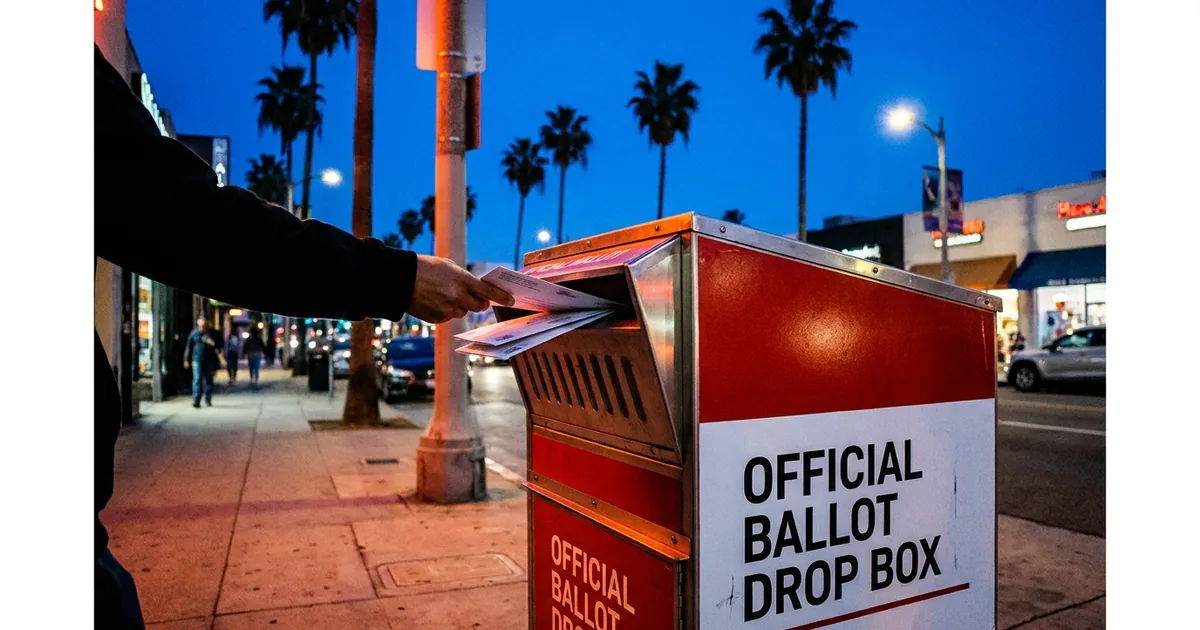
“Never before in American history has the federal government, on the eve of an election, sought to coerce a state and local government to abandon their own Constitutional elections procedures and bend to the will of the Executive Branch.”
That is the second paragraph of the 26-page order U.S. District Judge David O. Carter signed Wednesday evening in Los Angeles, denying the Trump Justice Department a temporary restraining order that would have forced California and Los Angeles County to pull more than 20,000 mail ballots out of the count six days before the midterm. The coverage that followed ran the quote and the result. What it mostly skipped is the part of the order that matters for the next week, because it is the part the government cannot appeal its way around: Carter went through the Justice Department’s own filings and found that the list of “likely noncitizens” at the center of the case does not survive contact with its own numbers.
We read the order and the Ninth Circuit opinion that preceded it so you do not have to. The arithmetic the government handed the court is below, and it is the reason LNC thinks this lawsuit was never about 20,000 noncitizens.
The List Shrank Every Time Someone Checked It
Start where the order starts. On July 16, Homeland Security Secretary Markwayne Mullin wrote to Secretary of State Shirley Weber claiming “there may be as many as 190,832 non-citizens registered to vote in California.” Weber wrote back on July 23 with “serious doubts” and asked for the methodology and for an explanation of how DHS had obtained a copy of the state’s voter file, which the state had not shared with any federal agency. DHS did not answer. The 90-day National Voter Registration Act quiet period began August 5 and passed with no action.
Then on October 13, after Los Angeles County had already mailed 5.9 million ballots and processed more than 331,000 of them, Justice Department lawyers hand-delivered a password-protected thumb drive to county registrar Dean Logan with “over 20,000” names and a 48-hour deadline to verify every one of them or set their ballots aside. The 190,832 had become 20,000 with, in Carter’s words, no “sufficient explanation.” The complaint was filed minutes after the deadline expired.
The county’s own check, filed as a sworn declaration, is where the list falls apart. Only 7,035 of the 20,000 records even had Los Angeles County addresses. In a sample of 200 records, 42.9 percent were cancelled registrations and 4.6 percent inactive, meaning nearly half were people who never received a ballot at all. And 71.2 percent of the list had never voted in any past election.
Carter then did what the wire stories did not: he lined that up against the government’s record in other states.
What the government claimed
- California, July 16: “as many as 190,832” noncitizens registered.
- California, October 13: “over 20,000” who are “highly likely to be noncitizens.”
- Nevada: 15,903 noncitizens registered, by “high-confidence” matching.
- 31 federal lawsuits filed nationwide demanding complete state voter rolls.
What the record shows
- No methodology was ever supplied for the 190,832, and the figure was dropped without explanation.
- LA County sample of 200: 42.9% cancelled, 4.6% inactive, 71.2% had never voted. Only 7,035 of 20,000 were in the county at all.
- Nevada’s 15,903 fell to 6,218, then to 185 after DHS’s manual review. Nevada confirmed all 185 were U.S. citizens.
- Of the 26 voter-roll cases decided so far, the Justice Department has won, in Carter’s phrase, “precisely zero.”
The Nevada line is the one to remember. The same agencies, the same “high-confidence” matching, and the same manual review produced a hand-picked subset of 185 names that the state then found to be 185 citizens. Carter cited a Northern District of California ruling from earlier this month that found USCIS builds these lists with “unknown artificial intelligence tools” and “commercial databases,” and he reached the only conclusion available: “the Court cannot conclude that Plaintiff’s process is credible.”
That finding is not a technicality. The government’s entire theory depends on the sincerity of the claim that these are noncitizens. Once a court says it does not believe the list, there is nothing left to enjoin.
The Emergency Was the Government’s Own
The Justice Department argued it faced irreparable harm unless the court acted before November 3. Carter’s answer is blunt. Homeland Security Investigations bought the California voter file on May 8. It told Weber about its 190,832 on July 16. It waited until October 15, months into the NVRA quiet period and two weeks into ballot processing, to sue. “Plaintiff’s theoretical risk of imminent harm is solely due to its own neglect,” the order says.
The Ninth Circuit had reached the same place two days earlier. Judges Mark Bennett and Gabriel Sanchez, one appointed by Trump and one by Biden, dismissed the government’s emergency appeal because it had not given Carter a chance to rule, and both wrote separately to say they would have denied it on the merits anyway. Bennett called the claimed emergency “self-constructed.” Sanchez called it “a delay entirely of the United States’ own making.” Judge Patrick Bumatay dissented, arguing the majority would let noncitizens vote. He was the only one of the four federal judges who looked at this request across two courts to accept the government’s premise.
There is also the matter of the threats. On October 23 the Justice Department sent letters to every county in California warning election officials they “risk significant federal scrutiny” if they did not comply, and at Tuesday’s hearing government lawyers said in open court that officials who did not comply risked charges for aiding and abetting a federal crime. Carter wrote: “The court reiterates what it said yesterday: these threats must stop.” We covered the same tactic in Washington state, where the department demanded 400 ballots be set aside and the state called it harassment of citizens. California is the same operation at fifty times the scale.
What LNC Thinks Should Happen Now
Carter left the government a door, and it is the right one. The same day it filed for the restraining order, the Justice Department charged 28 people with voting as noncitizens, many of them registered in Los Angeles County. Carter’s order points out that the county has said it will cooperate with those prosecutions. If the department has evidence that specific people voted illegally, the law gives it indictments under Section 611. What the law does not give it is the power to make a state quarantine 20,000 ballots on the strength of a list it will not explain, built by a process that in Nevada produced a 100 percent error rate on its own best names.
So we will say plainly what the order says carefully. This was not a fraud investigation. It was an attempt to get a federal court to bless the removal of a block of ballots in the country’s largest Democratic state, filed on a timeline designed to make the court choose between chaos and compliance, and backed by threats to prosecute the clerks who said no. Four judges looked at it. Three refused. The 190,832 became 20,000 became, in the one state where anyone finished checking, zero. The department should drop the appeal, and the Senate should ask Acting Deputy Attorney General Trent McCotter under oath who decided the number.
The ballots are being counted. As Carter put it, “California and its people are sovereign, too.”