
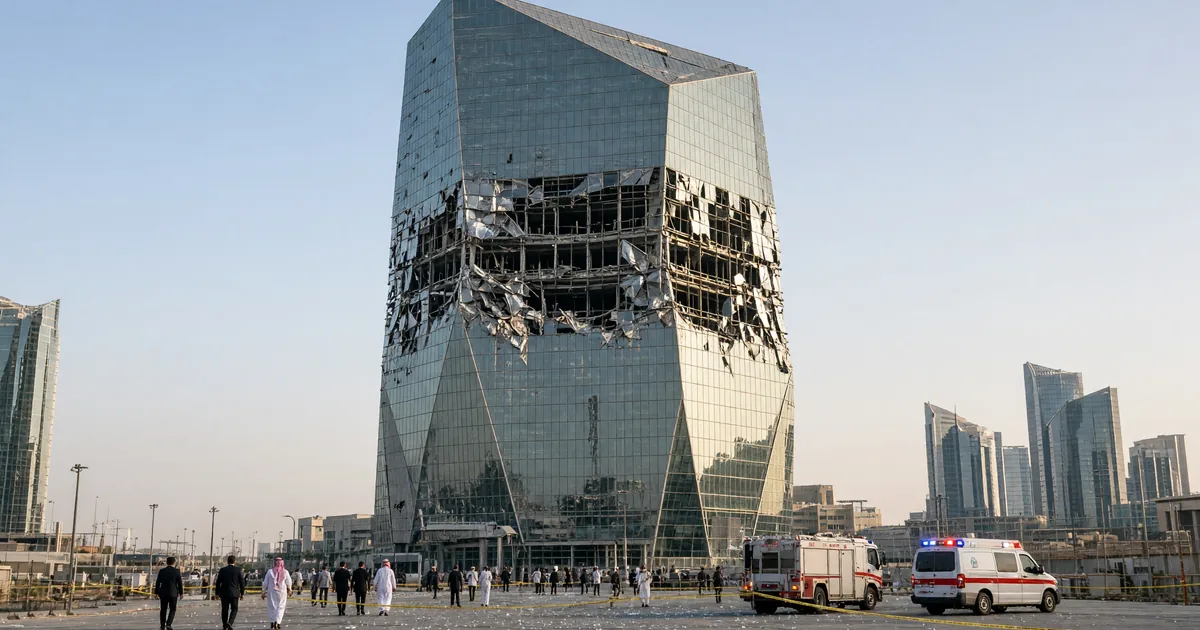
A missile attack damaged the headquarters of Saudi Arabia’s sovereign wealth fund before dawn on Thursday, shattering windows in Riyadh’s tallest skyscraper and forcing evacuations across the King Abdullah Financial District. No injuries were reported. What hit the 385-meter Public Investment Fund Tower is the part Riyadh has not settled, because Saudi Civil Defense and the Saudi-led coalition have described it differently.
Account one: a missile hit it. Saudi Civil Defense said a Houthi projectile struck one of the district’s towers, according to UPI’s report of the statement. Three people familiar with the incident told Reuters that a Houthi missile struck the tower directly.
Account two: falling debris. The coalition fighting the Houthis said it had responded to a missile fired toward Riyadh and that its initial assessment pointed to damage from falling debris. It did not say the missile had been stopped before it reached the building.
Residents heard a blast before dawn. A Reuters witness saw people evacuated from the district as entrances were closed and ambulances and fire engines gathered. Civil Defense said several floors of the tower and nearby buildings were damaged. The tower houses the fund that finances major projects under Crown Prince Mohammed bin Salman’s Vision 2030 program to diversify the Saudi economy beyond oil.
Eleven Days, Two Towers
This is the second prominent building damaged in the district this month. On Nov. 8 a strike hit an administrative building of the state oil company Aramco. We lined the two mornings up, using what each side said at the time.
| Nov. 8: Aramco tower | Nov. 19: PIF Tower | |
|---|---|---|
| First official line | Energy ministry: falling debris caused “limited damage” | Coalition: initial assessment points to falling debris |
| What the record shows | Photos and videos online appeared to show a large hole across several floors of the glass facade, a wire report said | Three sources told Reuters a missile hit the tower directly; Civil Defense reported damage to several floors |
| Casualties | None reported | None reported |
| Houthi position | Spokesman Yahya Saree confirmed the attack and named the financial district as a target | Saree said the group targeted the district twice, at dawn and in the evening; Reuters said the group had not immediately claimed the tower hit |
The same pattern shows up twice. The first official account is debris, and the pictures and the people on the scene describe something larger. Debris is a coherent story for an air defense that worked, because an intercept over a city leaves wreckage. It is also the story an air defense that missed would tell. We cannot tell from here which this is, and the three Reuters sources are anonymous. Nothing we could find from Riyadh by Friday morning settles it.
Here is what we think matters more than the forensics. If those sources are right, a missile reached the headquarters of the fund that carries Vision 2030. If the coalition is right, the intercept still dropped wreckage on a district seen as a symbol of modern Saudi finance. Both versions end with a tower with its windows out.
What the Houthis Said, and What Nobody Has Confirmed
Saree, the spokesman for the Iran-backed group, said it had targeted the financial district at dawn and again on Thursday evening. He also claimed attacks on the Al-Sadaf Petrochemical company in Jubail, the Khamis Mushait Air Base and Khalid International Airport in Riyadh. Saudi officials did not immediately confirm those, so treat the list as a claim.
The warning attached to it is the part to take at face value:
These sites will remain targets for our forces as long as the Saudi enemy continues its crimes against civilians and civilian infrastructure in our country.
The Houthis have been backing that threat with repeated strikes. On Wednesday Saree said the group had fired cruise missiles toward Riyadh’s international airport and the financial district, and the coalition said it intercepted two drones that day, one in the Riyadh region. The capital’s airport was the target of the October missile strike that put Riyadh on the front line of this war, and a later attack on Dammam’s airport showed the reach extending into the oil east.
A Campaign Saudi Officials Expect to Last Another Six Months
Saudi Arabia’s Foreign Ministry condemned the strike and reaffirmed what it called its “full and legitimate right” to defend itself. It asked the permanent members of the UN Security Council to condemn what it described as the Houthis’ “heinous attacks.” Qatar and Jordan condemned the strikes on civilian and economic sites in Riyadh, and the Gulf Cooperation Council’s secretary-general urged the Security Council to hold the Houthis accountable.
The diplomacy sits beside a harder timeline. Reuters reported on Wednesday that Saudi officials had told allies the Yemen campaign could last another six months, because Riyadh wants forces loyal to Yemen’s internationally recognized government to regain ground before any negotiation with the Houthis. Those forces took a setback on Sunday, when they withdrew from areas near the Bab al-Mandab Strait that they had recaptured. The coalition says it is striking Houthi missile depots and drone workshops, and Houthi-run media reported more Saudi airstrikes on Sanaa early Thursday.
Six months of this and a tower with its windows blown out are a hard pairing to sell as containment. Nor is the fight a Yemeni one alone. UPI places the renewed Saudi-Houthi fighting inside the wider U.S.-Israeli war with Iran, which began in February, and this week the U.S. struck Iran’s Qeshm Island while Iran fired at Kuwait and Bahrain. The Gulf is being hit from both ends of the same war.
The district has now been struck twice in eleven days. A third strike would no longer read as an anomaly, and we expect the firms Riyadh wants in this district to read it that way.