
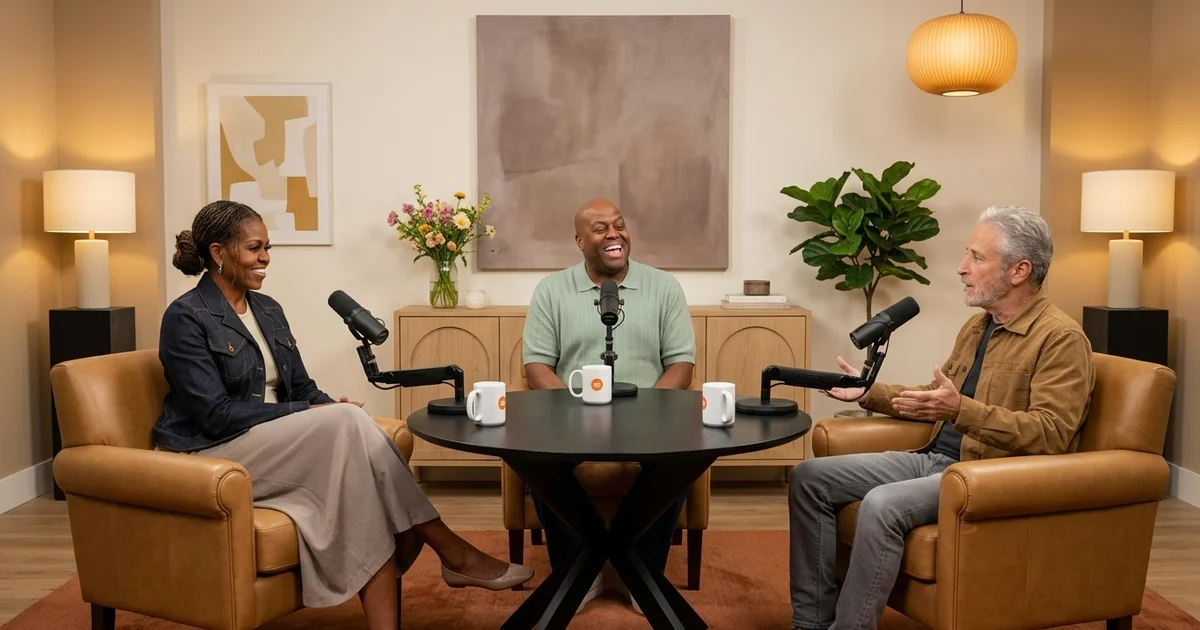
Jon Stewart sat down in Michelle Obama’s rented Los Angeles studio on Wednesday and conceded the one thing a satirist is never supposed to concede, which is that after twenty-five years he cannot tell you whether any of it helped.
The clips that traveled were the Trump jokes, and they were good ones, but the write-ups stopped at Stewart’s doubt and skipped the last ten minutes of the episode, where a listener from Vermont asks the exact question that doubt leaves hanging and all three people in the room answer it.
The Question Michelle Obama Actually Asked
It was not a softball, and she did not dress it up. “Do you think comedy helps or hurts the political climate?” she asked, then pressed harder before he could get comfortable: is it good that most young people get their news from The Daily Show, or that they keep asking him to run for president?
Stewart’s answer took a while to arrive because he kept refusing the easy exits. He started with the distinction he has held for years, that he never confuses cultural power with actual power, and that catharsis is a real thing comedy delivers. Then he turned on his own product. Satire is “impotent,” he said. Worse, it might be an opiate. Having spent time on Capitol Hill working the PACT Act and the 9/11 victim compensation fund, he said he now understands the gap between people who do the day-to-day work of moving legislation and people who make jokes about the people who do not.
I wish there were metrics. I wished there was a double blind study where you could find out, does this help? Does it corrode? Does it pervert? Is it ultra processed food that’s given the country a kind of political diabetes? I don’t know.
The most he would claim is that good-faith work put into the world is a win, and he was careful to mark the ceiling on that claim. He cannot sit there and honestly say twenty-five years of it has been a win for society, he said, and he would hate to think otherwise.
The Rebuttal Was Sitting Three Feet Away
Here is what the coverage of that exchange missed by cutting when it did. Minutes later, Michelle Obama answered Stewart’s question with the only kind of evidence anyone has.
She did not do a single interview with Face the Nation or Meet the Press. She never sat down with the New York Times editorial board. She came on The Daily Show. Culture, she said, was where people actually were, and if you wanted anybody to hear you, that was the door you went through rather than the one Washington preferred.
That is not a compliment. It is testimony. The former first lady of the United States is describing satire as her distribution channel, chosen over the entire Sunday-show apparatus, during the eight years she had the most to lose by choosing wrong. Stewart wants a double blind study. He got the next best thing, which is a principal telling him the mechanism worked on her end, and he mostly let it go by.
Stewart did note, dryly, that the Obama administration never tried to have him arrested or taken off the air, and that this was a function of confidence in your own worldview. Which set up the line The Daily Beast built its write-up around: nothing is more fragile than someone who holds real power and believes satire can diminish it. A man projecting alpha-male dominance, wrecked by something that happens at 12:30 in the morning. Stewart called it a shocking fragility, and said it has made all of their shows relevant again in a weird way.
He is right about the fragility, and the fragility is itself an answer to his question. Nobody spends political capital trying to shut down an opiate. The pressure campaign against late night, which is the same one Jimmy Kimmel described as poisoning the format and which drew comedy’s biggest names onto Stephen Colbert’s set in solidarity, is a revealed preference. The people in power are telling you what they think works.
A Listener Named Eric, and the Answer Nobody Ran
The episode’s last segment is a listener question, and it is the reason to watch the thing rather than the clips. Eric, in Vermont, writes that fixating on politics will not improve the hopelessness he feels, but that ignoring it feels naive given the economy, the loss of rights, the deaths at home and in wars overseas, the environment. So where does that leave someone like him, who wants to escape the nightmare and also knows that doing nothing fixes none of it?
Stewart went first. “Action is the antidote to anxiety,” he said, which is not a new line for him. He gave a version of it to a 22-year-old in a Daily Show audience in June 2024, in the same segment where he compared young people’s future to Mad Max. What was new was how small he made it. Existential anxiety is the kind you can never get your hands around, he said. What you can get your hands around is tactile. He learned drums. He does woodworking. Mechanical, rhythmic, repeatable, and grounding.
Then he told a story about Trevor Noah sending him something on Winston Churchill, who called his depression the black dog and who dealt with it by making things with his hands. Stewart wrote back that it explained why he always feels like bombing the Germans.
Michelle Obama took it from the tactile to the political. She knitted her way through COVID and plays tennis three times a week, ninety minutes at a stretch of not thinking about anything except hitting the ball better. But the part worth quoting is what she said next, because it is aimed at exactly the person Eric described: we keep believing all change has to be big change, and young people believe it hardest. How do I end drug dealing in my neighborhood. How do I fix this enormous thing right under my nose. The answer, she said, is that you cannot. Focus on what is in front of you. Are you in school? Stay in school. Do your homework. That is some power right there.
Stewart added the phrase that stuck: the quiet activism of living pleasantly, treating everyone you encounter in a way that recognizes them.
Craig Robinson closed it with the best story in the episode, and it happens to be set in Vermont. Campaigning as a surrogate during his brother-in-law’s first run, still coaching college basketball during the week, he got dropped at a small general store in a small town by the water, wearing a suit in a room full of flannel. A man told him he was not from around here, then allowed that he did not know about that Obama guy, that he had not done much. Robinson talked with him. Calmly, quietly, for an hour, about why you sometimes give a chance to people who have not had the same opportunities. He never learned how the man voted. By the end, he said, the man acted as if he had been convinced.
The Small Answer Is the Right One, and That Is Why It Did Not Travel
Our view: Stewart’s doubt is the most honest thing a person in his position has said in years, and it is also the part he has wrong. The evidence he says does not exist showed up twice in his own episode, once as a former first lady explaining that his show was how she reached people, and once as an administration currently spending real effort trying to make shows like his stop. Neither of those is a double blind study. Together they are more than nothing, and “I have no metrics” is doing work here that “I am uncomfortable being told I mattered” would describe better.
What the three of them landed on is unglamorous on purpose. Learn an instrument. Play tennis. Stay in school. Be decent to the person behind the counter. Spend an hour on one person instead of a season on a thousand. It does not scale, it does not trend, and it cannot be measured, which is exactly why an eighty-six-minute conversation got clipped down to the crypto jokes and the line about Trump’s perversion of leadership while the answer to the question everyone quoted went unreported.
That is not a failure of the episode. It is a demonstration of the thing Stewart was worried about, performed by the coverage of Stewart worrying about it. The outrage clipped clean. The advice did not clip at all.
Eric asked how to stay sane without going numb, and got a genuine answer from three people who have each been through a version of it. Whether he ever finds it depends on whether he watches the last ten minutes, which is a small, tactile, entirely fixable problem. Start there.