
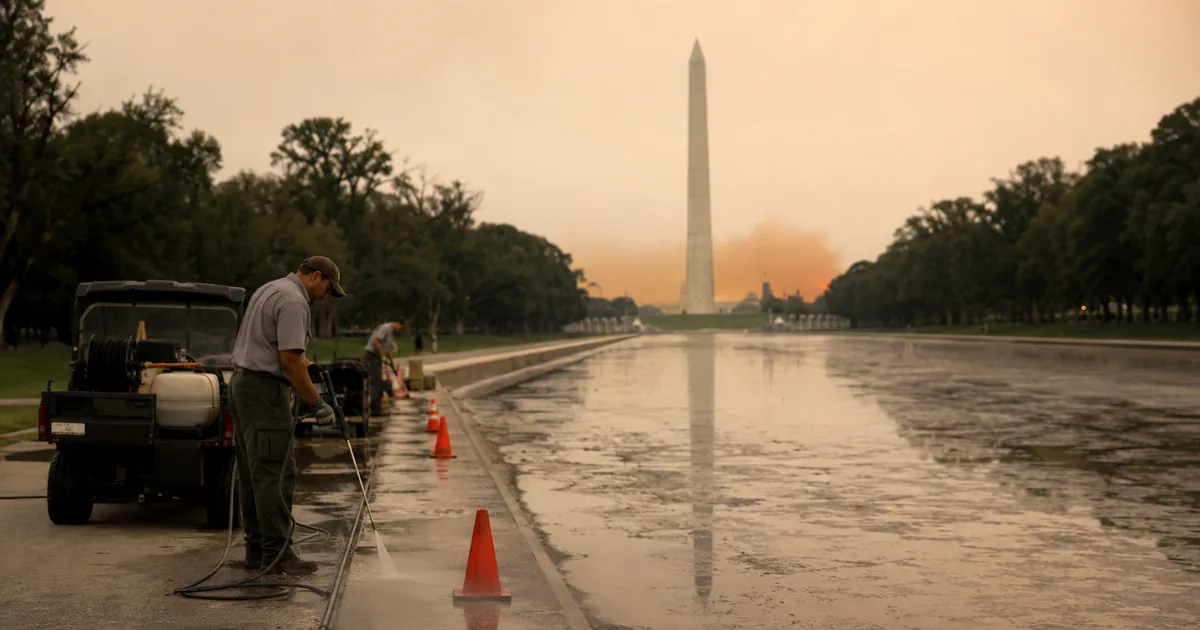
Nearly 300 National Park Service staffers drawn from the agency’s incident management teams have been pulled off parks as far away as California and Alaska and sent to Washington to work on the Lincoln Memorial Reflecting Pool, fountain repairs and debris removal at a municipal golf course. CNN reported the assignment on Tuesday, and almost every outlet that picked it up framed it as a story about political appointees micromanaging groundskeeping, which badly undersells what is going on.
Here is the piece nobody has set alongside it. Six days before that story ran, Australia and New Zealand sent the United States the largest contingent of wildland firefighters they have ever sent at one time, more than 240 people, and among them, according to reporting from Boise, a 15-member incident management team assigned to fires in the Pacific Northwest. Two countries in the middle of their own winter shipped us the precise resource that several hundred Americans are currently withholding from the fire line in order to tidy up the National Mall.
An Incident Management Team Is Not a Maintenance Crew
The term sounds bureaucratic, which is probably why the coverage skated past it. An incident management team is the command structure that gets dropped onto a large, fast-moving emergency and runs it: logistics, air operations, evacuation planning, finance, safety, the whole apparatus that turns a few thousand scattered responders into something that functions. They are certified, ranked by complexity, and deliberately kept scarce. The federal government does not have a deep bench of them, which is the entire reason the National Interagency Fire Center asks Australia, New Zealand and Canada for help when the season goes bad.
In Washington, according to the internal communications CNN reviewed, that structure has been applied to:
- The Lincoln Memorial Reflecting Pool
- Fountain renovations
- Debris removal at the East Potomac golf course
- Highly detailed status reports for Interior Secretary Doug Burgum’s office
One longtime employee told CNN that this level of operational detail would ordinarily be handled by lower-level managers rather than political appointees, and called the arrangement highly unusual. That is a fair description of the reporting chain. It is a wildly generous description of the deployment.
The Country Has Been at Its Highest Alert Tier Since July
The National Interagency Fire Center runs a five-step national preparedness scale. Level 5 means the top tier: fire activity is heavy, national resources are committed, and quieter regions are being drawn down toward minimum staffing to feed the ones that are burning. The United States has been sitting at Level 5 since mid-July, a threshold TIME wrote about at the time precisely because it is not a routine reading.
The numbers behind it are not close. NIFC’s own tally has passed 7.8 million acres burned this year across more than 51,000 fires, running at 129 percent of the ten-year average for fire count and 166 percent for acreage. By the time the Australian and New Zealand crews arrived in Boise on August 19, the season had already burned more acres than any year since at least 2011. Those foreign crews spent part of their orientation learning to deploy American fire shelters, the foil sacks a firefighter climbs into when the fire has already won, because their own services do not carry them.
Two allied nations sent us their largest-ever contingent, including a command team, because we did not have enough. We had enough. We had put them on a golf course.
“Continued Support Through September”
The detail that should end the argument is in the internal communications. Interior did not treat the Washington deployment as a one-week favor that got out of hand. It asked for continued support through September to sustain the great work underway, which is to say it asked to keep the emergency-response structure on beautification duty through the back half of the fire season and into the start of the Atlantic hurricane peak.
This is also not an isolated decision, which is the second thing the coverage has mostly left alone. CNN reported at the beginning of August on rangers stretched past the point of function across the park system, and the same administration has been redirecting park fee revenue toward projects in Washington. Interior’s own announcement of the initiative is explicit that Burgum is implementing a presidential executive order to make the capital safe and beautiful. Nobody hid the priority. It was published.
We have covered adjacent pieces of this before, including the permanent fencing of Lafayette Park and the court order forcing the Park Service to restore signage on slavery and climate that had been stripped out. The through line is an agency being steadily repurposed from stewardship into set dressing for the capital.
Where We Stand
This is indefensible, and it is worth being plain about why rather than hiding behind the anonymous employee’s word “unusual.”
The incident management team is a national emergency asset. It exists because catastrophes do not wait for the appropriations cycle, and it is scarce on purpose, because certifying one takes years. Using it to clean a reflecting pool during the worst fire season in fifteen years is not a question of taste in public spending. It is spending down a strategic reserve on cosmetics while allies are flying their own reserve halfway around the world to cover the gap. Burgum owns this. He signed the implementation order, his office is receiving the status reports, and his department asked to extend the arrangement into September.
The fix is not complicated and does not require Congress. Interior can release the incident management personnel back to their home units this week and hire contractors to power-wash the fountains, which is what contractors are for. The reflecting pool will still be there in November.
What makes this worth watching past the news cycle is that the request runs through September, and September is when the Northwest usually gets its worst wind events. If a Level 5 season produces a large-complexity fire in the next four weeks and the command teams are slow to arrive, nobody will have to guess where they were.